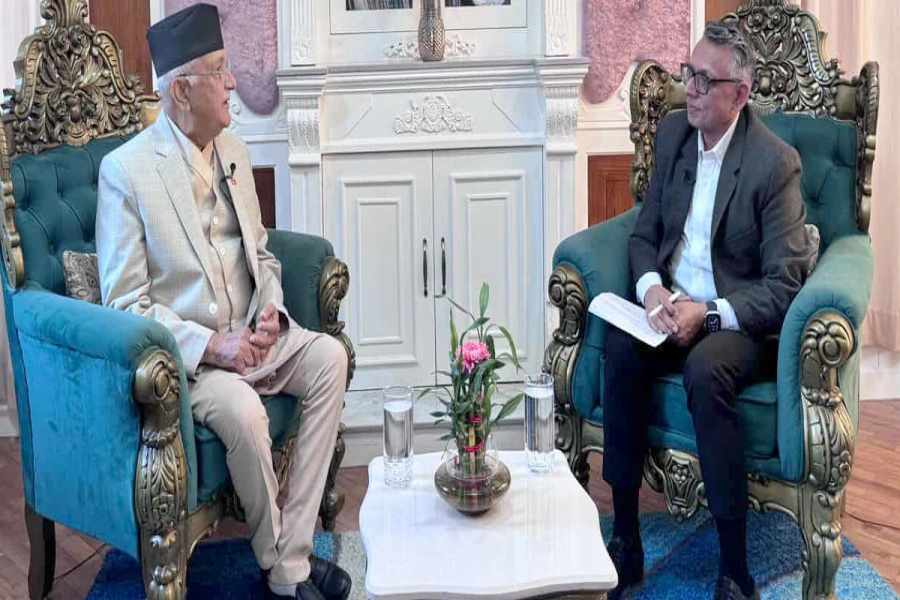
Nepali Congress Vice-President Ram Chandra Poudel has been busy drumming up support for his candidacy for Party President in the upcoming 13th General Convention scheduled for the first week of March. He is also involved in negotiations with Madheshi Morcha. Mahabir Paudyal and Ashok Dahal had caught up with him at his residence on Tuesday afternoon to discuss the convention and ongoing negotiations.
Related story
When Will We Be Free From Socialism?

How will the 13th Congress convention be any different to past conventions?
There is an important correlation between the promulgation of new constitution and our general convention. We were able to successfully promulgate a new constitution under the leadership of Nepali Congress. The constitution has charted a new course of change for Nepal. Congress is now responsible for managing this change. Nepali Congress is the only force that can take up this responsibility.
For this, however, Congress itself needs to change. The party needs to adopt favorable policies and programs to guide the nation towards economic, political and social change as laid out in the new constitution. This will be done in the upcoming general convention. In this context, our upcoming convention is crucial both for the party as well as the country.
What changes do you envision in Congress party?
I have been advocating for change in the party in my own way. Democratic socialism has always been the party's guiding philosophy. Congress officially adopted democratic socialism as party's philosophy even as the party was fighting the autocratic Rana rule in 1950. We started by plowing the field back then. This was symbolic of our vision for social change, respect for labor, equality and of the rights and interests of peasants, laborers and workers. The basic idea was to eliminate all sorts of discriminations against women, Dalits, Janajatis, Madheshis, Tharus and Muslims and establish an egalitarian society by ending the feudal system and bringing marginalized communities into the mainstream.
Again, this was our commitment as early as 1950. In 1957, the party endorsed democratic socialism as its guiding policy to meet these goals. The changes envisioned by new constitution have their roots in the agenda we pushed back then. Now Congress needs to go back to those roots, but with a new vision. This is why I say party needs to change.
But the party has in recent times been criticized for abandoning the path of democratic socialism.
We never abandoned it. The party had to in recent times concentrate on institutionalizing democracy and safeguarding political rights. This is why our guiding principle of democratic socialism could have been overshadowed.
That sounds like an excuse. Didn't the party throughout the 1990s actively promote privatization?
The 1990s was the time that witnessed liberalization and privatization around the world. It did not leave Nepal untouched as well. Nepal had an obligation to go along. We cannot overlook the importance of free-market economy in promoting growth and development. But social justice, eliminating inequality, alleviating poverty and ending discrimination are as important issues. There is thus a need for fine balance.
Congress in the past had come up with a number of policies to realize its socialist vision. We had programs such as rural self-sufficiency program, justice for the poor and weak, and income for the deprived. Despite this, there was a feeling that we were ignoring our socialist roots. In the process, an impression was created that Congress had completely given up on democratic socialism. We have the responsibility to clear this misunderstanding by devising and implementing socialist policies.
So Congress will make a course correction in the upcoming general convention?
First, I do not believe the 1990s represented a deviation from socialist policy, even though the spotlight back then was on economic liberalization. Now is the time to revive BP's philosophy of democratic socialism. The upcoming convention will give concrete shape to BP's vision.
Otherwise the country post-constitution could descent into anarchy. It is thus important to inculcate our cadres on socialism, which the upcoming convention will do.
You say Congress has not deviated from socialism. But how do you explain selling our public enterprises at dirt-cheap price? Or passing on important government responsibilities like health and education to the private sector?
It is not like that at all. Our government had made huge investment in health, education and rural development. It worked to develop irrigation canals, electricity and road networks in villages, which helped lift living conditions of the rural poor. Like I said socialist policies got little emphasis compared to our focus on privatization and liberalism. This is why we need to revive socialist values and make them guiding principles of the party.
You have been visiting different parts of the country on the eve of the 13th general convention. How are the preparations?
Preparations are in full swing, at the level of the ward, to the district to the central level. There are disputes over status of active members. We are working to resolve it through discussions. We will check and revise, if necessary, the list of active members in each district. In some cases, we will need to update the list and make updated list available in districts. We are in the process of forming an Election Committee. District election officers are being finalized. They will arrange for village, municipal and district level elections. Preparations for central level elections will then follow.
Should the number of office-bearers in the party be increased in your view?
With the promulgation of new constitution we have embarked on structural change of the country. We have adopted federalism. Party structure will also have to change in line with federal, provincial and local structures. We will need office bearers in each level. But office bearers will have to be given executive powers. As for the debate over whether to increase office bearers now or later, I tell my colleagues not to do politics over this issue. Let us not think in terms of which leader will need how many office bearers to win the election. It is time for us all to concentrate on how the party can address the country's needs. We need to focus on how the party can be made accountable to the people and the country.
It currently looks like a three-way race between you, Sushil Koirala and Sher Bahadur Deuba. Where do you fit in this scheme?
Good policies alone don't work if there is no good leadership to carry them out. Without good leadership, party cannot function, nor will it be dynamic. Who I am today is because of what I have done for the party. I have made significant contribution to the party. I am not someone who emerged with somebody's grace or favor. My belief, dedication and sacrifice for the party brought me here. I believe that under my leadership the party will be more dynamic, better managed, more united and more disciplined. It will end factionalism.
But Sher Bahadur Deuba makes exactly the same claims.
Look at what he is doing. The party is reaching out to every corner of the country with its programs. It is educating people about changes in national politics, and how Congress can help implement the constitution. It is spreading awareness on what the party should do to resolve the current crisis. This has been the focus of the party's Policy and Training Institute. But Deubaji, instead of focusing on these important issues, has been publicizing his candidacy. He has been misusing this campaign for personal gains. I am publicizing party policies and programs. He has been publicizing his candidacy. Now you judge for yourself.
I do not lead any camp in Congress. I am the one who wants to take Congress forward based on its policies and programs. Both Deuba and establishment camps feel comfortable about me. This is why I am claiming party leadership: to take the party forward as a unified and united entity.
Let's talk about ongoing talks with agitating Madheshi parties. Why has there been no progress?
I have been devoting some of my time to negotiations with Madheshi Morcha as well. I am committed to take the negotiations with Madheshis to its logical end. The talks seemed to be going in a positive direction. But then I leave for a party program and when I come back to Kathmandu I find that there has in fact been no progress. It is surprising. I returned from Dang Monday. I arranged a meeting between Sushil Koirala, Pushpa Kamal Dahal and the Prime Minister at Baluwatar Tuesday morning, when they discussed ways to accommodate Morcha in amendment bills. We must do as much as possible to accommodate their concerns.
Apparently the Madheshi Morcha is in no mood to compromise unless province demarcations are revised.
We need to take people's wishes into account while settling the demarcation issue. It's up to them which province they want to join. Madheshi Morcha should also understand this. We have provision for seven provinces in the constitution. Let us not change it in such a way that pacifies people in one region but agitates those in other regions. We need to take time and undertake rigorous homework on demarcation before making any decision. Madheshi Morcha is not as rigid about demarcation as it is sometimes portrayed. They are ready to discuss important issues.
Where does the problem lie then?
Problem lies in unfounded fears and lack of trust between political parties. There is psychological fear at play as well. Madheshi parties feel they are being ignored and humiliated. This psychology has made matters worse. We must be able to assure them that they will have fair share of representation in state bodies and that the country has dignified space for them as well. Once this is done, I believe talks with Morcha will result in desired outcomes.





_20210926115209.jpg)