In the age of English-American Thomas Paine, a republican detested monarchy, supported representative government and respected the rule of law. Politicos of his country would later dishonor the term by connecting it with rabid conservatism and religious bigotry.
Championing the right of the unborn to be born and then condemning the living to death penalty is an incongruity that only US Republicans can reconcile in their political agenda. However, republicanism of Paine’s dreams continues to be the driving force of history.
Other than intellectual wastelands of oil-rich West Asia, monarchy is on retreat almost everywhere. It barely survives as cultural symbols in island nation-states of United Kingdom and Japan along with reclusive kingdoms in Scandinavia. Some small and exotic places in Asia and Africa do retain the pageantry of princes as tourist attraction, but most of them endure due to sponsorship of regional powers.
The quest for truly representative governments and substantive rule of law, however, continues to elude most republics. The republic that Paine helped found in the New World is being controlled for and by the top One Percent. The Old World, where the fiery pamphleteer honed his propagandistic skills, is in the grips of unprecedented xenophobia.
Romanticism too is a much-misunderstood term. The word is ordinarily associated with sentimentality, idealism, imagination and even dissonance with everyday reality. Other than scholars interested in the history of ideas, few remember that romanticists once yearned for freedom.
The Swiss-French philosopher Jean-Jacques Rousseau (1712-1778) lamented in his celebrated tract the Social Contract, “Man is born free, but everywhere he is in chains”. His disciples went on to lead the French Revolution. The most notorious of them, Maximilien Robespierre (1758-1794), called “the Incorruptible”, authorised the Reign of Terror and pronounced that King Louis must die so that France could live.
The Romanticists were wishful dreamers as well as determined doers. Probably that was the reason their idealism came to be associated with brutal ideologies of nationalism and fascism in twentieth century Europe. French-American historian of ideas Jacques Barzun redeemed their honor by declaring solemnly, “… the romanticist is an individualist, a democrat and a cosmopolitan.”
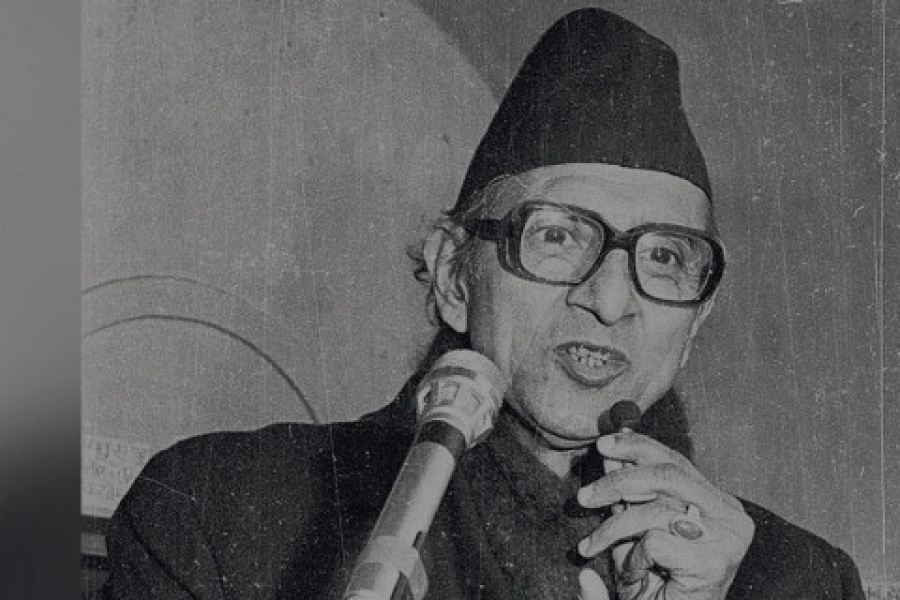
These two descriptive terms—romanticism and republicanism—perhaps best capture ideals that Ram Raja Prasad Singh (1936-2012) lived with and died for. Nepal does not have a monarchy anymore, but it is far from becoming—let alone being—the republic of Paine’s vision.

Singh was one of the lucky revolutionaries to have lived and seen at least partial fulfilment of his dreams—most are martyred at the altar of their ideals—but he was still modest enough to admit that he had too many regrets to claim that he had lived a fulfilling life.
REPUBLICAN RESOLVE
On a languid summer afternoon in early May this year, Singh was talking to one of his legions of admirers from Kathmandu in a tastefully furnished upper-floor room of his town house in Rajbiraj as an electric fan waited patiently for the load-shedding hours to end. Ill health had robbed his strength but failed to dampen the spirit of the scholarly revolutionary. Over tall glasses of homemade sherbet, he talked about English poetry, Hindi literature, and political intrigues in Kathmandu.
Singh rued about the books that he could not read due to his weak eyesight. The conversation drifted towards postmodernism and French anthropological works on Nepal and his aging eyes lit up behind thick-framed glasses. His hands gripped arms of the wooden recliner. The quote is from memory: “That is one of my lasting regrets,” the old warrior had bemoaned, “Not only because one needs to understand a language to appreciate the force of its civilisation but also because France is where it all began.”
The pioneer republican had left the process unexplained, but it was not difficult to guess that Singh had been referring to the French-American tradition of pursuing life, liberty and happiness in an atmosphere unencumbered by customs. Once again, it is Paine who shows the futility of one of the strongest institutions of tradition—the monarchy—with unmistakable contempt, “We must shut our eyes against reason, we must basely degrade our understanding, not to see the folly of what is called monarchy. Nature is orderly in all her works; but this is a mode of government that counteracts nature. It turns the progress of the human faculties upside down. Its subjects age to be governed by children, and wisdom by folly.”
Singh didn’t become a blazing republican overnight. His first few dashes at democracy were through parliamentary methods. He even won an election in 1971 but was ousted without being sworn-in because the royal regime was fearful of his intentions.
Educated in English literature and trained in the law of the commonwealth, he was fully aware of possibilities and limitations of constitutional monarchy that had evolved over four centuries beginning with the Magna Carta (1215) and culminating in the Glorious Revolution (1688) in England. Singh turned towards French-American model only when he realized that it was not just the rotten Nepali polity but the entire society mired in stagnation that needed to be shaken to its very foundations. Whether he was truly the mastermind behind bomb blasts in 1985 is yet unclear, but he owned it all up and had to live with its consequences throughout his life.
SHATTERED DREAMS
Tried by one-man tribunal under the Destructive Crimes (Special Control and Punishment) Act rushed through the Rashtriya Panchayat, Singh was condemned to death in 1986 and his property was confiscated. Within four years, Krishna Prasad Bhattarai, an adherent of British model of constitutional monarchy, was anointed as Prime Minister of a royal-democratic government. Bhattarai insisted that a leader that had refused to bow before the king apologize to the regime for what had clearly been revolutionary violence. Singh had to wait for the first general elections after restoration of democracy to get an amnesty and come back to his country.
Nepali Congress never forgave Singh for disrupting their Satyagraha (civil disobedience movement) in May 1985. Truth be told, it had already petered out with a damp squib and bomb blasts became a convenient excuse to withdraw it on a point of principle. Perhaps it was not just a coincidence that no high-ranking UML leader other than Ishwar Pokharel attended Singh’s last rites—the late leader loathed the duplicity of most Marxists and Leninists.
Maoists’ choice of Singh as a presidential candidate was probably a strategic move of Pushpa Kamal Dahal to undermine chances of Girija Prasad Koirala emerging as a winning candidate. Once NC fielded Ram Baran Yadav, Dahal lost all interest in the polls and allowed the game to find its own way. Finally, the country got a president it deserved.
History, defines The Devil’s Dictionary first published in 1911, is an account mostly false, of events mostly unimportant, which are brought about by rulers mostly knaves, and soldiers mostly fools. It is immaterial how history remembers Singh. From the collective memories of at least two generations of Nepalis, he would pass into folklore and remain as a legendary revolutionary: A hopeless romanticist and an unrepentant republican.
After all, makers of history always remain above those who write it.
cklal@hotmail.com
Related story
Exclusive: Over 50 Republican former U.S. national security off...