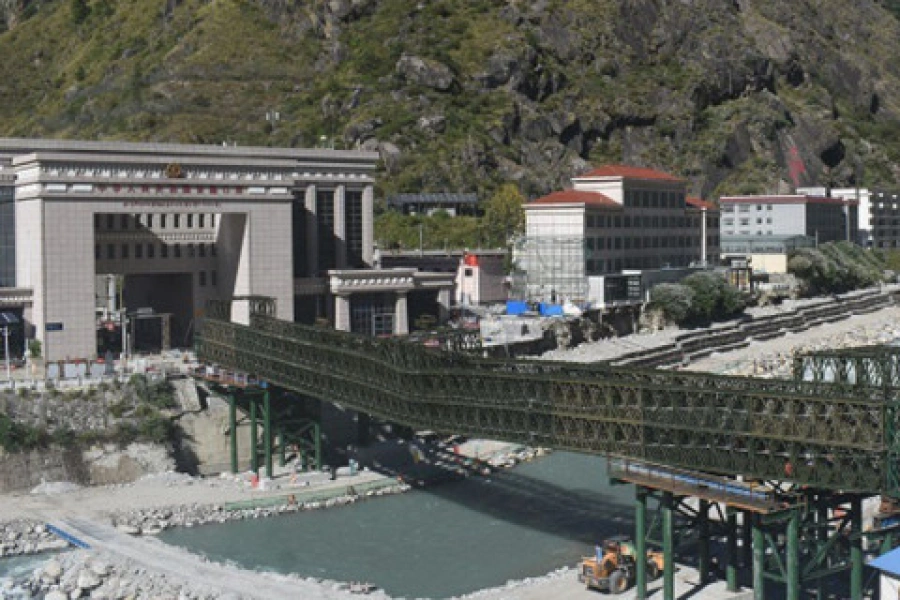
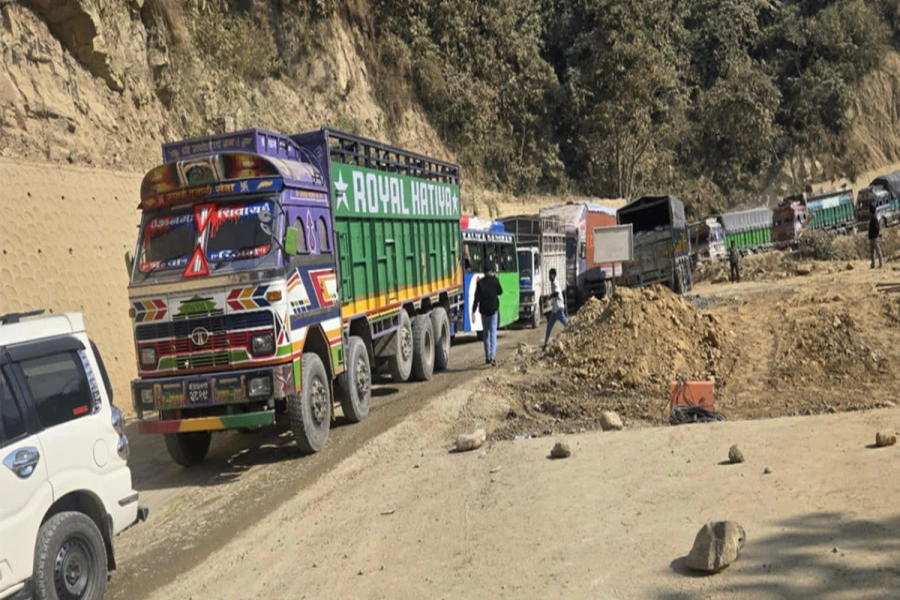
The recent unofficial Indian blockade in Nepal had a debilitating effect on the economy already crippled by poor growth in manufacturing and agricultural sectors, high inflation, never-ending blackout and low infrastructure investment. There was tremendous growth in illegal trade not only in border towns, but also in urban areas where demand for vital goods tend to be relatively high.Consequently, an upsurge in underground economy becomes apparent more than ever, as is evident in the unbridled rise in inflation; increased cost of production; and poor supply of necessities. The underground economy includes not only illegal activities, but also the legal ones that are untraceable and hence not taxable, and are not reflected in the country's accounting systems.
Normally, the size of the underground economy is much higher in developing countries compared to developed countries. Research shows that during the early 1990s the size of the shadow economy was between 35 to 44 percent of GDP in developing countries, whereas the same for transition and OECD countries was between 21 to 30 percent and 14 to 16 percent, respectively.
One of the important effects of the underground economy is the loss of government revenue, primarily due to tax evasion arising from unrecorded trade and business transactions. The revenue growth of Nepal in the past two decades exhibits shows a growing share of underground economy. For example, the average growth of all major taxes except excise duties declined after 2000/01.There was a surge in revenue growth following the introduction of voluntary disclosure of income in 2008/09. However, after that revenue growth has been stagnant and in recent months, it has even started to decrease.
The new estimates for 162 countries carried out between 1999 and 2007 and published in the World Bank Policy Research Working Paper finds that the weighted average size of shadow economy was about 37 percent of official GDP of Nepal. Nepal was ranked as having the 64th largest underground economy of 162 countries in the world and the second largest in South Asia (after Sri Lanka at 44 percent). Surprisingly, the study showed that the Indian economy's share was only 22 percent during the same period.
However, Arun Kumar, author of the famous book Black Money in India argues that the black economy in India is as big as almost US$ 500 billion—almost half the size of official economy. It would therefore not be illogical to assume that the size of the shadow economy of Nepal, which shares a 1,850km open border with India, must have also increased at a similar clip.
I led a research—carried out under the University Grants Commission Grant and published in the Economic Journal of Development Issues—to confirm whether the shadow economy in Nepal had grown. The popular Currency Demand Method was employed using time series data from 1985 to 2012. The study shows that the growth rate of illegal money (IM) has mostly been higher than the Legal Money (LM), confirming that the underground economy growing in Nepal, notwithstanding the multiple reform measures introduced during the period. The average growth of underground economy was 19 percent between 1991 and 2000. It stabilized at 17 percent between 2001 and 2010, but increased at the rate of 32 percent in 2011/12.
The political stability between 2001 and 2010 after the end of the Maoist war may be partly attributed to the anti-corruption campaign in Nepal that has intensified since 2000. This may be due to a proactive CIAA, plus increasing awareness of corruption-related issues among the people, and pressure from civic-minded factions of Nepali society and donor community. The Royal Commission for Corruption Control (RCCC) also had some role as it took action against several high profile politicians and bureaucrats. Furthermore, the end of the decade-long Maoist rebellion might also have slowed down the pace of illegal transactions (earlier used by Maoist rebels to mobilize recruits and for trade in ammunitions).
There may be several reasons for the upsurge in underground economy in the last two years of the study period. First, studies on black economy of India put it at between 50 to 70 percent of GDP. As mentioned earlier, it is not surprising for Nepal, which shares a long border with India, to have such a similarly large underground economy. Second, stagnant growth of tax revenue, most importantly income taxes and custom duties, in the last few years further proves that there has been massive tax evasion since revenue growth has not kept pace with increasing imports.
Finally, the growth in government corruption, the prevalence of a predominantly cash economy, open border with India, and poor regulation of trade and financial sector might have supported the growth of the black economy in Nepal. The recent supplies blockade has no doubt skewed the incentives for unscrupulous traders to do more transactions off the official radar. This effect of the blockade is going to linger for years even if the market supplies fully normalize in the days ahead.
Often politicians and even high-level responsible officers encourage underground economy. Without timely action against them, there is incentive for others to join the herd and earn money illegally and quickly, incurring a huge cost to the exchequer. The proposed Anti-Money Laundering Act in its full-fledged form has a provision to increase the scrutiny of financial position of politically exposed persons (PEPs), which is in line with the Financial Action Task Force's (FATF) revised recommendation in 2012.
Apart from this legal course, provisions such as efficient and effective labor market regulation, cutting down on taxes and red tape for the formal sector, and punishment and reward system in public service could help further minimize the size of the underground economy. Furthermore, better social security system and protection of taxpayers would discourage them from relying on the informal economy. Improving the quality and quantity of public goods and services will also help.
The severe economic blow due to the blockade is also an opportunity to clamp down on the underground economy and boost everyone's welfare.
The author is a PhD candidate at the National Graduate Institute for Policy Studies, Tokyo
Related story
Black is bold