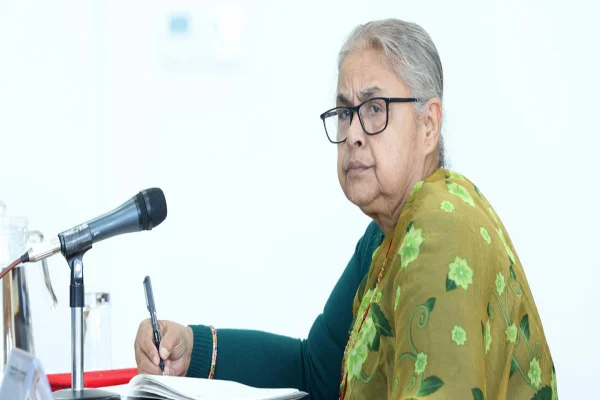
KATHMANDU, Nov 14: Prime Minister Sushila Karki on Friday again convened a high-level meeting to examine the feasibility of enabling citizens living outside their home constituencies—and those residing abroad—to cast their votes in the upcoming elections.
The discussion, held at the Office of the Prime Minister and Council of Ministers, brought together a delegation from the Ministry of Home Affairs led by Home Minister Om Prakash Aryal. Senior officials from the Ministry of Law, the Election Commission, the Policy Research Institute (PRI), and the Department of National ID and Civil Registration also attended the meeting.
During the meeting, the Policy Research Institute presented a summary of its study outlining possible options for facilitating external and overseas voting. The presentation focused on technical, logistical, and legal pathways for expanding voter access beyond traditional polling locations.
Four ways Nepalis overseas could vote — EC begins pilot for Mar...

Following the briefing, PM Karki stressed that the government must at least move forward on ensuring inter-constituency voting. She argued that forcing voters to travel to their home constituencies has imposed significant financial burdens on candidates and political parties, fostering corruption and other distortions in the electoral process.
“If we continue conducting elections in the same old manner, the Gen Z movement will have been meaningless,” she said. “Let us take a meaningful and robust step. Let us institutionalize a forward-looking system.”
She further stressed the need for a political consensus for the reforms. She said, “All stakeholders must be prepared. Our children are far ahead in digital literacy—how prepared is our political leadership to understand this?” She added that had such innovation been recognized during earlier elections, the incidents of September 8 and 9 might not have occurred.
Home Minister Aryal echoed the need for reform, insisting that this election must mark a departure from past shortcomings. “This is an election government,” he said. “Its mandate is to address previous weaknesses and conduct elections in a better way. Therefore, we must make a significant leap forward.”
The meeting decided to form a joint mechanism to provide recommendations on the technical, financial, and legal requirements for enabling inter-constituency voting and ensuring the voting rights of Nepalis living abroad. The mechanism includes the executive chair of the Policy Research Institute, Law Secretary Parashwor Dhungana, and representatives from the Election Commission.
Suman Ghimire, information officer at the Election Commission, talking to Republica earlier, had said they were working to find out ways to conduct a ‘pilot’ project of allowing voting for Nepalis residing abroad. The EC has forwarded four options - in-person, online, postal and proxy voting - to allow voting for Nepalis residing abroad.









-1200x560-1774441847.webp)