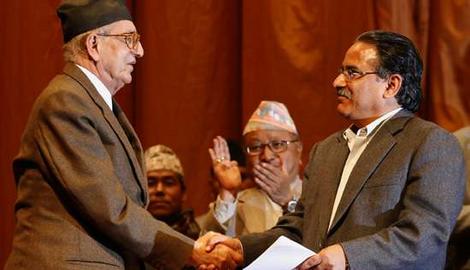
Don’t blame bichara (helpless) former Chief Justice Om Prakash Mishra. It is us (three leaders—Sher Bahadur Deuba, Pushpa Kamal Dahal, and himself)—who decide the commissioners’ selection, and he added to wait and see for two months. If they become dysfunctional, they can be replaced.
Listening to the anguish over the shortlisted candidates published by the Mishra Recommendation Committee (RC), Prime Minister KP Sharma Oli stated this to a victim group on 4th May at his residence, Baluwatar. They challenged the process that ignored them and undermined the transitional justice (TJ) principles. The eight potential chairpersons shortlisted for the Truth and Reconciliation Commission (TRC) and the Commission of Inquiry on Enforced Disappeared Persons (CIEDP) lack credibility and were listed without serious and sufficient exercises, they said.
Following the shortlist being made public, the victim organizations sent a withdrawal notice of their candidates to the RC, revealing a loss of trust in it. The human rights defenders (HRDs) Raju Prasad Chapagain, Santosh Sigdel, and Reshma Thapa withdrew from the process, responding to the call. Their participation till the end and being disqualified is baseless propaganda. However, some HRDs who defied the boycott, backed by either leader, secured the berth. Though the TRC Act doesn’t bar victim families from contesting, they were disqualified, stating ‘conflict of interest’. On the contrary, Tika Dhakal and Kumari Kausilya Ojha were recommended for TRC members although they belonged to the victim families.
Undoubtedly, the participation and support of the victim community in the TJ process is a must. Nepal also abides by this rule. However, the state-sponsored foul play has been ongoing, discrediting the TJ defenders for some time. Victims’ inherent rights—to trust or reject the TJ bodies—should be respected, considering their separate backgrounds, needs, and priorities.
However, the ten-year (1996–2006) conflict victims’ challenge to the TRC and CIEDP formation being faulty and politically controlled hasn’t been rejected. Forcing them to remain ‘prisoners of injustice’, accepting the flawed process and the entities captured by the ‘big three’, who have protected the perpetrators for twenty years, harboring the culture of impunity, is immoral. Their right to ‘boycott and seek course correction’ should be respected.
Let’s live in peace and embrace diversity

Recalling UN Secretary-General António Guterres’ visit to Nepal in October 2023, he said TJ has the greatest chance of success when it’s inclusive and comprehensive and has victims at its heart, in an address to the Parliament. He reiterated, “The United Nations stands ready to support a victim-centric process and its implementation that meets international standards and Supreme Court (SC) rulings.”
Furthermore, the UN, in 2014 and 2016, issued ‘Technical Notes’ to the Nepal government on the TJ process, highlighting concerns about compliance with human rights standards. The UN position in the note, point 10, dated February 16, 2016, categorically states: “In absence of steps by the government of Nepal to ensure that enabling law and procedures of COIED and TRC are in compliance with international legal obligations, the UN is unable to support these institutions.” Additionally, on January 2, 2014, the SC issued an order to the government to ensure the mandatory and meaningful participation of victims at all levels of the TJ process, including the formation of independent, impartial, and accountable commissions.
From June 24 to 25, 2025, I had a chance to visit Dhangadi, situated in the Far Western region, to interact and obtain the ground reality. To my notice, none of the victims, civil society, or media persons defended the new TRC and CIEDP or advised giving the ‘benefit of the doubt’ to engage. The interaction with about 400 individuals in seven districts of the region was also shared by one of the civil society members at the event. He found no victims, rights defenders, or journalists supporting the newly constituted bodies. Thus, it is unfair and unethical to question their integrity and honesty, without fact-checking, to claim that the boycott agenda is only of a few victim leaders and human rights defenders active at the center.
Notably, both the TRC and CIEDP constituted in 2015 and 2020 failed to yield results. Though the initial bodies received ‘critical support’ from the victims, they couldn’t reveal the truth of a single registered case out of 65,000, even though the Act didn’t prevent unfolding the truth or addressing reparation. The ensuing commissions didn’t encounter any rejection but failed to deliver. After the third amendment of the Act, with ambiguity and gaps, TJ bodies were expected to be established in a credible manner, but it didn’t happen. Beyond this, viewing their insensitive approach towards the victims, it has so far turned out to be the worst episode.
The TRC complaint registration call targeting sexual violence victims is a demonstration of its incompetence. Issuing a three-month submission notice, without having consultation or a proper mechanism in place, was annoying. Moreover, forcing them to complain by disclosing the incident details, including the names of the perpetrators, is truly not a diligent move. Many human rights organizations, including the National Association of Conflict Rape Victims (NACRV), led by Devi Khadka, issued a statement with despair. It objected to its insensitivity and said, “It will be suicidal to take part in this process.”
Sadly, the TRC Chair, in a parliamentary committee meeting, gave derogatory remarks against victims. He overstepped his mandate, defied victims’ enrollment, and accused them of putting unnecessary and intolerable pressure on him. On the other hand, following an event, CIEDP issued a misguiding official statement quoting victims’ names in its support. This was objected to by the named victims on social media. Hence, even monitoring these entities—disrespectful to victims—will be legitimized, wasting four years’ time, money, and titanic state resources.
Surprisingly, beyond the law, PM Oli appointed former minister Agni Prasad Kharel as his human rights and TJ expert advisor. Moreover, with the intention of a ‘divide and rule’ policy, he has been engaged in influencing the Mishra search committee, NHRC Chair, misinforming the international community, lobbying victims, offering benefits, and misusing favored HRDs. Kharel’s manipulation reminds us of a ‘high-level political mechanism’ orchestrated by a project-hungry team, currently engaged in discrediting the victim leaders. With sizable financial support from the Swiss Embassy, they succeeded in dividing the victims with a ‘stick and carrot’ approach. The substantial Swiss aid was wasted in this futile exercise, having no transparency.
The question of disbanding TJ bodies is not a big deal to the ‘big three’. Foreseeing serious consequences, they can find ways—especially through the tool of ‘political consensus’—to agree on restarting a credible process. The call of then Nepali Congress leader Girija Prasad Koirala to reinstate the Parliament during the ‘People’s Movement 2006’ was taken as a foolish demand, but it happened. ‘You reap what you sow.’
The author is a former Chair of Amnesty International Nepal, former President of the Human Rights Organization of Nepal (HURON), and former Coordinator of the Accountability Watch Committee (AWC).