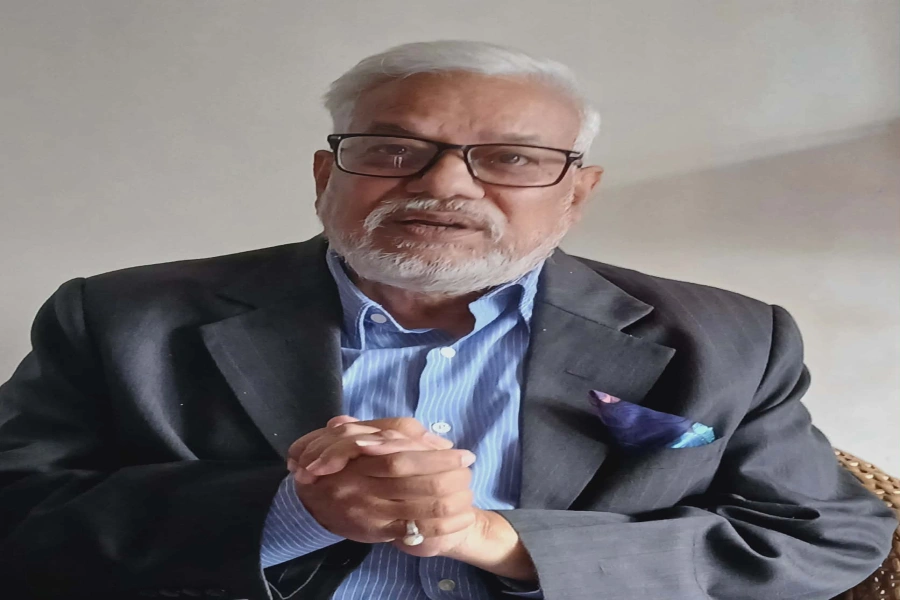
‘Transition, transition, transition – Nepal seems to be lost in Transition.’ Though the start is quite pessimistic, ‘Lost in Transition’ by diplomat and development professional Kul Chandra Gautam has an overall optimistic tone.
Related story
What Nepal can learn from China

Gautam’s read on contemporary socio-political and economic issues is based on interdisciplinary approaches. As a diplomat and high ranking official of the United Nations, Gautam has a sharp insight over global and domestic issues. The book has redrawn the rhetoric of Maoist movement in Nepal in the light of modernist and pro-leftist scholars who have glorified the Maoist movement and have appreciated Maoist leaders for establishing the issues of inclusion and representation of marginalized.
Such rhetoric pins the blame on the Brahmins and Kshetris as perpetrators of discrimination in the Nepali society. By challenging such notions, Gautam has argued that the failure of economic progress and corruption are the roots of the Maoist insurgency and its partial success.His main purpose behind writing the book, it seems, is to foster a sense of optimism in the new generation and his contemporaries, though the book deals with issues like poverty, backwardness, corruption, Maoist mayhem and political instability that he thinks have hindered the socio-economic progress of the country.
According to him, three challenges are hindering the progress and prosperity of the nation: Maoist insurgency, earthquake and trade blockade. The first one killed, injured, and displaced over 17,000 people by planting seeds of ethnicity and secessionism. He terms it as ‘man-made earthquake’ which is more catastrophic than natural earthquake. The second one is the April 25 earthquake and the subsequent aftershocks that killed over 9,000 people and injured an additional 20,000 people.
And the third one is the border blockade imposed by our southern neighbor resulting in dire humanitarian crisis and huge trade loss. He defines it as the Indian conundrum and opportunity given to Nepal. The conundrum is due to excessive dependency on India and the opportunity is to lessen this dependency and strengthen trade ties with China for developing interdependency with both neighbors in balance. He defines Indian border blockade as unwise and counterproductive beyond the diplomatic practices in 21st century where soft and smart power could be exercised to influence others rather than coercive hard power.
The burning Tarai, unwanted intervention of southern neighbor over our internal affairs and vulnerable political courses have found space in Gautam’s analysis on the issues. Though he was guided by the principles of the UN, he criticizes the role of UN mission (UNMIN) here for differently treating the then Maoist. The Maoist wanted to extend the term of UNMIN for prolonging political turmoil and transition. Gautam has tried to be an honest observer and participant in Nepal’s peace processes. However, he was tagged anti-Maoist, anti-monarch and as a feudalist supporting the status-quo. He realizes that it’s challenging to be neutral in Nepal.
Gautam also criticizes the whole political system and the then actors – Maoist, Monarch and parliamentary parties. The Maoists implanted ‘the seeds of inter-ethnic and hatred and suspicion’ while fighting for issues of marginal representation and inclusion.
The then King Gyanendra enjoyed playing seven different cards – Military card, terrorist card, loyalist card, Hindu card, China card, corruption card and censorship. Though his analysis over the issues seems valid, Gautam fails to provide the right solutions.
As a development expert, he has suggested that no ideologies and ‘isms’ are enough for development as Nepal has experimented with several regimes guided by different ideologies and ‘isms’ like absolute monarchy, constitutional monarchy, liberal democracy, and communism, and mixed model for the last seven decades. Though hard work, good governance, respect for human rights and democratic norms ensure progress, surprisingly these are only slogans in Nepal. Readers expect him to present a roadmap of development in his book but there is none.
Having a lot of experience on development practices and peace process in several areas, diplomat Gautam, who also served as the special foreign affairs advisor of the then Prime Minister Madhav Kumar Nepal, says that the federal model is not a panacea for development. However, Nepal accepted the federal model despite realizing its negative aspects outweighed the positive ones. Here the author fails to suggest a way out from the dilemma.
In a long chapter entitled ‘Deception and Delusion of the International Community’ International relations (IR) scholar Gautam criticizes the role of the international community, including international non-governmental organizations and intergovernmental organizations. He also questions the silence of international community and says that particularly Kathmandu based European Missions, who fancy themselves as defenders of human rights and humanitarian intervention, didn’t show any courage when millions of Nepalis, including those in the Tarai-Madhesh, suffered great hardship mainly because of the Indian blockade.
Gautam has clarified that the book was not based on scholarly research and specialist knowledge. Though the book is not written through perspectives practiced in IR and socio-political development studies, it was shaped through the liberal democratic and idealist perspectives of the writer. Though it is written honestly, it leaves some ambiguity, paradox and ambivalent position over the subject matters. Also there’s a little lack of coherence in some chapters and narration is not the book’s strong point. Nevertheless, “Lost in Transition” is a masterpiece to understand contemporary Nepal. After the retirement from the position of senior official at the UN, Gautam has been contributing in different national and international organizations and has come up with an insightful publication that must be read by all Nepalis to
better understand its development processes.
deependrasanchar@yahoo.com