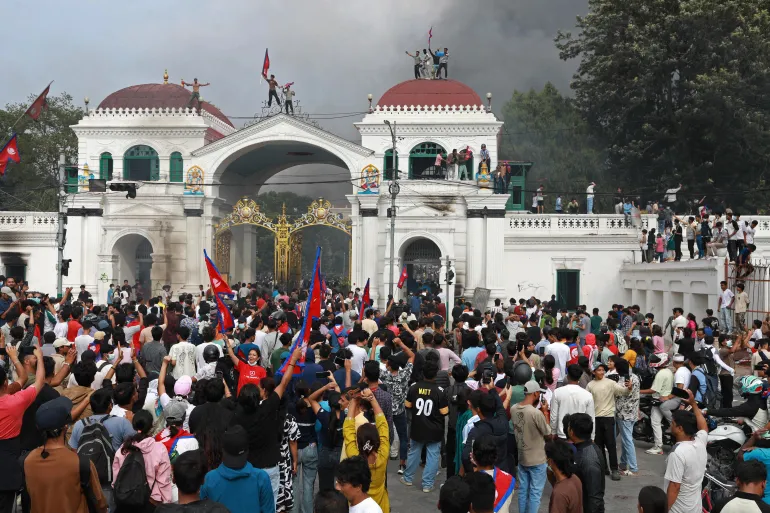
Two months into the interim government’s tenure, and the explicit turmoil of the Gen-Z protests has largely quietened down. There still, however, remains a level of distrust ; the ‘calm’ we see now feels less like peace and more like a pause in a long and unfinished conversation between the people and the government. The protests, though short-lived, exposed more than just anger at leaders : they reflected exhaustion and a perception that the political class no longer listens.This uncertainty raises questions as to the nature of the citizen-state relationship: has Nepal’s social contract been renewed, or merely suspended in its erosion? Were the protests an interruption of the social contract or evidence of its fragility?
These are non-abstract concerns and are critical to address, for its answers can accurately describe the socio-political fabric of present day Nepal, underscore administrative discipline and most importantly facilitate citizens and the state navigate concerns of legitimacy, trust and accountability.
With a background of years of political instability, the fall of a government itself is not surprising, though the manner of change is disparate. Despite this fundamental difference, the Nepali people remain skeptical, for governments change at a much greater rate than do the perception of state-society relations. This unchanging social and moral contract is a continual theme post the introduction of republicanism in Nepal; the state actors change, or often repeat, yet the relational contract remains the same. Over-promising and under-delivery has gradually eroded trust in the state so much that many proponents of different governance systems altogether have started vocalizing their contentions. This is a strong reminder that when the government doesn’t listen to its citizens, the citizens shall find different ways of expression.
A new social contract in the making? As existing social contrac...

But the path forward cannot be paved through just resentment alone. If the contract between us, the citizens, and the government is to be renewed, or its degeneration halted , we must first be clear of what to correct within the confines of the present interim government. Even with a short and defined mandate, the interim cabinet can demonstrate strength and good-governance through small, but symbolic actions. Public trust is not built by establishing commissions, platitudes or by decreeing an end to corruption, it is done through conduct. However, neither the old guard of political parties and leaders, nor the interim government and emerging advocates of institutional reform seem to be interested in creating an environment of informed decision making to facilitate said conduct. Nepal has no shortage of competent economists, constitutional experts and public administrators, but they remain conspicuously absent from current decision making. It is only with their expertise that frameworks for timely audits, public procurement, federal and local fiscal activity can be made transparent. In such moments of uncertainty, we must not confuse improvisation with innovation. In ensuring the guidance of experts, it must be understood that what is being demanded is not elitism, just a guiding force. Appointments must focus on both expertise and representation. If the next four months demonstrate informed and inclusive governance, citizens will gradually demand the same, if not higher standards from the successive governments on matters of transparency of appointments, disclosure of finances and handling of dissidents. Therefore, the interim’s legacy need not be measured by policy and executive will, but by setting a precedent for open, competent and fair governance.
It is further important to acknowledge that the interim government cannot overhaul the entire system in a matter of months, as that is not what is being demanded. But it can begin to model transparency, clarity and co-ordination in ways that last ; when conflicting reports and confused decisions are taken, such as recent disputes over the ministerial appointments, they dominate headlines, invoke discussions, incite disagreements and deepen instability. The interim doesn’t have the mandate to redefine the state, but it does have the ability, and most definitely the responsibility, to ensure consistency and credibility.
Yet the renewal of any social contract requires institutions to be responsive to civic engagement. Civic participation should not be seen as pressure from the outside, rather it should be a force embedded within the institution. Equally, citizens must also view participation as a duty, not as a reaction. The protests were only the starting point of accountability, and large pressure has since been removed in the post-protests weeks. The same energy that was directed in the streets must now be directed into sustained engagement in civic discussions and community oversight to establish a practice of ensuring leadership accountability well into the future.
Ultimately, the erosion of Nepal’s social contract will stop not when governments stabilize, but when power fundamentally behaves differently. Legitimacy is not restored through declarations but through daily fairness, honesty, and responsiveness. The interim may be temporary, but the standards it sets need not be. A state that listens before it acts, and citizens who engage beyond moments of crisis builds reciprocity and institutional discipline that becomes ideology. Nepal’s renewal will not begin in parliament, but through fairness between those who govern and those who consent to being governed.
Every contract, social or otherwise, survives only when both sides uphold their word, and the next part of our country’s path depends on rediscovering that truth.
The author is an Economics undergraduate at Shri Ram College of Commerce, University of Delhi. His interests lie in development economics and public policy. He has previously gained experience with Premji Invest, EY, and IFAD.