BARA, Aug 8: Locals on August 2 staged an all-day protest in front of Ganapati Ghee Industry and Nandan Ghee Industry located in the Birgunj-Pathlaiya Industrial Corridor, placing the body of 13-year-old Sandip Mukhiya of Jitpursimara Sub-Metropolitan City (JSC)–5 to demand compensation
The boy had drowned in a canal in JSC–5 where polluted water discharged from the industries had accumulated. Protesters demanded that the industries compensate the family for his death in the contaminated water.
Sandip’s mother, Anju, joined the demonstration alongside relatives, holding her son’s body. She claimed that polluted, chemical-laden water from industries such as Ganapati Ghee, Nandan Ghee and Ashok Steel had been flowing into the canal. “If the water discharged from these industries had not been polluted, my son would still be alive,” she said. “The toxic water took my son’s life.”
Residents also complained that the untreated waste water produces a strong foul odor in the area.
After the boy’s body was recovered, it was taken to Narayani Sub-Regional Hospital in Birgunj for post-mortem examination. The autopsy confirmed that toxic water was the cause of death.
Bara police begins probe into complaints filed against Bomjon,...

Following the protests, Ganapati Ghee Industry and Nandan Ghee Industry each paid Rs 300,000 in compensation, according to DSP Bed Prakash Joshi of the Area Police Office, Simara. He said the payment was made after discussions between the victims’ family, local representatives, and industry officials.
The Birgunj–Pathlaiya Industrial Corridor — the largest in the country — has long been accused by locals of polluting rivers, streams, and air due to indiscriminate industrial practices.
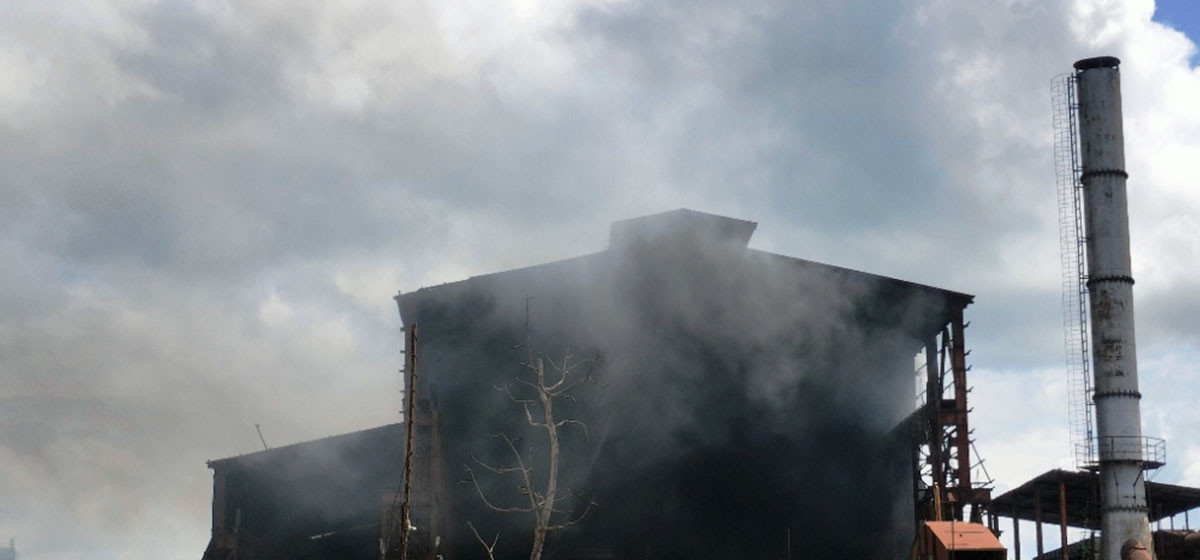
In Simara, residents have raised serious concerns about Ashok Steel. According to Dashai Ram of Bakuliya Tole, smoke from the industry’s furnace is released directly into the air without treatment, producing thick black clouds that darken the sky even during the day and cause breathing problems. “The smoke enters our homes every day,” Ram said. “It irritates the eyes, harms animals, and makes it difficult to breathe.”
Locals alleged that the factory’s owner, Punam Agrawal, has ignored complaints and taken no measures to control the emissions. Ram further accused regulatory agencies of turning a blind eye while industries openly flout environmental rules.
Regulations require that industrial smoke be filtered and released through a chimney at least 32 feet above ground, but Ashok Steel has not complied. The furnace smoke contains carbon dioxide, carbon monoxide, nitrogen dioxide, and other harmful gases, posing serious health risks to nearby residents and travelers along the busy highway.
Kul Prasad Ghimire, a resident of Auraha in JSC, said the factory’s reckless release of toxic smoke has created daily hardship for the community. “The pollution is constant,” he said. “It affects both people living near the factory and those just passing through.”
Ashok Steel says it melts scrap iron in its furnace to produce billets for making rods. Compared to regular factories, scrap iron–melting plants emit far greater volumes of smoke, which should be treated through chimneys or filtration systems before release.
Administrative Officer Binay Jha claimed the smoke is discharged upward through industry-installed pipes, but admitted that damage to the exhaust pipe had caused smoke to escape through the factory roof instead.
Industry officials said the plant processes more than 10 truckloads of scrap iron daily. Director at the Department of Industry, Khagendra Bahadur Basnet, noted that all industries must commit in writing at registration to release smoke above 32 feet. Those that fail to do so, he said, can face action.
Deepak Gyawali, Information Officer at the Department of Environment, added that the law requires industries to install chimneys with filtration systems and release white, not black, smoke at least 11 meters above ground. If Ashok Steel continues to violate this rule, the Department of Industry has the authority to act.
Because importing raw iron from India and other countries is costly, Ashok Steel buys scrap iron from across Nepal to melt and remanufacture into rods.
Many steel factories in the corridor — including Hulash, Jagadamba, Saakh, Narayani, and Bhagwati Steel — reportedly avoid installing costly pollution control systems, releasing untreated emissions into the environment.