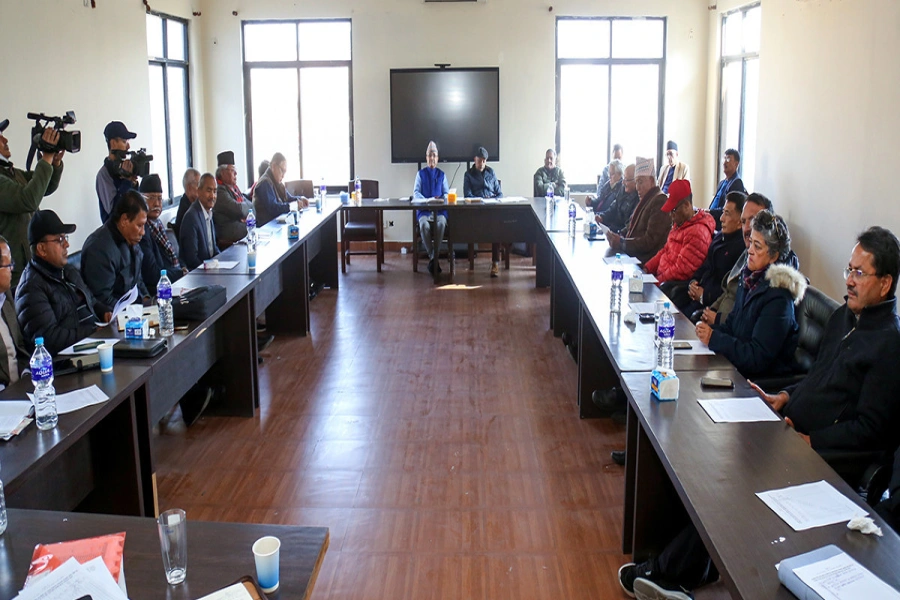
The council meeting on Tuesday recommended Deepak Kumar Karki, Kedar Chalise, Sharada Prasad Ghimire, Mira Khadka, Hari Krishna Karki, Bishwambhar Prasad Shrestha, Ishwar Khatiwada, Aananda Mohan Bhattarai, Anil Kumar Sinha, Prakash Man Singh Raut and Sapana Pradhan Malla for appointment as Supreme Court justices.
Among the recommended 11, Deepak Kumar Karki, Chalise, Ghimire, Khadka, Shrestha, Khatiwada and Bhattarai are career judges serving as chief judges at appellate courts. Hari Krishna Karki, Sinha, Raut and Malla are senior advocates.
Hari Krishna Karki, the chairman of Nepal Bar Association, was appointed attorney general by Prime Minister KP Sharma Oli a few months ago and is close to the ruling CPN-UML. Malla was a member of the first Constituent Assembly from the UML under the proportional representation electoral system. Raut is considered close to the main opposition Nepali Congress.
While picking justices from among career judges, the council has not considered the seniority list. In the seniority list of chief judges, Deepak Kumar Karki is at the top while Bhattarai is 13th. Tej Bahadur KC (second in seniority list), Purushottam Bhandari (4th), Sambhu Bahadur Khadka (5th), Poshnath Sharma (7th), Bam Kumar Shrestha (9th) and Dambar Bahadur Sahi (10th) are not recommended for justices this time while Shrestha, Khatiwada and Bhattarai are below them in the list.
The Judicial Council had not made any recommendations for appointment as Supreme Court justices since April 2014, when the recommendation of eight career judges had sparked controversy. But they were all ultimately appointed after being duly approved through parliamentary hearings.
As the new constitution provides for 20 justices at the Supreme Court, apart from the chief justice, there were 11 positions of permanent justices lying vacant.
The five member Judicial Council is itself incomplete as the prime minister and Nepal Bar Association have not recommended any lawyer for one position of council member. Recently, the main opposition Nepali Congress had formally appealed to the council not to appoint the justices before the council itself gets full shape. However, the council was also under pressure to recommend justices to the vacant positions as the number of unsettled cases at the apex court has neared almost 25,000.
As per the constitutional provisions, people recommended for the council must go through a parliamentary hearings process, but the regulations related to parliamentary hearings have yet to be finalized.
Since there are just 10 justices on the Supreme Court, service seekers have been facing delays in finding legal remedy, said Agni Kharel, minister for law and justice and ex-officio member of the Judicial Council, adding, the council has therefore taken today’s decision unanimously. Only chief judges and advocates have been selected for recommendation, he further said.
Related story
Judicial Council recommends six candidates for the appointment...