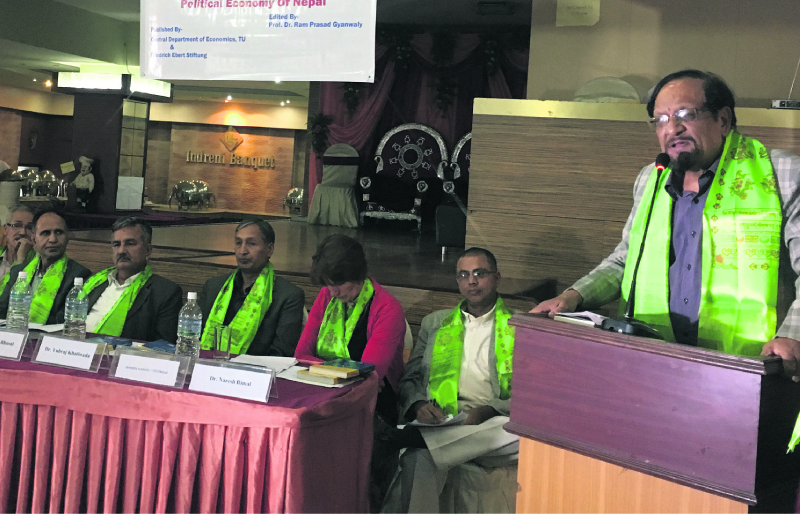
KATHMANDU, Dec 21: Nepal’s public expenditure in recent years has increasingly shifted toward general public services at the expense of high-return economic sectors prioritized under the Sustainable Development Goals (SDGs), economists said.
Economist Dilli Raj Khanal said government spending had deviated from constitutional norms and SDG targets, worsening the imbalance between planning, budgeting and development. “The disequilibrium among planning, the government budget and development has been deepening in recent years,” Khanal said while speaking at a program organized on Friday.
Government data show that allocation to general public services rose sharply from 18.9 percent of the annual budget in fiscal year (FY) 2011/12 to 42.9 percent in FY 2022/23. In contrast, spending on economic affairs declined to 17.5 percent from 23.3 percent during the same period. Budget allocation for the health sector also fell to 4.2 percent from 7.8 percent.
Let Sajha rise

Similarly, the education sector saw a steady decline in funding, with its share dropping from 21 percent in FY 2011/12 to 11.27 percent in FY 2022/23, and further to 10.95 percent in FY 2023/24.
Spending on social security, however, increased significantly to 16.20 percent from 3.6 percent. Despite the rise, Khanal said outcomes remained limited. “Even with a notable increase in budget allocation to social security, the results have been nominal,” he said.
Khanal also pointed to the underperformance of Nepal’s 15th Five-Year Plan (2020–2024), which recorded economic growth of about 2.6 percent, far below its target of 9.6 percent. He said the growth lacked quality and failed to adequately support employment generation and inclusiveness.
A recent World Bank report has also highlighted weak human capital as a major constraint to Nepal’s economic progress. While acknowledging improvements in health and education indicators over recent decades, the report noted that one in four children remains stunted, limiting learning capacity and future productivity. It added that Nepal’s per capita investment in education and health is significantly lower than that of countries with similar income levels.
Khanal further underlined inefficiencies in project management, noting that some national pride projects were estimated to take up to 40 years to complete.
Finance Secretary Ghanashyam Upadhyaya said the government faced major challenges in ensuring the productive use of financial resources. He cited the lack of employment opportunities for around 500,000 new entrants to the workforce each year as one of the country’s most pressing problems.