

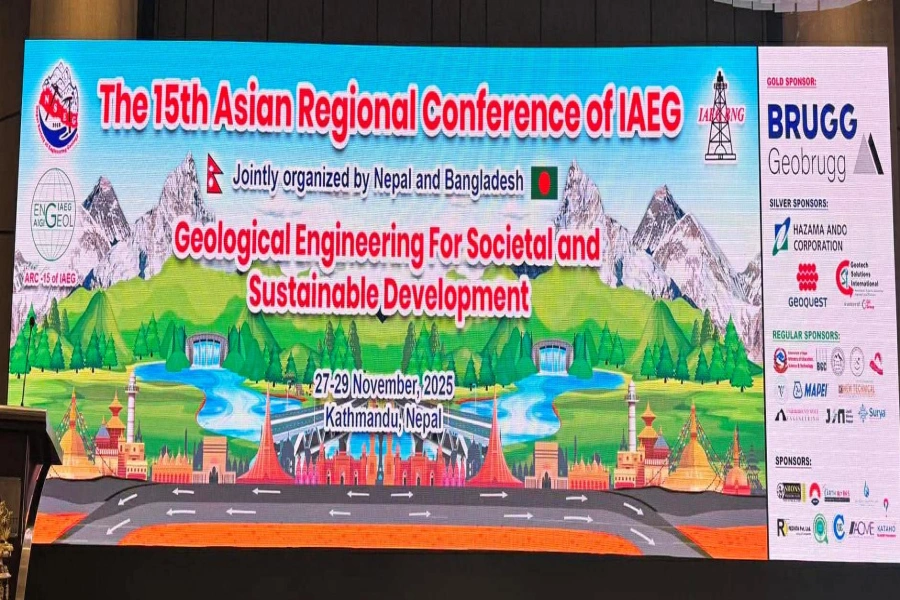
KATHMANDU, Nov 27: More than 200 engineering geologists from across the world have begun convening in Kathmandu for the 15th Asian Regional Conference of the International Association for Engineering Geology (IAEG), which opened with a grand ceremony highlighting the urgent need to integrate geological expertise into major development projects.
Supported by engineering geologists worldwide, the three-day conference aims to advance the discipline in Nepal by promoting professional practice, strengthening training and education, facilitating research for civil infrastructure and forging stronger ties with national and international experts.
Engineering geologists apply geological science to assess ground conditions for construction, infrastructure, and natural hazard mitigation—ensuring that roads, tunnels, dams, and buildings are safe and compatible with the environment. In Nepal, professionals with a Master of Science in Geology or a Master’s in Engineering Geology are eligible to work in the field as engineering geologists.
The event is jointly organized by the Nepal Society of Engineering Geologists (NSEG) and the IAEG Bangladesh National Group.
Himalaya College of Engineering wins the First National FPGA De...

Speaking at the inauguration, Minister Kulman Ghising—who currently oversees three ministries: Energy, Water Resources and Irrigation; Physical Infrastructure and Transport; and Urban Development—said the government must take the role of engineering geologists far more seriously across all major construction sectors.
“As Nepal enters a new phase of development with extensive road, tunnel, dam, and reservoir construction, we must include engineering geologists to ensure resilient and robust infrastructure,” Ghising said.
Vice-President of the International Society for Soil Mechanics and Geotechnical Engineering (ISSMGE) and conference convener Prof. Dr Ranjan Kumar Dahal said hosting the global conference in Nepal—bringing together leading geological scientists—has elevated the country’s visibility in engineering geology. Nepal is now the fifth-largest IAEG member nation, with 542 engineering geologists affiliated with the global body.
Prof. Dr Dahal noted that the government's reluctance to integrate geological expertise has already begun to affect development outcomes. “Ignoring geology before commencing engineering work will impose severe costs in the near future,” he warned. “The government must recognize its importance before it’s too late, especially in a geologically fragile country like Nepal, where haphazard construction is common.”
Prof. Dr Dahal, the immediate past president of NSEG, also criticized the absence of active engineering geologist positions within the Department of Roads, despite the existence of sanctioned posts. He further called it an “injustice” that the Nepal Engineering Council still does not recognize geologists as engineers.
“It is disheartening that our work is not accredited by the Engineering Council, even though we provide expert advice and scientific evidence on the very foundations upon which infrastructure stands,” he said, urging amendments to the Council’s rules to include engineering geologists.
Sharing similar concerns, young engineering geologist Anjila Babu Malla said their work had long been overlooked but was gradually gaining recognition. “Expert geological insight and scientific data are crucial for large structures. Take Kathmandu Valley—small in size but with vast variations in soil and bedrock. Overlooking minor differences can have major consequences,” she said.
Malla, who moderated a session on “Global Perspectives on Women’s Careers in Engineering Geology,” added that women in the sector face additional hurdles. “Women are often overlooked, their expertise questioned, and the travel demands of the profession are seen as barriers to growth,” she said.
Nirmal Kafle, senior lecturer at Khwopa College of Engineering, echoed these concerns, calling it “deeply disappointing” that both government and private sectors continue to undervalue geological expertise. He said engineering geological feasibility studies should be mandatory for all major projects and recommended assigning at least one engineering geologist to each District Development Committee.
“Unfortunately, we still see districts and local governments hiring civil engineers to serve as geological experts. This practice increases the risk of severe accidents in the future,” Kafle warned.







-1781762832.webp)


