KATHMANDU, Feb 3: As election momentum builds across the country, formal and informal talks have quietly begun among top leaders of the four parties represented in the now-dissolved House of Representatives (HoR). The discussions, according to sources, center on the evolving political landscape and the shifting electoral mood—at a time when parties are officially contesting the polls on their own.
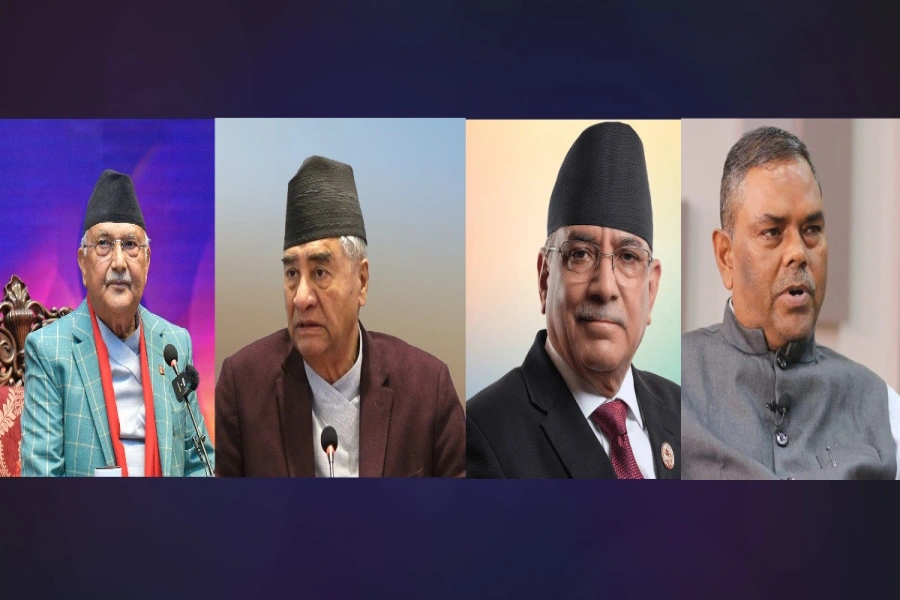
Sources say CPN-UML Chair KP Sharma Oli, Nepali Congress (NC) outgoing President Sher Bahadur Deuba, and Nepali Communist Party (NCP) Coordinator Pushpa Kamal Dahal met on Sunday evening to discuss recent political developments. Deuba, notably, is not contesting this election.
With internal rifts persisting within the NC, Oli and Dahal are said to have sought Deuba’s cooperation. The meeting—held with a focus on the House of Representatives election scheduled for March 5—reportedly included serious deliberations on a possible electoral understanding. Sources claim Oli requested support in constituencies where the UML believes it has a strong chance of victory.
However, Deuba’s personal secretary, Bhanu Deuba, denied knowledge of any such meeting. “I am outside Kathmandu and have no information about this. Perhaps the meeting did not take place,” he said. UML Publicity Department Chief Min Bahadur Shahi also said he was unaware of any meeting among the top leaders. “I have no official information on this,” he said. Despite these denials, sources insist the UML is seeking support in districts such as Jhapa and Dang.
Local leaders lobbying for poll candidacy

The meeting marks the first interaction among Oli, Deuba, and Dahal since Gagan Thapa assumed the NC presidency following a special general convention. The leaders are reportedly reluctant to make the discussions public. Dahal’s press coordinator, Gobinda Acharya, could not be reached for comment as his phone was switched off. UML leader Ram Kumari Jhakri, meanwhile, reacted on social media, stating that cooperation could not be proposed from the UML chair. A source, however, claimed the meeting took place at an apartment in Hattiban.
Political observers see the Oli–Deuba–Dahal meeting as a “warm-up” ahead of a possible electoral alliance for the March 5 polls. Informal discussions reportedly revolved around whether to forge a declared or undeclared alliance. Sources also say the leaders have been in contact with Janata Samajbadi Party (JSP) Nepal Chair Upendra Yadav, who is currently engaged in a door-to-door campaign in Saptari.
According to sources, Oli, Dahal, and Yadav have all sought Deuba’s support in this election. In Jhapa-5, where Oli is contesting, he faces competition from former Kathmandu Metropolitan City mayor and senior Rastriya Swatantra Party (RSP) leader Balendra Shah, along with NCP candidate Ranjit Tamang. In Saptari-3, Yadav is being challenged by an RSP candidate—another factor driving the push for broader backing.
After Gagan Thapa became NC president, many leaders aligned with the Deuba faction were denied candidacies. Sources say this has prompted the UML, NCP, and JSP-Nepal to seek Deuba’s support to ensure the victory of their top leaders.
Sources further claim that Sunday’s meeting went beyond political consultation, extending to requests for mutual electoral support. The talks reportedly included serious discussions on possible electoral coordination centered on the March 5 HoR polls.
The UML is also said to have agreed to support Sandip Pun of the Gatisheel Loktantrik Party, led by Janardan Sharma, as part of efforts to keep Dahal in check. Dahal, who is contesting from Rukum East, also requires UML backing, aligning the interests of the two sides. “He sometimes makes unexpected decisions; it’s hard to say what will happen this time,” an NCP leader remarked.
Another UML leader hinted that any declared or undeclared arrangement could emerge to counter what he described as a broader challenge to the leftist movement. “At present, no leader is truly safe. Seeking each other’s support is natural,” he said, adding that the election has increasingly become a contest between old and new parties and leaders. Fears of a repeat of the 2064 BS scenario persist, making the recent high-level meeting politically significant.
Given the long history of unity, splits, and sharp accusations between Oli and Dahal, their open discussion on possible cooperation is being closely watched. Notably, as the election campaign intensifies, the two leaders have refrained from publicly attacking each other—unlike in the recent past.
Following the Gen Z movement, relations between the UML and NCP had further deteriorated. Although Dahal met Oli ahead of an official visit to India a few weeks ago, NCP leaders had maintained that cooperation with the UML was unlikely due to Oli’s remarks. The latest meeting, however, has fueled speculation that Nepali politics may be entering a new phase.
Responding to reports of the meeting, NC leader Ramesh Lekhak said that despite internal differences, the party is now fully focused on the elections. “The House of Representatives, the country’s highest elected institution, has been dissolved. Although elections were supposed to be held in 2084 BS, circumstances have forced them to be held in 2082. Democracy is under strain, and the situation is not easy. Even so, we have moved ahead with the elections,” he said.