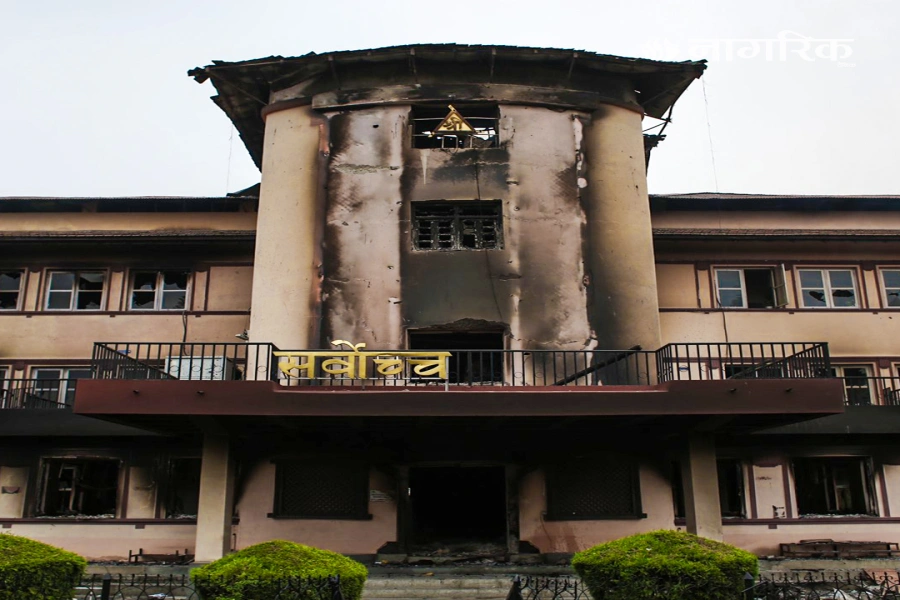
These destructions bear the hallmark of our failure to honor those fundamental principles. They showcase the gross negligence in applying the basic principles of natural science in constructing, operating, and maintaining those structures. Failure of state and non-state actors in formulating adequate policies and codes on earthquake resistant structures, and implementing them accordingly has been exposed.Good news is that we have just learnt our lesson, albeit the hard way. Suddenly, we have started realizing the needs for sound structures constructed on strong foundations, and planned urbanization with wide roads and open spaces. This new-found enlightenment has, for the sake of nation rebuilding, opened floodgate of opportunities and challenges for those who are, or strive to be, the masters in the applied field of natural science.
Among them, our engineers are positioned in the frontline to deal with the aftermath of the devastation. Specifically, civil engineers have found themselves in high demand, particularly, those who have expertise in structural, geotechnical, and earthquake engineering.
In this nation-rebuilding mission, engineers are not the sole players, yet their role is central in reshaping the society. The profession is entrusted with providing safe and comfortable buildings and physical infrastructures for the society to live a comfortable life and to prosper. Yet their failure to adequately apply the law of natural science may lead to another catastrophe in the future.
This raises a question: Are our engineers ready to take new challenges to inspire and lead the society to the new frontier? Is the pool of our engineering resources sufficient and capable to meet the demands and aspiration of the society?
Out of 16,000 engineers registered with Nepal Engineers Association (NEA), many are working overseas. They may not be readily available for the nation rebuilding. Among the available engineers, structural engineers reportedly number around 400, and geotechnical engineers constitute a fraction of that number. By any standard, these figures are far from adequate to meet the present national demand.
On the positive side, there should be no real issue on capability of our engineers. They are among the country's best brains. Nepal's brightest students have historically opted for the engineering field. And that trend has not reversed to date. Unlike in some other countries, our society views civil engineers with high regards.
But all is not well. How many of our engineers have got the opportunities for adequate training and experience in designing, constructing, retrofitting, maintaining, supervising, and inspecting the earthquake-resistant structures and their foundations? How often have they got the opportunity to apply those skills into practice? And how often are they compelled to ignore one or more of the basic design steps: subsoil investigation, loading tests, foundation design, and structural calculation?
That's not all. Have all 'experts' gained self-confidence in the profession from the quality of their expertise, or merely from their function and position? And how often do they play the role of self-appointed 'expert', drifting into field of expertise other than their own despite their lack of specific knowledge? There were many cases of an architect or a structural engineer purporting to act as, or undermining the role of, a geotechnical engineer.
These issues touch the core of the profession. If we are to tackle them, we all have our role to play.
Our engineers should not be afraid to take the emerging challenges. They should upgrade, and reinforce their skill and knowledge, and should not hesitate to involve into life-long learning process—updating themselves on applications of new theories, practices, and technologies, and applying them into practice.
Academic institutes should focus on creating competent engineers. Besides hiring qualified faculties, furnishing adequate facilities and designing adaptable courses, the institutes should also ensure that only capable students get admitted. Faculties should be encouraged to conduct quality research by providing essential resources and opportunities, and by tying up with private sector and reputable foreign institutes.
NEA has a central role to play in the professional and ethical development of engineers. It should be proactive in advising and assisting the government in formulating policies, and in drafting codes and standards. NEA should create wide opportunities for interactions among the practitioners, researchers, and other stakeholders. This may be done by publishing quality researches, and by organizing seminars, workshops, and conferences, both at national and international level.
The state has the longest to-do list. It must formulate and codify relevant policies, enhance institutional capabilities of its machineries, and objectively regulate the system. Steps should include introducing mandatory exam-based licensing system, establishing an independent institution to regulate the system, and imposing specific license requirement for specific type and class of work. To reverse the brain drain, the state should encourage the overseas Nepali engineers to return, by creating for them at home the opportunity they deserve.
The state should regulate the functions of private (and governmental) engineering institutions. Finally, it must ensure that the engineering education is accessible and affordable to the best and the brightest students across the country.
The author is an Environmental and Safety Engineer
sandhyaregmi2000@gmail.com
Related story
Himalaya College of Engineering wins the First National FPGA De...