

KATHMANDU, Oct 21: The festival of lights, Tihar—also known as Yam Panchak—has formally begun from Saturday. It is the second-largest festival celebrated by Hindu Nepalis and usually falls between mid-October and mid-November.
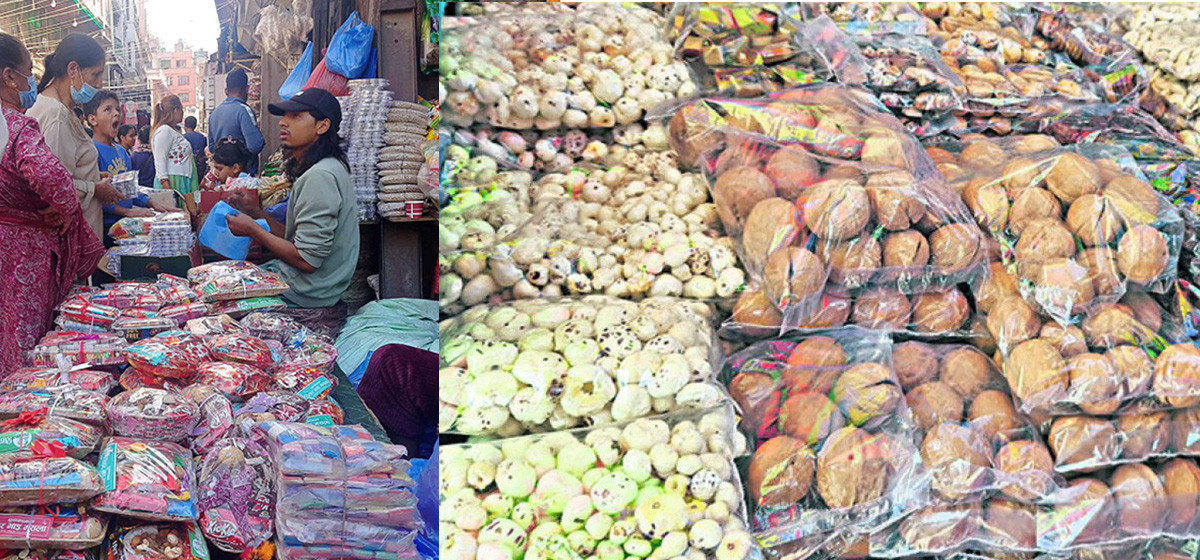
With the festival kicking off, the market for Bhai Masala has become vibrant. During Bhai Tika, sisters apply tika to their brothers and present them with Bhai Masala, which typically includes cashews, raisins, walnuts, almonds, chocolates, betel nuts, coconuts, and puffed lotus seeds.
Major shopping hubs like Asan and Indrachok in Kathmandu are packed with people buying festive essentials. This year, the prices of Bhai Masala have skyrocketed compared to last year, leaving consumers frustrated.
Rajya Laxmi Paudel, who came from Dhapasi to Asan for Tihar shopping, said the prices of almost all items have skyrocketed. “Everything costs double this year,” she complained. “The same Tihar items we bought last year are much more expensive now.”
Sunita Khatri, who hails from Balkot, Bhaktapur, also expressed disappointment, saying she couldn’t shop as freely as she had hoped because prices had surged tremendously.
The rising cost of these items has made it difficult for many families to afford them.
Bhai Masala prices increase by 30 percent this year

“The price hike has affected ordinary families,” said Bhaktapur resident Babita Basnet. “The amount of money that was enough to prepare masala for four brothers last year barely covers two this year.”
According to traders, prices have surged due to reduced domestic production and higher import costs. Retailers in Asan, Indrachok, Khalte, and Kalimati reported noticeable increases in the prices of spices, nuts, and sweets.
Rajendra Oli, a trader from Balkot, Bhaktapur, who has been in business for five years, said the price of Bhai Masala has risen by about 20 percent. “Prices have gone up, and sales have slowed,” he said, adding that current economic conditions might have contributed to the decline in business.
Chandra Shrestha, a trader from Thimi, Bhaktapur, who has run a shop in Asan for 50 years, said, “In the past, we used to be busy nonstop for three or four days before Bhai Tika. This year, due to higher import prices from India, retail prices have risen by about 10 to 15 percent.”
He added that cashews, lotus seeds, and walnuts have become particularly expensive, and demand for them has dropped by around 20 percent. Shrestha also noted that Bhai Masala is now available in many parts of the city, which has reduced Asan’s trade dominance.
Meanwhile, locally produced items like walnuts, corn, bananas, and ingredients used in chatamari (a Newari dish) have gained popularity. Younger customers increasingly prefer pre-packed Bhai Masala sets for convenience.
Trader Suvarna Shrestha said ready-made sets sell better than buying each item separately. “Customers want convenience,” she said. “Pre-packed masala sets make sales easier.” However, she added that overall sales are lower this year, though she hopes for improvement by Bhai Tika.
Online orders for Bhai Masala have also increased this year, with some retailers offering home delivery services. Sharmila Khatri, a trader in Asan for 20 years, said the rise of online shopping has reduced in-person customers. “Earlier, we could barely keep up with the rush. Now, we’re just watching,” she said.
Khatri added that Bhai Tika represents love, care, and duty, and despite inflation, the festival still brings festive energy to the markets. Shops in Asan, Indrachok, New Road, Kalanki, and New Baneshwor remain busy from morning to evening, with cashews, raisins, dried meat, betel nuts, and walnuts being the top-selling items.
According to the Department of Customs, during the first three months of the current fiscal year, Nepal imported Bhai Masala items worth Rs 1.62 billion, weighing 14.3 million kilograms.
This included cashews worth Rs 178 million (187,653 kg), peanuts worth Rs 237.9 million (111,000 kg), and walnuts worth Rs 246.4 million (347,160 kg). Similarly, pistachios worth Rs 40.6 million (200 kg), betel nuts worth Rs 470.9 million (1,679,000 kg), cloves worth Rs 267.3 million (77,827 kg), and large cardamom worth Rs 114 million (22,653 kg) were imported.
During the same period of the last fiscal year, spice items worth Rs 1.46 billion, weighing 8.52 million kg, were imported. In that period, cashews worth Rs 260.16 million (298,946 kg) and peanuts worth Rs 186.45 million (232,694 kg) were imported.
Similarly, walnuts worth Rs 209.83 million (607,225 kg) and areca nuts worth Rs 216.23 million (1.71 million kg) were imported.
In addition, coconuts worth Rs 317.52 million (5.4 million kg), cloves worth Rs 164.55 million (214,537 kg), and large cardamom worth Rs 99.43 million (37,183 kg) were imported.
According to the department, the total import value has increased in the current fiscal year compared to the previous one due to the rise in prices.
They also stressed the need to strengthen market monitoring during festivals like Tihar to minimize the growing tendency among traders to focus on profit rather than fair competition.


