

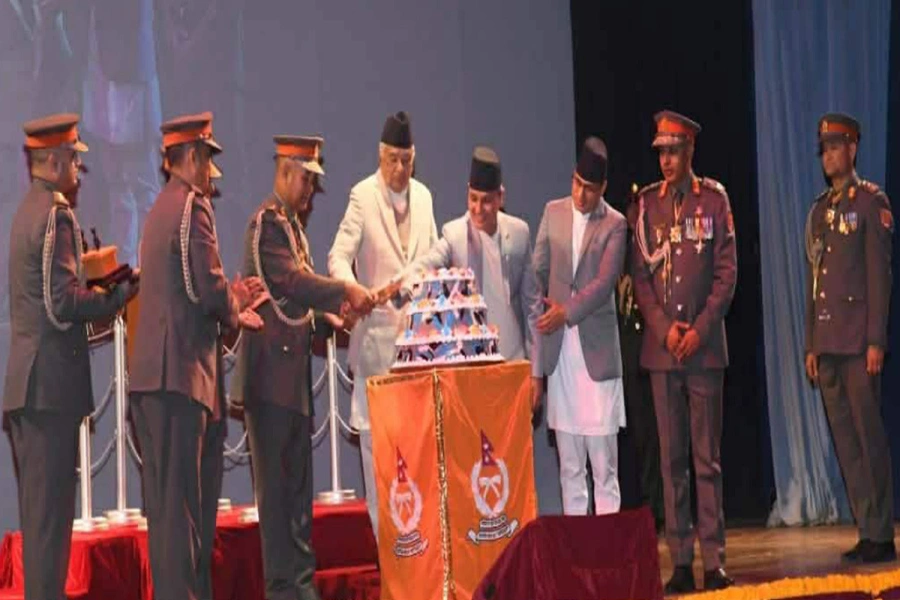
KATHMANDU, Jan 24: The Armed Police Force (APF) has marked 25 years of service, navigating challenges, clashes and change along the way. On Friday, the APF celebrated its Silver Jubilee with programs and congratulatory exchanges.
The APF was born out of necessity during the armed rebellion initiated by the then CPN (Maoist) in 1996. As the insurgency intensified, the Nepal Police struggled to maintain law and order and officers were increasingly targeted by rebels—underscoring the need for a paramilitary force.
A turning point came on October 24–25, 2000, when Maoist rebels captured Dunai, the district headquarters of Dolpa. Fourteen police personnel were killed, 40 were injured, Rs 60 million was looted from Nepal Bank and the residence of the Chief District Officer was destroyed. Despite prior intelligence, the government failed to prevent the attack. When Prime Minister Girija Prasad Koirala’s request to deploy the army was denied by the royal palace, the concept of a dedicated armed police force was finally realized.
Arjun Kapoor: I don’t have a dream role

On January 22, 2001, the APF was formally established to maintain peace, protect lives and property and uphold freedom—tasked with defending both citizens and democracy itself. Born in a democratic era, the APF continues to operate within democratic principles.
This paramilitary force was created following the recommendations of the “Armed Police Service Formation Suggestion Taskforce–2056 BS,” chaired by then Home Secretary Khem Raj Regmi, and formalized through the “Armed Police Force Ordinance, 2057 BS” issued by King Birendra Shah.
Initially operating under royal oversight, the APF witnessed the nation’s transition to a democratic republic during the 2006 movement against the active monarchy. It is a paramilitary force that bridges the roles of the Nepal Army and Nepal Police, designed to respond to challenges the other forces could not fully address.
At its inception, the APF drew personnel from both the army and police—about 120 from the army and around 10,000 from the police. The first Inspector General of Police (IGP) was Krishna Mohan Shrestha, who was tragically killed by Maoist rebels in 2003 during a morning walk. Today, under IGP Raju Aryal, the APF has grown to over 37,000 authorized positions.
Over the years, the APF has expanded its role beyond countering insurgency. It now maintains permanent and temporary bases near brigades, border areas, and strategic locations. Under Section 6 of the Armed Police Force Act, 2058 BS, the force is empowered to manage law and order, counter rebellion and terrorism, control riots and crowds, provide disaster management, and secure borders. Additional mandates over time have included revenue, customs, industrial, and railway security.
The APF currently secures borders through seven reserve battalions, 45 border security offices, and 215 posts. Programs such as “Armed Police with Border Communities” enhance international border security, while the force has established itself as a key player in disaster response.
The APF also acts as an auxiliary to the Nepali Army in cases of foreign intervention and is designated by the constitution as a central security force. As federalism evolves, the force continues to adapt strategically to emerging security challenges and operational gaps.
Marking its 25th anniversary, the APF celebrated its Silver Jubilee with President Ram Chandra Paudel as the chief guest, reflecting on a quarter-century of service, sacrifice and dedication to democracy.




_20230114102317.jpg)


