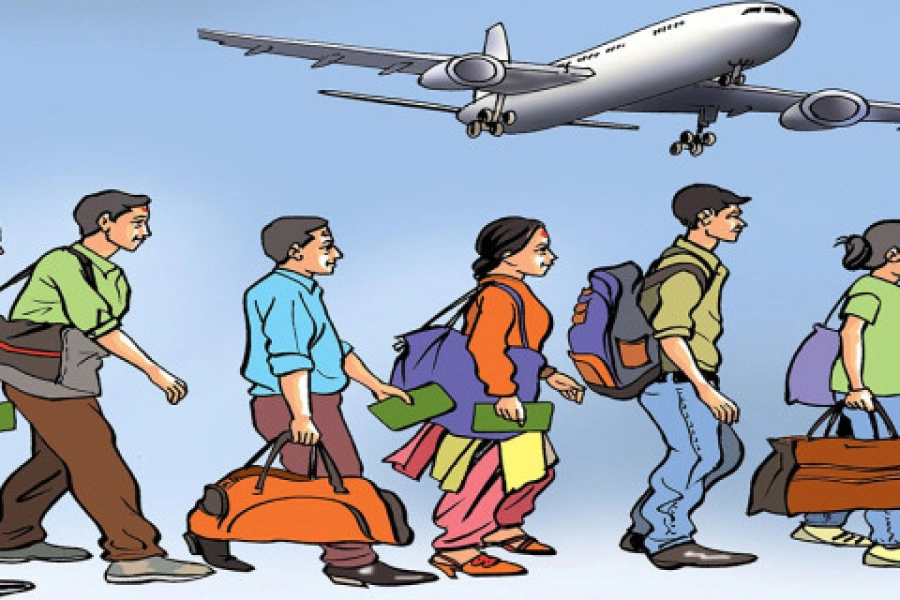
After almost seven years, though I haven’t quit pursuing my “rocket scientist idea” of working with the National Geographic, I couldn’t agree more with Dr Yonzon.
Ms Mahat’s suggestions on educational loan – especially when many youths discontinue their education because of lack of funds – by the government is commendable, but her idea of procuring loan lacks pragmatic judgment. At times when the government cannot procure back loans from businessmen, who evade hundreds of thousands of rupees from Birtamod Bank and start a business in Birgunj, less than 100 kilometers away, how can Ms Mahat expect a “medical graduate” who is “thousands of miles away” to repay back his/her educational loans?
Having said that, let’s get to the main gist of this article – a lot is said, written and talked about brain-drain and youth going out of the country but we seldom talk or write about what is leading the youth to go out of the country or keeping the skilled youth from coming back to the country.
WHY DO PEOPLE LEAVE THE COUNTRY?
The answer is a no brainer. Better job opportunities, better pay and benefits, better living conditions. There is no denying that we are a poor country and the decade long civil war, current political deadlock and social unrest has added fuel to the already dilapidated security and lawlessness. Hence, the youth today just needs a reason to leave the country – be that for higher education, for work, or just because their “peers” are going abroad because everybody else is going and a large number of youths are leaving because of the current security situation of the country.
Why people leave the country is universal. But the million-dollar question is: Why do most of the people who go to a foreign country never return?
Everyone might have a different answer. But a common answer, one of my friends gave, during the mid-nineties, which should match with most of the people, was as follows.
The major question that haunts the minds of those who are planning to return is whether or not the education and/or experience that they gained abroad will land them in a decent job.
After spending about two years in one of the Middle Eastern countries, my friend was back with “some experience”, a good “understanding” of the “value of time and money”, attitude to “do something”, and of course with “some money”. He was of the opinion that if similar hard work is done in the home country, then no one needs to go abroad. He confided that he would not go back and would invest the “hard-earned money” in a small business and would live happily ever after in the home country with his family.
Next Dashain vacation, when I was home, he was already gone.
When I met him almost after two years, I reminded him about his plan of starting a “small-business” and living with his family in his “home country”. He was a little apologetic. But he gave me all the reasons to go back – the-then “political situation”, “bribery, nepotism and favoritism”, and the problem of “water, electricity and security”. He also said that instead of approving the loan on the basis of his business plan, the banks, at times, made it difficult even to withdraw his own money. He also said that he fought with the “system” for a while but as it was difficult to fight at every step, he decided to go back as he had the “option” to go back.
The story of my friend must have matched with many youths who have either returned from abroad or those who are in the process of returning home. The major question that haunts the minds of those who are planning to return is whether or not the education and/or experience that they gained abroad will land them in a decent job. Another problem is that the returnees or the ones who are in the process of returning compare Nepal with the place they are in right now – and unfortunately with the exception of the closeness with family and friends, Nepal fails in all other comparisons.
We have to seriously consider the three things that my friend said. First – the problem in our “system”; the second – the “option” that an abroad returnee has to return; and the third – if a “Middle Eastern Country” returnee does not like the “system”, then will the US/Europe educated returnee like our “system”? This is justified by the fact that most of the abroad returnees come back with the “option” to “go back”. This option is either in the form of a “return visa” already got from the country or in the form of the likelihood of getting the “return visa”. This, in turn, says that most of the youth who go abroad do not want to come back to Nepal, those who do come back only for a temporary “vacation”.
YOUTH PERSPECTIVE
We need to understand the “youth perspective” to understand why the youth does not want to return to the home country. Today’s youth – who consider patriotism as “hollow” – is more motivated by “career”, “independence” the “ability to do something”. Except for some exception – most of the youths – because of this, put patriotism as the second priority that entices them to wait for the opportunity abroad. Today’s youth, who believe that perseverance and persistence will land them to their dream job, opt to wait for “years for an opportunity” in a foreign land than return to their homeland where they understand that without “buttering” somebody “influential” they won’t get a decent job.
However, the blogs and internet forum discussions among the Nepalis scattered all over the globe show that they are equally concerned about the ever deteriorating conditions of the country. These discussions also prove that they are equally interested to apply the knowledge and experience gained abroad for the betterment of the country. Like the youths all over the world, Nepali youths like to show their energy and confront the challenges. The only thing common among the Nepali youths that ignite the tires, torch the vehicles, intimidate and kill people all over the country to that of the Nepali youths that work hard abroad to learn or to send money home is the willingness to show their strength. It’s up to our leadership to decide whether to utilize the energy of our youths to torch vehicles or to utilize it for nation-building.
Related story
Ministry of Youth and Sports in collaboration with UN in Nepal...