

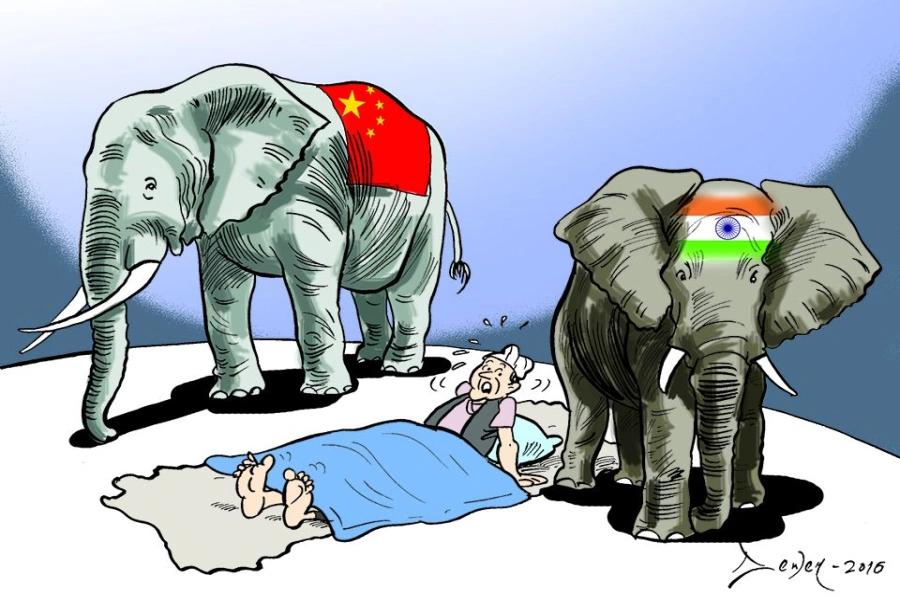
The Sino-Indian “bonhomie”-Hindi-Chini Bhai Bhai which marked the 1954 visit of Prime Minister Jawaharlal Nehru to China, proved to be short-lived. There was a deadly border war between China and India in 1962. Chill in diplomatic relations ensued, only to be restored in 1979. Strained bilateral relations saw little improvement despite several rounds of talks at various levels. Indian Prime Minister Rajiv Gandhi’s landmark visit to Beijing on December 21, 1988 generated high expectations, setting in motion the concept of a ‘China-India Century of Cooperation’ –an Asian century to be jointly led by India and China in the twenty-first century. This optimism coincided with the initial signs of Asia’s economic resurgence.
Eminent political scientist Bhabani Sen Gupta recorded Prime Minister Gandhi’s meeting with Chinese paramount leader Deng Xiaoping. Deng is noted to have clasped Gandhi’s hands for three minutes, addressing him as “my young friend.” Deng said, “You are young. You are the future. We are receding into history. There is a new generation of leaders now and a global desire to live in peace and end conflict and tensions. It lies in your hands to shape the destiny of the new world order. Use it wisely.” Deng added, “We have both made mistakes and we can learn from each other. Why cannot we share our experiences, our successes and failures? There is much we can achieve together. We can achieve nothing by being antagonists?”
Despite occasional low intensity skirmishes, stability at the border was largely maintained through confidence-building measures and numerous bilateral mechanisms in the following years.There were also informal summit meetings between the leaders starting in Wuhan (2018) and Mahabalipuram (2019), during which “direct, free, candid” exchange of views between two countries took place something that might not have happened in the formal format. Reports indicate over 19meetings between Chinese President Xi and Indian Prime Minister Modi since they came to power.
However, the border clash of June 2020 put a brake on this stability along the disputed Line of Actual Control (LAC). It has been the most serious crisis witnessing the loss of lives for the first time since 1975. India resisted Chinese aggression and revised its security posture with enhanced engagements with Washington and its friends. China blamed India for the border clash in which India lost 20 of its security personnel. Beijing only confirmed the death of four Chinese soldiers eight months after the clashes occurred. Whereas India maintains that bilateral relations cannot progress without first ensuring peace and tranquility at the LAC,Beijing wants the border dispute to be treated separately from the broader bilateral relationship.
Various aspects of India-China relations suffered from the border clashes of 2020. India restricted Chinese business activities including prolonged restrictions on Chinese companies that continued through 2024. This is reflected in New Delhi reducing Chinese economic activity and maintaining a more guarded stance. According to the Indian Ministry of External Affairs, the number of Indian students in China dropped to 5,000 in 2024 from 200,000 in 2019- a trend going against the spirit of strengthening people to people ties. The Brookings Institution noted that Chinese investment in India once as high as USD 8 billion has largely stagnated. The two countries are unlikely to see a quick return to their pre-2020 economic relationship, despite a recent breakthrough made on the border issue and the restoration of direct flights.
Looming crisis in Gulf dims prospects for Nepali economy

The India-China relationship is basically asymmetrical across economic, diplomatic and military spheres. They are at different levels of development. China is the world’s manufacturing power house, and largest trading nation. It is worth noting that when China launched its economic reforms and opening up of its economy in 1979, India and China were at the same level of development. Experts argue that Indian public and private sectors had an initial edge in areas like electronics and computers. While India was not able to fully capitalize on its position in the 1970s and 80s. China continued to surge ahead with three decades of near double-digit growth.
While strategic and border tensions persist, economic ties look booming. India remains one of China’s largest trading partners with a substantial trade imbalance, its trade deficit with China running to $99.2 billion as of March 2025. Indian imports include among others specialized equipment like tunnel boring machines and rare earth magnets. Experts suggest that increased Chinese investment could be crucial to boosting India’s domestic manufacturing and helping reduce this growing trade gap.
October 21 Sino-Indian border patrol agreement is a positive turn in bilateral relations. Nevertheless, the deep strategic mistrust will continue to constrain the economic engagements. Despite recent signs of warming bilateral relations, a diplomatic row has erupted between India and China after an Indian student was detained at Shanghai Airport because her passport listed her as a resident of the Indian state of Arunachal Pradesh. China calls Arunachal Pradesh as Eastern Tibet. China continues to offer diplomatic and military support to India's neighbor and congenital enemy Pakistan.
In the larger theater of the Asian continent, India, China and the United States will be the main players. As their interests intersect, they will have to be managed in a competitive world. India needs both China and the United States for Indian membership of the UN Security Council. As an old Chinese saying goes, “one mountain cannot accommodate two tigers,” China does not want India to become a member of the UN Security Council, Asia-Europe Summit (ASEM) and the Asia-Pacific Economic Cooperation (APEC) and emerge as a peer competitor. China also wants India not to get closer to Washington. Cooperative and competitive relations between them are likely to continue in days to come. Competition between them comes with a variety of complex interactions.
The 73-day-long standoff in Doklam between India and China in 2017 was seen as a part of India’s strategy to maintain its influence in South Asia. Recent years have witnessed that contest and competition in their positional and territorial tensions. China’s all-weather friendship and enduring strategic relationship with Pakistan stands as the most important constraint on India’s search for security and status in Asia. India has its own aspirations to maintain its own sphere of influence in South Asia.
The exchange of visits in recent months at various levels indicates a demonstration of goodwill towards each other.In August 2025, Indian Prime Minister Narendra Modi made his first trip to China since the June 2020 border clashes. Though the visit was primarily to attend the Shanghai Cooperation Organization (SCO) summit, its timing carries significant geopolitical interpretations. They include among others the imposition of US punitive tariffs against India for its continued purchase of discounted Russian oil, and state of Indo-US relations and China-US relations, possible formation of Russia, India and China (RIC) which is viewed with concern in Washington. Of the three countries in the RIC group, India is seen as one of the most pro-American nations including in the BRICS, and also a member of the QUAD- though its summit meeting to be held in India remains uncertain given the current state of Indo-US relations.
The China-India relationship holds enormous economic potential, given that these two Asian giants are home to 40% of the world’s population, commanding huge markets with over 2.7 billion people. However, restoring mutual trust and returning to pre-June 2020 relationship levels will require significant, and sustained political will and effort at the highest levels.The late Indian Prime Minister Dr. Manmohan Singh once said that the sky was big enough for both China and India to grow together. Indeed the future of the Asian century depends on how these two Asian giants will cooperate.
Nepal in prism of its neighbors
As a nation, strategically located between two great powers-India and China, Nepal places its relations with its immediate neighbors at the highest priority of its foreign policy. India and China together with the United States, are global engines for transformation. For countries across the world, engagement with these powers has become an indispensable part of modern diplomacy. Nepal seeks to deepen its historic relationships with them while remaining constructively engaged with the wider international community to earn their trust and confidence for bettering the lives of its people. It must also fully comprehend their inner workings and understand how they operate and assess how their interactions-especially amid shifting global forces-influence Nepal’s national interests.
Nepal welcomes the growing cooperation between its neighbors. Nepal, India, and China are members of the United Nations; uphold multilateralism and advocate for a multipolar world to safeguard their national interests. Nepal remains ready to facilitate their cross-border trade and people to people exchanges within the overall framework of a rule-based liberal international order.
However, Nepal has been taken for granted. The inclusion of Nepal’s territory-Lipulekh-in bilateral agreements-between India and China, with a view to "enhancing border areas cooperation through border trade, pilgrimage by people of the two countries (India and China) and other exchanges" in 2015 and then again earlier this year, without Nepal’s knowledge or participation, runs counter to international norms. India and China working bilaterally to use a Nepali territory without consultation or consent constitutes a violation of Nepal’s sovereignty and territorial integrity. Extracting concessions without consent undermines the very international norms and rules that both countries publicly claim to uphold.





-1782782519.webp)


