KATHMANDU, Aug 18: Paddy plantation has been completed on 94.15 percent of rice fields across the country as of mid-August this year, down from 98.44 percent during the same period of the last Fiscal Year (FY).
The decline in plantation is attributed to the prolonged drought in the Terai region and erratic rainfall in many parts of the country. According to the Department of Agriculture (DoA), Sudurpaschim Province recorded the highest rate of paddy plantation at 99.72 percent, while Madhesh Province saw the lowest at 86.35 percent.
Plantation completed in 50% of paddy fields in 14 districts
Prakash Sanjel, director general of the DoA, said the slow plantation in Madhesh Province was due to the delayed monsoon this year. Citing prolonged drought conditions that severely affected drinking water, irrigation, and agriculture until the last week of July, the government even declared Madhesh Province a disaster-affected zone. According to Sanjel, the plantation ratio could increase slightly as the monsoon typically lasts until the end of August.
So far, Karnali Province has achieved 99.34 percent plantation, followed by Lumbini Province with 98.07 percent and Bagmati Province with 97.27 percent. The figures for Gandaki Province and Koshi Province stand at 94.83 percent and 94.42 percent, respectively.
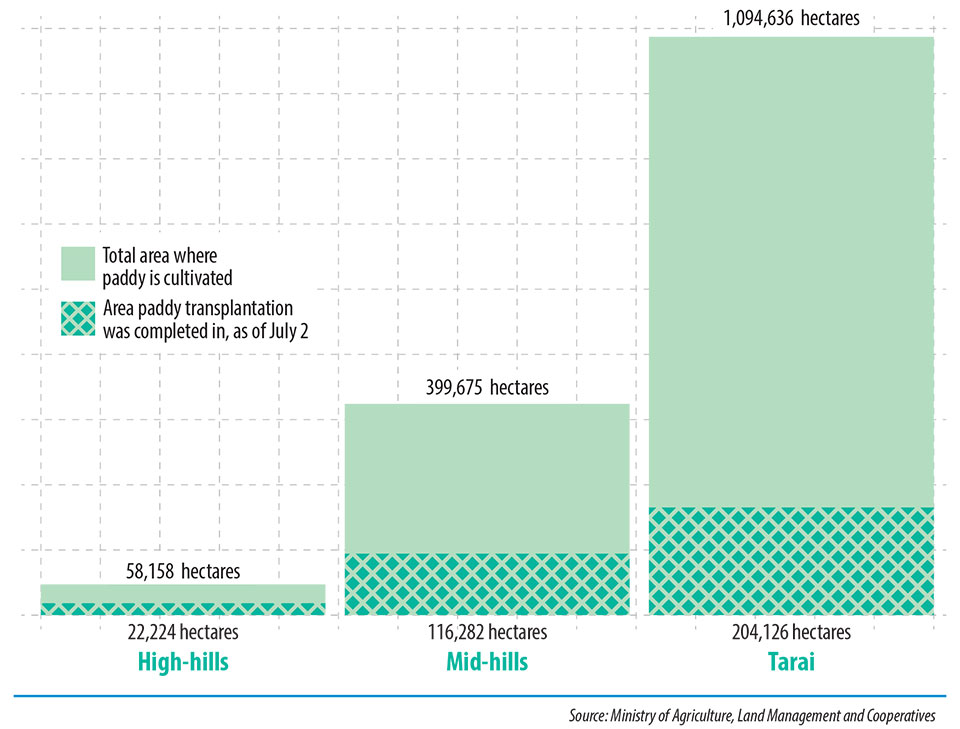
Statistics from the Ministry of Agriculture and Livestock Development show that paddy is cultivated on 1.4 million hectares of land nationwide. As of now, plantation has been completed on around 1.3 million hectares.
The Terai region is considered the most suitable for high-yield rice production. It supplies an estimated 70 percent of the staple food, with the remaining 30 percent coming from the hilly areas.
In FY 2023/24, the country produced 5,724,234 tons of paddy, which was expected to increase by 4.4 percent compared to the previous year. According to estimates, a total of six million tons of paddy will be produced this year, yielding 3.5 million tons of rice.


-1200x560-1779899638.webp)








-1779842101.webp)


-1779943688.webp)