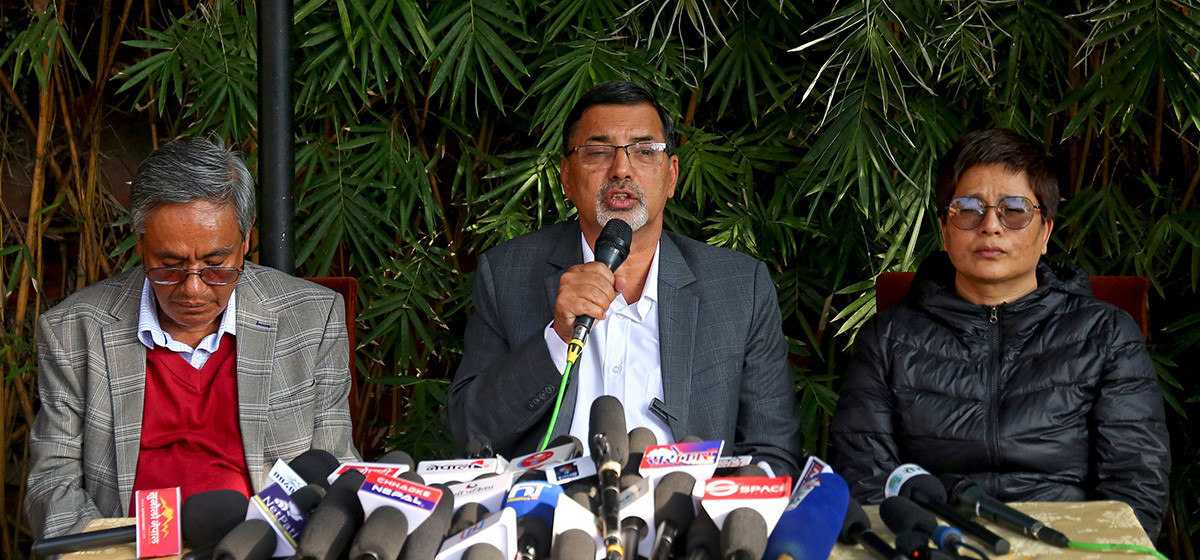
KATHMANDU, Nov 17: The CPN-UML has completed preparations for its two-day national gathering, scheduled to begin on Wednesday, tomorrow. The party announced the preparations had been finalised at a press conference on Monday.
Party Chair and former Prime Minister KP Sharma Oli will inaugurate the gathering at Maitighar in Kathmandu. More than 3,000 party leaders, cadres and elected representatives from across the country are expected to attend. The event is increasingly being viewed as more than a routine organizational program, with significant political implications for the party.
Since the Gen Z uprising in September 2025, UML has been pushed out of power. It also failed to secure a favorable outcome in the House of Representatives elections held in March 2026.
The poor electoral performance triggered prolonged internal disputes among senior leaders, deepening frustration within the party. With its organizational machinery largely inactive, the upcoming local elections could pose another major challenge.
Against this backdrop, UML has sought to contain its internal disputes and present the gathering as an opportunity to strengthen ideological and organizational unity.
Chair Oli will analyse the current political situation and outline the party's future direction. Senior leader and former President Bidya Devi Bhandari will also share her views on contemporary political issues and the party's responsibilities.
Vice Chairs Ram Bahadur Thapa and Bishnu Paudel, along with General Secretary Shankar Pokhrel, will present working papers on the party's parliamentary role, a review of its previous government, internal reforms and organizational strengthening.
Unity restored between parallel NRNA committees in South Korea
The party has assigned responsibilities to Oli, Bhandari and other senior leaders in an effort to maintain the internal balance of power.
Bhandari had sought to return to active UML politics during the party's general convention held shortly after the Gen Z uprising. However, Oli blocked her return, arguing that someone who had served as head of state should not re-enter active party politics.
After Bhandari was prevented from returning, leader Ishwar Pokhrel challenged Oli for the party chairmanship. Following UML's poor performance in the February elections, several leaders considered close to Oli, including Bishnu Prasad Paudel and Shankar Pokhrel, also began opposing him. Their shift in position put Oli under pressure.
It was during this period that Bhandari returned to active party politics as a senior leader. Her presence and role have since attracted considerable attention. Now, both Oli and Bhandari are scheduled to address the gathering from the same platform.
Party leaders claim their joint appearance will help ease growing tensions and send a message of unity within UML.
General Secretary Pokhrel has said the gathering is intended to unite the party and move forward rather than make new decisions.
Speaking at a press conference at the party's central office in Chyasal, he said the national gathering would bring the entire organisation onto a common political course.
"The national gathering is not a forum for making new decisions. Its purpose is to implement the decisions already taken by the party uniformly and move the entire organisation forward with a common political direction," Pokhrel said.
However, Oli and Bhandari appearing on the same platform does not necessarily mean that the party leadership has reached a political understanding.
Whether the two leaders have agreed on leadership styles, participation in decision-making and the question of future leadership remains a more significant issue.
Another challenge for UML is conducting an objective review of its electoral defeat. Party members argue that organizational reform will remain difficult if the results are explained merely in terms of an unfavorable political environment or the opposition's influence.
Leaders have repeatedly raised questions about why voters abandoned UML, why the party has become less attractive to younger generations and why its organizational influence has weakened at the local level.
Those holding views different from Oli's have continued to argue that his departure is necessary. However, the agenda released by UML prioritizes preparations for local elections, organizational strengthening and establishing a common understanding of political issues.
This raises another question: will the party accept dissenting leaders and cadres as a natural part of its organization, or will it restrict them in the name of discipline?
Whether the two-day gathering becomes a common platform for reviewing past mistakes and charting a new course, or remains an exercise in testing competing power bases, will become clearer in the coming days.
At Monday's press conference, UML said the gathering would focus on preparations for the upcoming local elections, strengthening ideological and organizational unity, and establishing consistency in party decisions, political understanding and perspectives.
A press statement distributed at the event said the gathering also aims to counter the growing sense of misgovernance and public frustration in the country and generate renewed hope and energy.