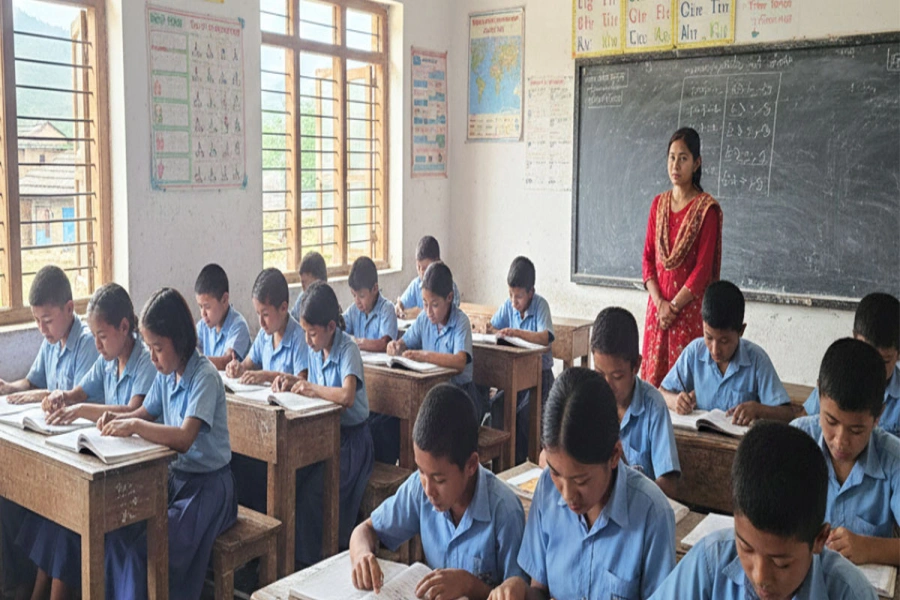
The government has spent Rs 2.676 billion over four years on teacher capacity development. Yet the National Assessment of Student Achievement (NASA), conducted by the Education Review Office, shows that student learning outcomes remain poor. As many as 78 percent of Grade 5 students fall below the minimum proficiency level in mathematics. In Grade 10, the figures are equally concerning: 60 percent of students fail to meet the minimum proficiency level in mathematics, 50.1 percent in science and 53.8 percent in Nepali. The gap between public investment in teacher development and student achievement raises serious questions about the effectiveness of educational programmes and the returns on public spending. Teachers are central to improving education quality. Even a well-designed curriculum cannot deliver results if teachers cannot communicate its content effectively in the classroom. Investing in teachers’ professional development is essential, but conducting training sessions, issuing certificates and spending allocated budgets cannot, by themselves, be considered progress. The real test is whether training improves teaching practices and, in turn, students’ reading, writing and problem-solving skills. Although statistics show that 99 percent of teachers in government schools have received training, learning outcomes remain weak. This calls for a serious reassessment of how training programmes are designed and implemented. Training teachers is one thing; ensuring they apply what they learn in the classroom is another. Unless professional development is linked directly to student learning, the investment is unlikely to deliver its intended results.
Why teachers are important

More training and additional programmes will not solve the problem unless the reasons behind students’ learning difficulties are identified. The fact that so many Grade 5 students struggle with basic mathematics is particularly worrying. Weak foundations in the early grades make it harder for students to grasp more advanced concepts later. By Grade 10, more than half remain below minimum proficiency levels in mathematics and Nepali, raising broader concerns about the effectiveness of school education. This does not mean teacher training is unnecessary. Rather, the government must determine what training is needed, which teachers need it and what improvements it should produce. Instead of offering uniform programmes to everyone, training should be tailored to subjects, grade levels, local needs and teachers’ demonstrated competencies. Practical training should address specific gaps in student learning. The Ministry of Education must establish a reliable system to assess whether training leads to measurable improvements. Evaluations should examine teaching practices before and after training, changes in student achievement and the additional support provided to struggling learners. Schools, local governments, provincial education training centres and the ministry must have clearly defined responsibilities.
The results of the National Assessment of Student Achievement must also inform policy rather than remain confined to reports. Improvement programmes should target the subjects, grade levels and student groups where weaknesses are most pronounced. Regular assessments, additional support for struggling students and measurable indicators of school progress are essential. Decisions about whether learning has improved must be based on sound analysis of evidence. The success of education spending should be judged not by the number of buildings constructed, training sessions held or programmes launched, but by what students can actually do: read, write and solve mathematical problems. Assessing the returns on teacher-training investments is not about blaming teachers. It is about determining whether public programmes are achieving their intended purpose. The government must provide teachers with appropriate training, resources and support. It must also take responsibility for evaluating the outcomes. If billions of rupees spent on teacher development fail to improve student learning, the design and delivery of these programmes must change. Before allocating additional funds, the government should evaluate existing programmes, address their shortcomings and publicly account for their results. Otherwise, teacher training will continue while student learning remains weak—a costly and avoidable failure that demands urgent attention from all stakeholders.