The Humanities and Social Sciences, Jacques Derrida
In this quote, I believe that the writer is trying to explain to us the essences of an educational institution or the major ideas surrounding a university. It tells us what an ideal university constitutes of.
Through this quote, the writer is trying to say that a university is a place where education, the process of learning, is practiced unconditionally. Unlike the situation of education in our country, which constitutes of one-way learning, the quote is trying to stress on the fact that education should be free of all boundaries and restrictions. People or pupils are supposed to be able to ask questions freely in a bid to satiate their curiosity.
I particularly like the writer’s idea that education constitutes of faith, and without this, one cannot learn. There should be faith in what you study because only then will you be able to trust your learning and thus fully utilize it wherever you are.
Bhaswor Ojha
About Gupto
Academic Director at the Institute of Advanced Communication Education and Research (IACER) College, Arun Gupto is also Professor of Literature at Tribhuvan University. Previously, he was also affiliated with various newspapers as columnist. Gupto, who is required to read fiction and poetry by his profession, is also an avid reader of literary theories.
At present, Gupto is involved in a research project on South Asian Studies at IACER College. Hence Gupto has lately been spending most of his time reading books on South Asian art and architecture. The main aim of his research is to promote South Asia through a Nepali perspective by bringing out the various aspects of our culture, architecture and philosophies.
Gupto, who is also a writer, has recently completed two books, which are due to be published soon.
On Gupto’s bookshelf
The Origins of Yoga and Tantra by Geoffrey Samuel
This book mainly compares and discusses the philosophies and components of Yoga and Tantra. These two aspects of meditation are both interrelated yet vary in numerous aspects. While tantra looks at the esoteric and physical aspects of meditation, yoga is a totally different spiritual concept. I believe this book to be of a special importance as both yoga and tantra are practiced in Nepali and South Asian cultures.
Introduction to Buddhist Art by Chikyo Yamamoto
This book, written by a Japanese professor, was a result of extensive research conducted at his Japanese university. The book mainly discusses ideas of Buddhist art, Buddhist traditions and origins of Buddhist culture. This book also wonderfully represents Nepal and its importance in defining the whole concept of Buddhism.
Goddess: Divine Energy by Jackie Menzies
This book mainly explains to us why we worship goddesses in so many forms. It tells us that goddesses themselves are forms of energy. Thus, by giving millions of names to them, we are only describing the various forces of nature in terms of supernatural powers. In this book, there is a particular reference to Salabhanjika, a gesture in the form of a triple bend, which I found quite intriguing. Salabhanjika is a popular form of Nepali art and has quite
Nepali Architecture by NR Banerjee
This book was given to me as a gift by Mandala Book Point. I find this to be of particular importance as it contains the details of all types of temples and places of architectural importance as recorded in Nepal during King Mahendra’s reign. This book was written during his reign in order to document temples for renovation. Since this book was used as a means to document and preserve these structures, it can be used as an excellent reference to Nepal’s art and architectural history.
Devi by Vidhya Derejia
This book comprises a collection of essays written by South Asian and western writers. Here, Devi, meaning goddess, is shown in the form of numerous avatars. It shows us how we can relate Devi with our environment, our ecology, our rituals and festivals. This book mainly tells us how it can vary in the definitions of a Devi, from a figure that signifies strength and fear, such as Goddess Durga, to another cosmic and divine figure, such as Goddess Laxmi.
As told to Nisha Bhatta
Related story
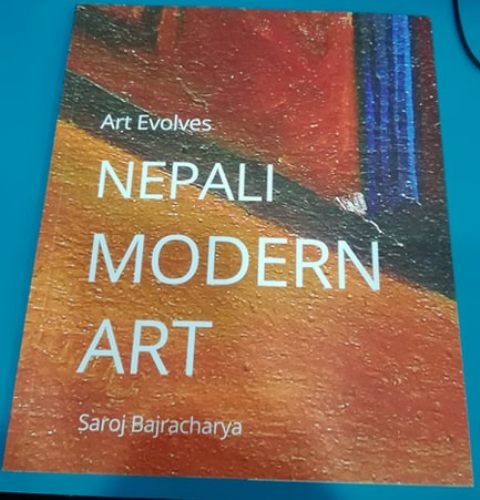
‘Art Evolves: Nepali Modern Art’: Review
_20220508065243.jpg)