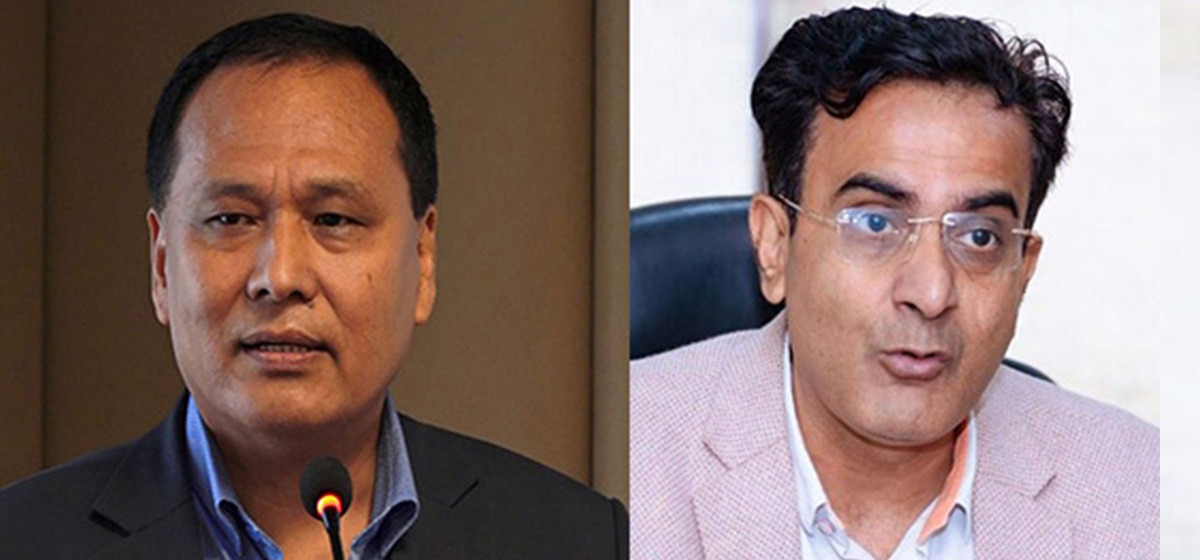
The party leaders expressed their differences over fundamental economic ideology. But citing the looming economic crisis, they said they could agree to ´no strike´ in sensitive industries and work together with a common economic policy and program for a span of three to 10 years. [break]
“Politically speaking, calling for no strike in all industries is not possible. But given national sensitivity, we can restrict labor strikes in key industries,” said Dr Baburam Bhattarai, former finance minister from the UCPN (Maoist).
Speaking at a policy roundtable held on the occasion of the 44th annual general meeting of the Federation of Nepalese Chambers of Commerce and Industry (FNCCI), he floated the idea of ending private ownership of land through state-ownership and leasing out the land to private individuals for productive uses.
However, former finance ministers from other parties, including Mahesh Acharya of Nepali Congress and Bharat Mohan Adhikari of CPN (UML), did not agree.
Instead, Acharya pushed for the parties to adopt a principle of ´no intervention´ in the business and economic sectors. “Differences on the political front must not act as a brake on the economic front. Unfortunately, that is what has happened in Nepal,” he said.
He opined that strong commitment to ´no political intervention in industrial affairs´ and ending all forms of political constraint will instantly create the basic environment for investment, thereby spurring industrial activity.

As for export promotion, he along with former governor of Nepal Rastra Bank Dr Tilak Rawal said that the parties will need to collectively address structural problems like electricity supply and provide fiscal support as well. Dr Rawal laid emphasis in particular on subsidy and fiscal support in the agricultural sector, particularly livestock, for replacing imports.
While Acharya expressed dissatisfaction with the weak monitoring capacity of regulatory bodies and lack of pro-activeness in the bureaucracy, Adhikari pushed for the parties to work out a common economic agenda and implement rules in order to avert an economic crisis.
Dr Prakash Chandra Lohani, former finance minister and co-chairman of Rastriya Janashakti Party, urged all the parties to respect the law and ensure equal enforcement of the law on all, irrespective of political affiliation and status.
“This is very crucial for restoring the law and order situation,” he said and also urged all political parties to say no to appointing party men in public enterprises.
Dr Lohani also laid emphasis on the enforcement of competition law and urged the parties to come together to do away with supply problems so that people could feel a price relief and the workings of a fair market.
Prime Minister Madhav Kumar Nepal inaugurated the AGM.
Speaking at the function, FNCCI President Kush Kumar Joshi urged the government and the parties in opposition to improve the security situation, restrict strikes at least for two years and ensure year round uninterrupted supply of electricity in industry.
Related story
Cement, steel industries in trouble as demand stagnates


-1779178226.webp)