“It was only much later that I realized how mediocre those translations were. I felt cheated that my sole window to the global literature scene had been a grimy one,” says Yuwaraj Nayaghare, an acclaimed essayist.[break]
It is believed that there are more than 6,000 active languages in the world at present. It would be an impossible feat to learn them all in a lifetime. However, translation makes it possible for readers to acquaint themselves with the global literary scenario.
Ever since the Holy Bible was translated from Hebrew into Latin, Greek, English and other languages, translation has come across as one of the most powerful means of communication. We, as Nepali readers, have been introduced to masterpieces from Europe, Asia and Africa through translation. However, there are questions being raised about making our literature an international affair.
Writer and Professor of English and Translation Studies at Tribhuvan University, Dr. Govinda Bhattarai says that unlike European nations such as England, France and Germany and Asian countries like Japan and China, Nepal’s literary history is only a little more than a hundred years old. Further, the trend of translating Nepali books into foreign languages like English is at an infantile phase, this owing to the fact that there are very few people around who are proficient in both English as well as Nepali.
“We’re still very young in this field. And after Mahakavi Devkota, there have been very few litterateurs who have had an equally powerful command over both English and Nepali,” claims Bhattarai.
Translation is a tricky business indeed. When you translate something from one language to another, you do not just jot down the words that mean the same in different languages. It also means that the translator has to shoulder the responsibility of bringing in the same flavor, mood, ambience and sentiments that the original contained, sometimes at the cost of making some alterations as per the text demands.
This technique is sometimes visible in drama, which is considered one of the most complicated genres when it comes to translation, second only to poetry. One popular instance is when Ibsen’s “A Doll’s House” became “Putaliko Ghar” and the Christmas celebrations in the original play were converted to Tihar revelries in the translated version.
Bal Bahadur Thapa, Lecturer of English at Tribhuvan University, has translated and edited popular Western dramas like “Desire Under the Elms” and “‘Night Mother.” He thinks it is important to localize an international work so that it fits the mindsets and imaginations of those readers and audience that are from an entirely different cultural context. However, at the same time, it is also necessary to keep it as close to the original as possible.
“In theater, it’s called the art of adaptation. For example, in ‘Night Mother,’ when one of the characters makes some hot chocolate, we had to change it to ‘kheer’ to suit the Nepali taste and context,” he elaborates.
Nayaghare opines that in stories, novels and essays, this problem can be solved just by italicizing the concerned word and providing a footnote regarding its position and significance in that particular culture and society. Universal feelings like love, jealousy and bravery are understood everywhere. But when it comes to colloquial terms and local dialect, one needs to be as explanatory and elaborate as possible. He, who has now started reading the English translation of Nepali books, feels that there is ample room for improvement in terms of information provided.
“It doesn’t do to just translate our ‘tulsi’ as ‘basil,’ or worse, ‘a kind of plant.’ It’s always better to provide a little more information about its religious and spiritual connotations in Nepali tradition,” Nayaghare explains.
This may turn out to be extremely beneficial not just to the international readers but also to that large group of native readers that finds it more comfortable to read in English than in Nepali. According to Sidhharth Maharjan of Mandala Book Point, the sales of translated texts are almost as good as those of original texts since there are many people who try to connect to the original texts through their translated versions.
“There’s a different set of readers who reads translated books. Of course, nothing can beat the original but you can’t undermine the impact of transition,” he declares.
Kartikeya Ghimire, children’s storywriter who is also involved with Ketaketi Media, which mostly publishes translated stories for children in English, believes that a translator should always be crystal clear about the target readers. Also, he thinks that one of the major reasons behind Nepali literature not gaining much global recognition is that there are very few stories at present that contain exclusive Nepali elements, symbols and metaphors. As a result, we keep repeating the same old things that have been read and reread in different languages since ages.
“We need to bring our local fables out in the open and translate them into English. Urban kids studying in private boarding schools that are miles away from rural Nepal and its ancient stories can benefit so much from such translations,” he emphasizes.
His argument about readership and originality is heartily supported by Mahesh Paudyal, writer, translator and Lecturer of English at Tribhuvan University. He agrees that there is a growing mass of readers who read translated texts. It is particularly common among those Nepalis who reside abroad. But unfortunately, Nepali works remain confined within the boundaries of Nepali intellectual communities even in foreign soils. This tends to happen mainly because our writings have nothing fresh or typically ‘Nepali’ to offer that would allure the foreigners.
“We’re extremely rich in myths, histories, folklores and fairytales. But they have seldom been addressed in our recent works. Unless we produce good original works, it’s rather unfair to expect good standards when it comes to translating them,” insists Paudyal.
In addition to this, both Bhattarai and Paudyal feel a huge lack of trained and experienced translators in the current scenario who are professionally trained and theoretically informed. Paudyal further elaborates that people jump into translation and editing modes without even attempting to understand the linguistic and cultural heart and soul of the matter at hand.
“Bookish knowledge is always half-baked. We lack academics, professional trainings and intensive research that should precede any translation work,” declares Paudyal.
However, from what it seems, it is not just the translators who bear the sole responsibility of not meeting the reader’s expectations. Since translation is becoming so important in the present day and context, the existing authors too need to be alert regarding this issue.
If writers can discuss with the translators about their books and have the final say on their work, they can be happy about it. Narayan Wagle, the writer of “Palpasa Café” that won the renowned Madan Puraskar for the novel, believes that translation is an act of recreating, and if done properly, can be better than the original texts. The English translation of Palpasa Café may have received mixed comments but Wagle himself expresses satisfaction in the way it has turned out.
“Personally, I’m happy with the final product. I had sat with the translator several times to talk about my book and we went through many rounds of editing before we decided it was good enough to be published,” he claims.
That being said, questions are always raised regarding the quality of translated works, and comparisons, irrespective of their fairness quotient, are continually made with the original. Therefore, experience, proficiency in different languages, close study of cultural flavors and retaining of original sense and sentiments are mandatory in order to produce a good translated text. Perhaps, if we could work more on these components, we could be producing better translated works in the days to come, and Nepali literature could gain better recognition in the international literary circles.
younitya@gmail.com
Related story
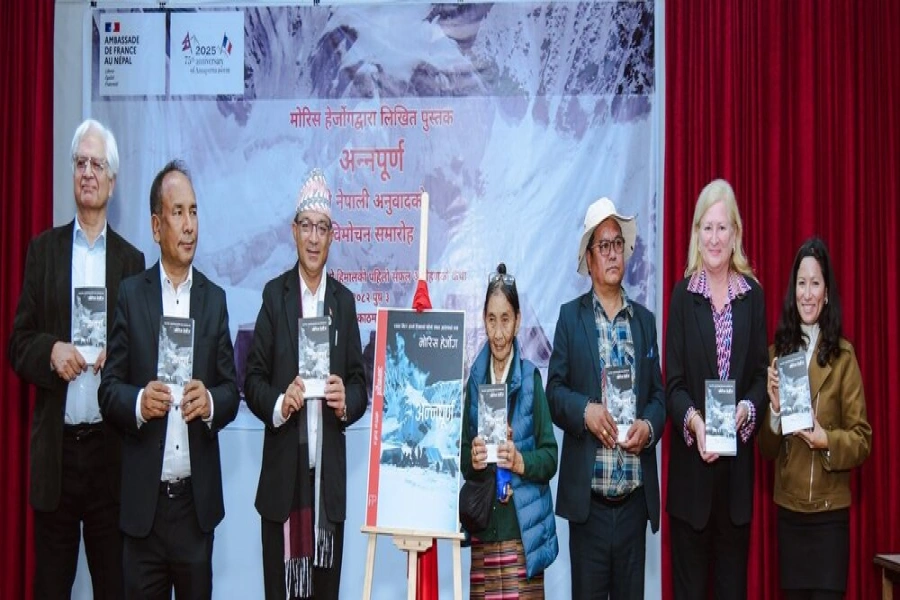
Nepali translation of Annapurna Premier 8000 launched