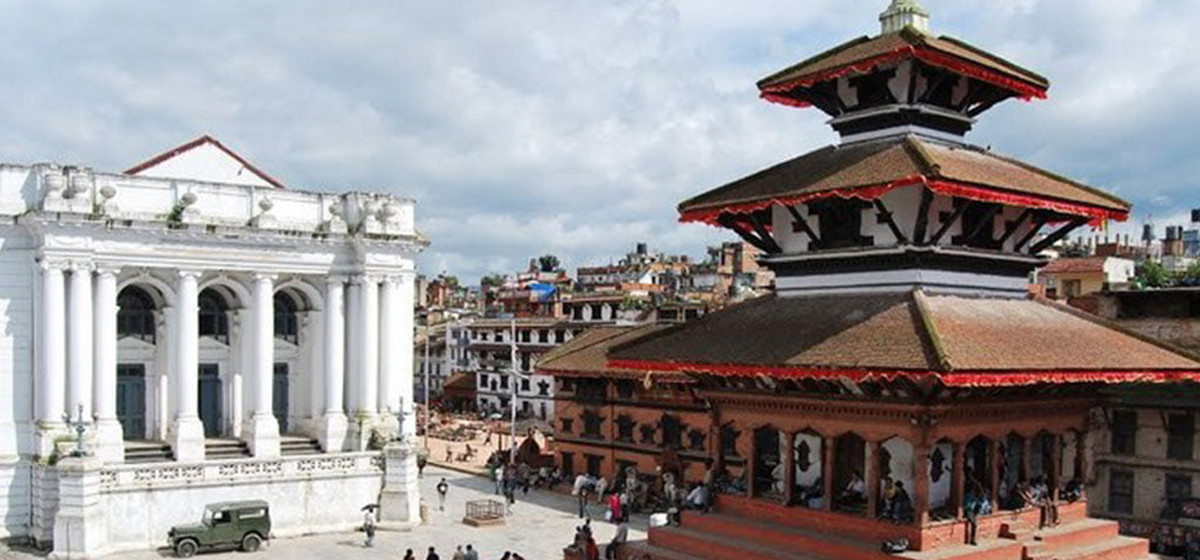
The walls of most of the temples and buildings inside Hanuman Dhoka durbar, used by Malla and Shah dynasties as their royal palaces, suffered cracks during the earthquake on September 18, 2011. [break]
The earthquake damaged many historical temples and buildings like Nautalle Durbar (nine-storey palace), Mohan Kali Chowk, Sundari Chowk, Lamo Chowk, Gaddhi Baithak, Panchamukhi Hanuman Mandir, among others. Among them, Nautalle Durbar was badly affected.
Although the earthquake is considered to be the reason behind the recent damages, engineers claim that poor engineering of the durbar complex is yet another major reason for its sorry state.
“The durbar was designed in a way that even a mild tremor could have caused significant damage,” said Darshan Babu Adhikari, an engineer with Hanuman Dhoka Durbar Museum Development Committee. “Bricks were not set properly while building the walls and the lower room does not support the weight of the upper room."
According to him, Nautalle Durbar is safe up to the sixth floor and the remaining floors are fraught with risks of collapsing any time.
The durbar is risky as many people come every day to visit it.
“The use of woods has made the rooms up to the sixth floor strong and such woods should have been used to support other walls as well," said Adhikari. “There are lots of open spaces inside the durbar but the walls around them do not have adequate support.”
The Hanuman Dhoka Durbar Development Committee has recently hired two consultant firms to conduct a detailed study of damages caused by the earthquake to the durbar complex.
“After they submit their report, we will carry out renovation program immediately,” said Saraswati Singh, chief of the museum.
The cracks that appeared in the walls have been temporarily covered with white cement.
Related story
Hanuman Dhoka Conservation Program collects Rs 152.35 million