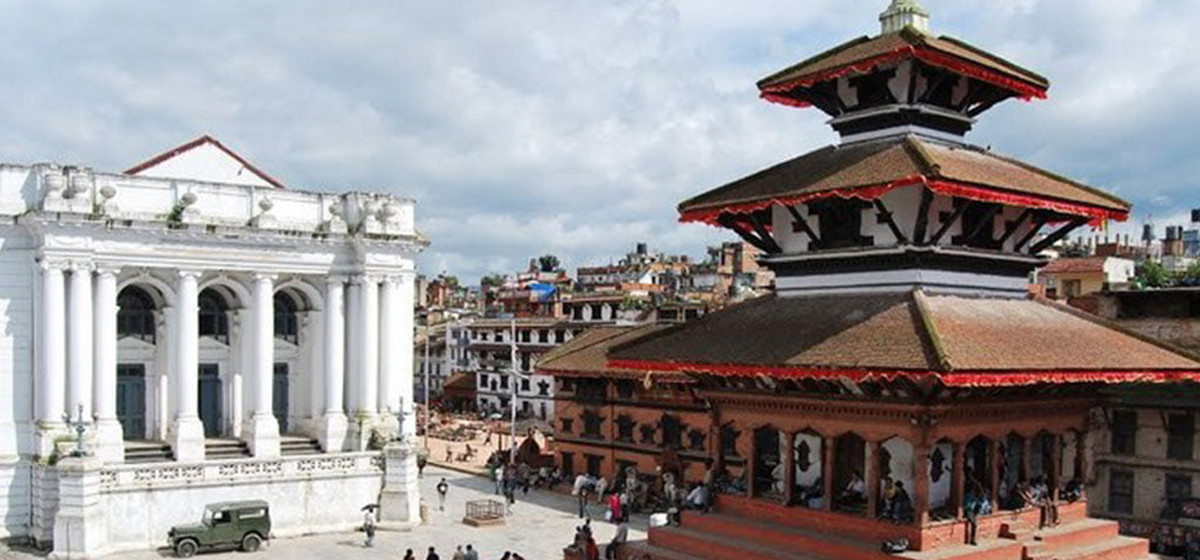
Earlier, the renovation works used to be only temporary in their nature. But an earthquake measuring 6.8 on Richter scale in 2011 proved to be an eye-opener for the government.
The earthquake damaged various historical temples and buildings constructed by Malla, Rana and Shah rulers in different periods.
Among them, Nautalle Durbar (nine-storey palace), Mohan Kali Chowk, Sundari Chowk, Lamo Chowk, Gaddhi Baithak and Panchamukhi Hanuman Mandir have developed several deep cracks on their walls.
Fearing further damages to the historical site that is enlisted in the UNESCO World Heritage list, the Hanuman Dhoka Museum Development Committee (HDMDC), which is chaired by Cultural Minister Ram Kumar Shrestha, is preparing to upgrade the old structures to earthquake-resistant structures.
The centuries-old site was enlisted in the World Heritage Site by the UNESCO in October, 1979.
"In the past, we only repaired cracks in the name of renovation. But no initiatives were ever undertaken to make the old structures inside the durbar area resilient to earthquakes," said Sarswati Singh, member secretary of the HDMDC.
"We will reinforce the historical monuments from the very next month as Kathmandu Valley at high-risk of earthquake. For the purpose, our committee has decided to invest 5 million rupees from the committee´s internal resource for the renovation work in the first phase," she said.
She said the committee wants to begin the restoration work as soon as possible because some buildings are already on the verge of collapse.
Due to the government apathy, a popular temple of Lord Krishna opposite to the Hanuman Dhoka Museum collapsed in the devastating earthquake of 1934, causing a huge loss to the historical site. "So, this time, we are reinforcing the structures to make them resilient to earthquakes," she said, adding that it was the first time that any world heritage site in the country is being renovated keep earthquakes in mind.
In order to assess the damages caused to the historical monuments by earthquakes in different times, the committee had hired two consultant firms six months ago. The firms, Integrated Development and Research Services (IDRS) and Design and Build Solution, are going to jointly submit a study report with recommendations by the next two days.
The government had provided Rs 12,00,000 to the committee to conduct the damage assessment study of the historical site.
According to Ram Chandra Poudel, managing director of the IDRS, as there are several openings in the buildings, cracks are seen originating from them as well. Likewise, the white building south of Nasal Chowk is heavily tilted.
"As we were given a very short time, we categorized our study in three phases. In the immediate phase, we have recommended for the immediate renovation of the structures that are critical and are on the brink of collapse," informed Poudel.
He said the committee should immediately start reinforcing the buildings to ward off any untoward incidents.
"But the earthquake is not solely responsible for the dire situation of the historical structures. There are other reasons for the damages, like seepage, improper use of buildings and technical lapses during the construction as the buildings have been constructed in different phases," he admitted.
"Historically, the buildings inside the durbar square were constructed for various purposes. But now, the same buildings are being used for other purposes, without assessing the fitness of the buildings. So, we are also recommending changes in the way the buildings are used," informed Poudel.
He mentioned that the firms have recommended a micro level assessment for at least a year to come up with the real condition of the structures within the historical sites. Only then, the durability of the old buildings can be ensured for the long run.
"In the later phases, we will gradually reinforce other structures. From the current fiscal year, we have kept the renovation task under huge priority," Singh added.
She maintained that the structures will be retrofitted and repaired without distorting their originality and archeological significance.
Bhes Narayan Dahal, director general of the Department of Archeology (DoA), believes that the renovation is likely to start from the next month and will give a new lease of life to the old and ill-maintained historical site.
"It sends a positive message among the international community concerned about the historical monuments that the Nepal government is paying serious attention to protect the sites with historical and archeological importance," he added.
"The move will be expanded to other world heritage sites in the days to come."
Related story
Hanuman Dhoka Conservation Program collects Rs 152.35 million