Though 1853 is generally considered the year when English education started in Nepal, English and its influence was trying to find an outlet here from much earlier. According to historian Baburam Acharya, “the Christian missionaries who entered Nepal in the early 17th century had made efforts to translate even the sacred Hindu scriptures and scripts (in English).” There were foreigners living in the Kathmandu valley before it was subjugated by the Prithvi Narayan Shah who was a strong anti-firangi king. After the triumph over Kathmandu valley, he is said to have expelled all foreigners from here. But this did not hold long. With the beginning of the colonial grip in the south, English had already arrived next door. But Bhimsen Thapa, another anti-English statesman, resisted it. With his power in decline, after the 1816 Sugauli Treaty, Britishers were allowed permanent residency in Kathmandu. A change now. Kathmandu denizens lived among English people but English education was yet 37 years away.
Though 1853 is generally considered the year when English education started in Nepal, English and its influence was trying to find an outlet here from much earlier.
This long resisted English education seeped in amidst very strange and complex political circumstances of the 1850s. Colonial power in India was enjoying its heyday. It had only been four years since Jang Bahadur Rana had annihilated the courtiers and assumed power in his hands. He had yet to tackle intrigues and voices of dissents from the durbar. In such a situation, it is interesting, how he succumbed to the fancy of making a visit to Britain. This visit, made in 1850, marks the importation of English. What struck Rana about English language is mystifying. There in London, he had declined to eat from the hands of the English. He had observed strict Hindu codes and treated his English counterparts virtually as untouchables. It is strange that he who had thus “othered” the English people, should come back home impressed by their language. But he did not begin English education outright. He must have deliberated long over the consequences of introducing English education, for only in 1853, after two years of his arrival from Britain (1851), he arranged for two of the English teachers, Rose and Lord Canning from Britain, and had them teach his brothers and nephews on the ground floor of Thapathali Durbar. Like any other precious import, he kept English education confined to the clique of his family and relatives. For decades, hence, English education remained confined to the Ranas.

However, not all the royalties – the sole-intended beneficiaries – fared well. There is an interesting anecdote. In the entrance exam of 1880 held in Calcutta, Khadga Shamsher, Dhir Shamsher’s second son, had failed miserably. But those were the days! He was awarded medal by the-then viceroy Lord Rippon. That was the time when you would be awarded even for failure if you were a royalty.
Little can be said with certainty about curriculum and syllabus design of English as a subject since, until 1971, Nepal did not have an official body to administer and monitor school curriculum. The first SLC graduates of 1934 had to take examination of two English papers. In 1956, nine years after the Britishers had been made to quit India, National Education Planning Commission blighted English off from the school curriculum. 1956 Commission berated English as good for nothing. It wrote “The English schools have been described as a third-hand version of a system never designed for Nepal. The successful graduates are likely to find clerical employment with the government by virtue of their ability to read and write Nepali and English but much of the curriculum has no vocational value.” Again in 1963, the Panchayat government-funded National Education Committee prescribed English; one paper for lower secondary and two papers for SLC as compulsory subjects.
In what may sound strange, National Education system plan of 1971 again deleted English as a “compulsory subject” from the primary school curriculum (class I to III) and relegated its status to “one of the UN languages” as a compulsory subject in lower secondary and SLC curriculum. This time it was a single paper with 100 marks. And it did not necessarily have to be English. Call it coincidence or politics, 1971 is one of the years of Panchayat heydays, which defined Nepali nationalism in opposition to everything foreign. From 1981 onwards, however, English has been kept as a compulsory subject in high-school curriculum.
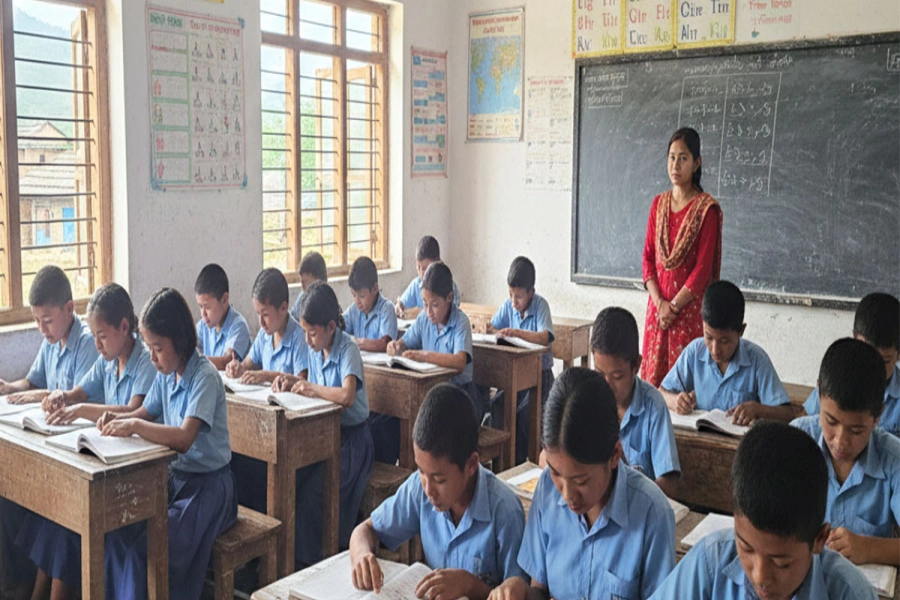
Time has transfigured this history. The country that had less than 300 college graduates in 1950 now populates thousands of university graduates, unemployed though, with years of exposure to English education. English, which was once the language of rulers and elites, has now reached the mass from the urban locations to schools in the hills. It has become an indicator of “educatedness.” The English that once eluded, excluded and estranged Nepali people is one of my means to taunt and tame its origin. I have tried to own it and make it a part of my language game. This, for me, is more relishing than anything.
mbpoudyal@yahoo.com
Related story
Revised interest rate corridor system introduced