Nepalgunj continues to grow in all directions. The main expansion is northwards. Ribbon development along the Surkhet Road has made it possible for minibuses to ply frequently between the Indo-Nepal border at Jamunaha and the Kohalpur crossroads of East-West Highway. New settlements have also extended westwards, but these areas still retain their rural character.
The Karkado locality appears to have gone through most spectacular transformation. It all began with a camp built for the construction of Butwal-Kohalpur section of E-W Highway. The camp was intentionally erected a little outside the town so that the noise of earthmoving machinery would not disturb locals. [break]
Requiring more commodious runway to manage flights to the mountainous regions, the airport was relocated from Khajura along the Gularia Road to Ranjha in the north. Karkado then became the midpoint between the old town and the new airport. The army had its barracks in the east. The police chose Karkado to build its regional headquarters. The bus park nearby completed the urbanization of the area.
A string of fancy hotels now line the road between the bus park area and the airport. In the early eighties, the guesthouse of Sikta Irrigation Project was the only place where VVIPs could stay. Other important visitors used to put up with the Rana family in their sprawling house close to the old town. Even though what they ran was technically a hotel, friendly Asit and lively Nina had the reputation of treating almost every customer as their personal guest.
Though slightly more commercial than before, Asit’s establishment continues to retain the loyalty of its old patrons. His cousins later built a little fancier place right next-door. However, bigger hotels in Karkado seem to have created a lucrative niche with more aggressive marketing strategies. In addition to lodgers of humbler inns along the New Road, guests of hotels in Karkado present a cross-section of visitors that keep the economy of the settlement humming.
Frequent travelers to the town can be grouped roughly into four categories. Nepalgunj serves as the gateway to almost virgin mountains of the mid-west regions. State is the biggest business of this area. Suppliers, transporters and contractors serving the government are the most important clients of hotels of all categories. It is somewhat natural that they feel more at ease in impersonal hotels with their business-like atmosphere.
The do-gooder industry (DOGI)—representatives of donors, employees of INGOs, and entrepreneurs behind successful NGOs along with their consultants, trainers, accountants, auditors, monitors and other professionals—constitutes the second most lucrative customer base of the hospitality business. During the Maoist insurgency, when government activities had almost come to a halt in most districts, the DOGI sector saved hotels from bankruptcy. Prominent opinion makers and most media-persons professing BORING (Bottom-up, Rights-based, NGO Approach) ideology have been incorporated into DOGI sector in multiple ways: Many moonlight for INGOs as reporters, some function as local contact persons, several are entrepreneurs behind NGOs themselves, and quite a few are on the roasters of consultants meant for ad-hoc assignments.
Privatization of health services has resulted in the creation of a huge trade in medical supplies. Brash and boisterous medical representatives are permanent fixtures of economy hotels in most small towns. Education supplies too is a big business with private schools running their own retail outlets for the captive market of cowering parents. Apparently, branded stationary business pays its agents sufficiently enough for their sales representatives to offer to foot the bill of a complete stranger they had previously seen only on television screens.
Brand Wai Wai has hogged a lot of limelight lately, but it constitutes a tiny part of the packaged food, essentials and toiletries sold from grocery stores even in the hinterland. What the trade calls FMCG (Fast-moving consumer goods) is the mainstay of retail outlets. An unbelievable number of salespeople from such suppliers frequent regional market centers such as Nepalgunj. Expense accounts vary according to the status of the distributor and the standing of their representatives, but this group too consists of some big spenders. Smaller hotels try to lure and retain their loyalty. The telecommunication industry has appropriated retail outlets with fast moving recharge business and spawned a new breed of agents of its own.
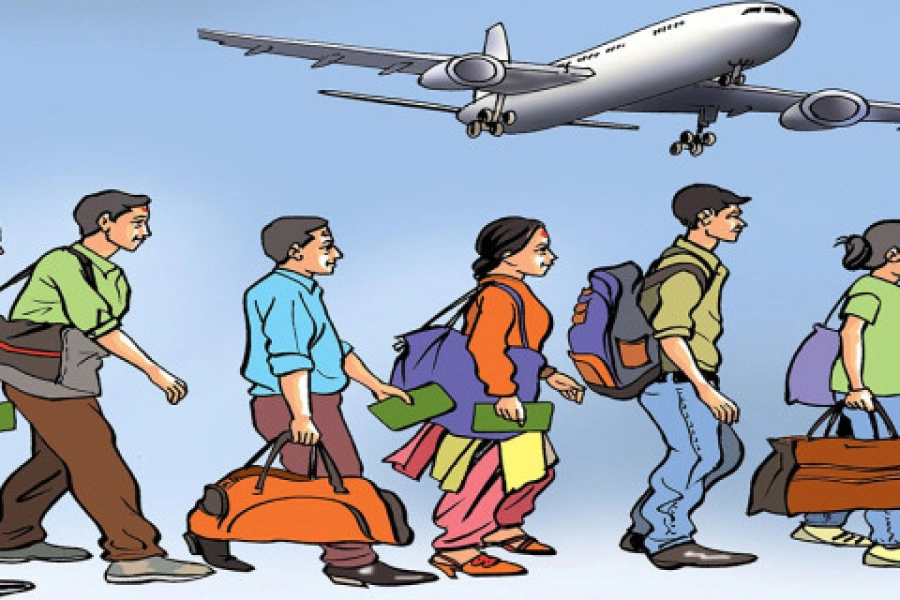
Less conspicuous but probably more important are the middlemen of manpower and remittance businesses. A sector that constitutes over 25 percent of national economy is bound to exercise considerable influence. Operators from banking, finance, insurance, money transfer and the plain old profession of fixing deals often frequent the town on some or the other errand. Surprisingly, these people appear most rushed as they hustle and bustle in hotel corridors with one ear permanently glued to cellphones.
A common feature of this group is that they mix politics with whatever is their business. Most of them have strong opinions and have no hesitation in voicing them strongly at the first opportunity. The economy of politics is thus increasingly being influenced by the foot soldiers of commerce rather than their commanders in distant metropolises.
Economic levers
Until the 1980s, extraction of commons fueled the engine of politics. Landlords had been decisive in the elections of 1950s. In the 1960s, royal land grants lured democrats to the authoritarian fold. The Panchayat politics of 1970s were run with the hybrid fuel of forest clearance, export subsidies and import monopolies granted selectively to the cronies of the crown. Massive deforestation prior to the Referendum in 1980 to ensure the continuity of the royalist system and consequent hue and cry over environmental degradation implied that the PEON had to find more innovative ways of buying political support.
Businesses based on foreign aid and import trade bankrolled nationalist politics of King Birendra and his minions in 1980s when Kathmandu began to emerge as an important node of all kinds of international transactions. Restoration of multiparty politics in 1990 brought new type of manipulators on the scene. Privatization of state enterprises, transfer of vital services such as education, health, air transport, banking and finance to the profit sector, and further liberalization of trade throughout the 1990s created a category of ‘liberal’ entrepreneurs that was willing to exercise its economic power to gain commensurate political influence. Revolving door governments were as much the cause as the effect of political funding right through the Constituent Assembly elections when Maoists brought in their own band of ‘nationalist capitalists’ into open politics.
The last CA elections turned out to be an eye-opener. The country discovered that Binod Chaudhary was a Madheshi and wedded to the Marxist-Leninist ideology. Padma Jyoti may have been a closet Maoists for the party of the proletariat nominated which him to the CA as representative of the civil society. Rajendra Khetan too turned out to be a Marxist-Leninist. The Golchhas became secularists and liberals. The Kedias embraced identity politics of federalism and republicanism. When puppeteers gyrate with the movement of puppets, the stage ceases to be entertaining. The CA was a flop show in every respect.
Comprador intelligentsia
Unlike commanders of commerce that relied mostly on the power of money—and possibly muscles of their shadier associates—foot soldiers of global capitalist order are equally adept in manipulation of the mind through persuasion. They interact, are adept at using social media, and can influence the “manufacture of consent” through their penetration into the mainstream press. They are the advance party of what philosopher Kwame Anthony Appiah calls the “Comprador Intelligentsia”.
Like their brethren in the bourgeoisie, the comprador intelligentsia too operates mostly from metropolitan centers. The influence of “a relatively small, Western-style, Western-trained group of writers and thinkers who mediate the trade in cultural commodities of world capitalism at the periphery” is hence limited. However, travelling teams of the ideology is taking the agenda of comprador intelligentsia deep into the countryside. Whether they turn out to be as influential as their predecessors in the economics of politics would be tested in the upcoming elections.
Related story
Instant Economics: A Revolutionary Third Wave