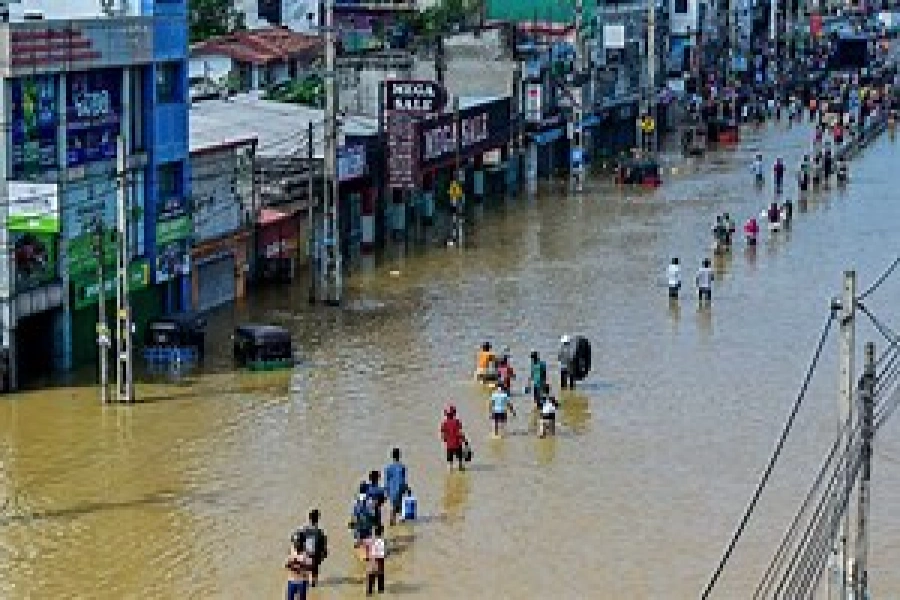
They have argued that the implementation of relatively smaller projects provided with adequate flood control storage would suffice to resolve the present Koshi flood problems at least for a period of next 50 to 60 years.
Speaking at a function organized by the Independent Power Producer´s Association of Nepal (IPPAN) Friday, Dr AB Thapa, a noted hydropower expert said, "It would be a big mistake to opt for implementing the mammoth Koshi project to resolve the rapidly worsening flood situation," adding, "It would take a very long time to complete the detailed study and construction of the optimum-sized dam project and a hydropower plant capable of generating 16,000 MW in accordance with further studies based on more correct recent data and well-tested evaluation procedures recently applied in the Karnali project study."
To prevent the re-run of the last-year-type disaster, Dr Thapa suggested that one of the relegated old Koshi channels must be developed as a "buffer channel" for the diversion of the high flood water in excess of the carrying capacity of the present Koshi course. "A spillway must be provided to discharge safely the flood water across the embankment into the buffer channel, which could also help to hold back the sediments already accumulated on the riverbed," he added.
The Ministry of Irrigation (MoI) has, however, dismissed all possibilities of opting out of the Koshi high dam project. Shital Babu Regmi, the joint secretary of the MoI, said at the function that the carrying capacity of the Koshi river quoted as 5 lakh cusec is only a "magic figure" which has yet to be validated. He added that if Nepal opts out of the high-dam project and go for building smaller ones, "it will take decades to just do the studies." Regmi argued that at a time when the government has not even been able to complete the study of Koshi project itself, going for studies of smaller dams would be a beginning of yet another "mammoth task." The two governments are currently undertaking third study to complete the detailed project report of Koshi.
Asked to comment, the liaison officer of the the Government of Bihar in Kathmandu, Arun Sinha, said, "It is more feasible to go for Koshi high-dam project as the benefits are immense," adding, "In smaller projects, there are surely benefits in irrigation and flood control, but the benefits in Koshi in all three sectors -- irrigation, flood control and power generation -- is relatively high." Sinha, however, added, "But there is a need for further studies regarding this."
Related story
The Do's and Dont's before buying a laptop