

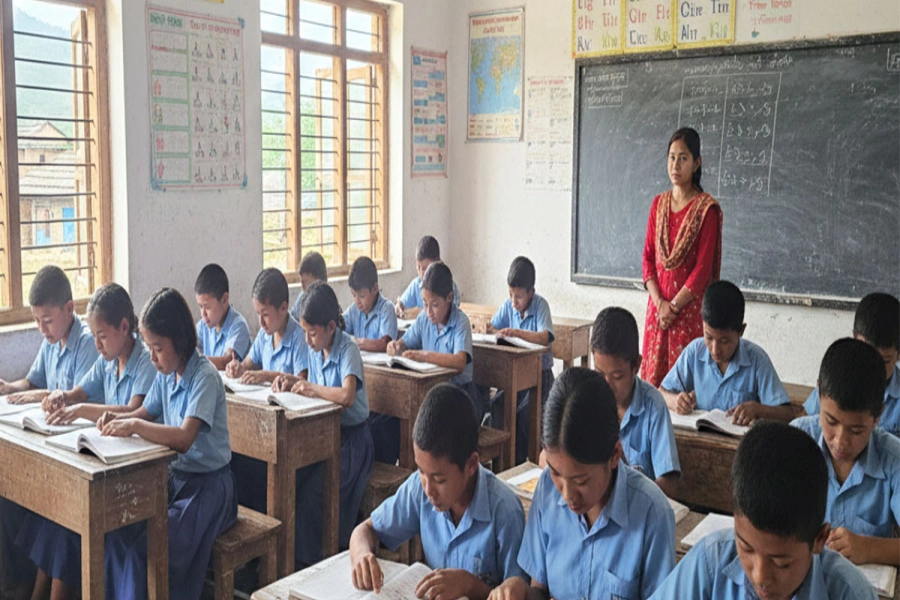
This was how I saw my fellow classmates, seniors and juniors. However, for slum children, life is far from the stability and routine of school-going middle- and upper-class children. They don’t have an opportunity to go to school and their dreams are shattered by their everyday plights.
Everyday, one particular sight, on my way to school, always devastated me. It was a foul smell of something rotting and getting worse. Small shabby children as young as two years running to our school bus, begging for money across the infamous trans-district Bagmati Bridge, was a very surreal sight. Even a locally born and raised teenager like me had a hard time coming to terms with such sights. My experiences with these children weren’t particularly pleasant. If you refused them money, they would either cling to our school van or pass nasty comments enough to ruin one’s entire day.
I decided to head to the slums where these children came from and to their parents. One reason was to understand the driving forces behind these behaviors, and the other hope was to see if their parents could be swayed to send these children to school.
Little did I know about the surprises waiting for me on the other side of the street.
One Saturday morning, I bribed a child with chocolate so that he would take me to his parents. My question, “Why isn’t your child going to school?” was followed by if they knew he was begging in the streets of the city? Did they also know about his suspected glue-sniffing habits?
Their response did little to justify the kids’ behavior. To my utter distaste, one father said, “If they don’t do their work, who’ll feed the family?” That moment, even a bigger question struck my mind: “Does poverty force one to stray from morals?”
For the slum children, life isn’t easy. From fighting hunger, poor access to clean water, electricity, healthcare and education to growing up in an environment where gambling, theft, alcoholism and violence exist, life is insidious.
Admissibly, it’s the parents who have to support their offspring emotionally, mentally and financially. However, in the slums, the opposite are the facts of life. Children are exposed to prostitution, forced to become laborers or household workers to make ends meet at home.
To earn their daily wages, parents leave their children at free pre-primary classes run by the various governmental and non-governmental organizations. However, as they get older, children are expected to look after their younger siblings. What’s even more outrageous to me is when parents tell me that they don’t have the money to send their children to school when they have all the money and resources to come home drunk every single night.
Children are the mere reflection of their parents. Most parents treat their children the way they remember their own parents treating them when they were young. It was pretty clear from my experiences that helping the children of the slums alone wouldn’t solve the problem because parents are exacerbating the root cause of this social issue. It’s not that parents have completely lost their moral compass, either; it’s the fact that they themselves aren’t educated, and don’t have any other option to make their ends meet in a city as expensive as Kathmandu.
My experience in the slums has been a bittersweet one. Teaching the slum children has become my passion and I loved every moment I spend doing something for those children. But their unhappy faces and unwillingness to go home surprises me. Unfortunately, too, some children face physical, mental, and emotional abuse on a daily basis. For these children, their homes are mere “houses.” They were homeless kids with no direction in life.
Some slum dwellers are fairly educated while others have total ignorance. Recognizing the true behavioral patterns of a particular slum and effective approaches to teaching parents to learn about discipline will sway their proper approach to parenthood, taking care of the future of their children and eventually the nation and the world.
The writer is a Rato Bangala School graduate and worked in INCLUDED, a not-for-profit organization based in Kathmandu.
Related story
Poverty: A Multidimensional Problem, Nepalese Context





-1781882999.webp)


