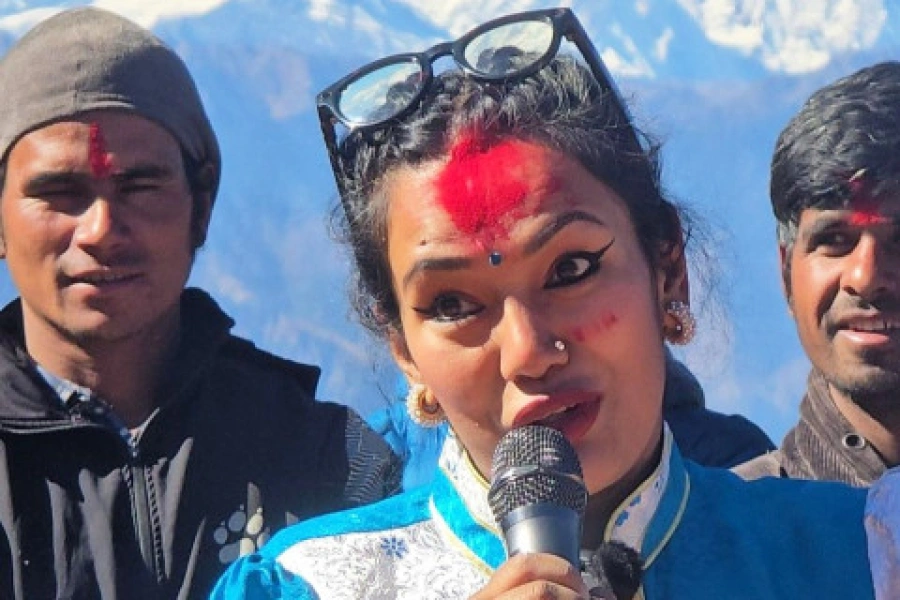
The night before graduation each of us pulled out our more treasured Bakkhus, Cheogoris, Chhubas, Drindles, Hanboks, Kimonos, Kiras, Lehengas, Lederhosens (and other pieces I never learned the names of). We tried on each other’s clothing and posed for pictures. Before the actual ceremony itself, I recall non-Nepali parents asking I stop mid-track for them to get a better picture of my “exotic” Gunyu Cholo. I, on the other hand, was mesmerized by the rabbit leather dress my Native American classmate had on. Think Pocahontas if you must.
It is only human nature that we are drawn to what is the most foreign of all that we know. The lehengas, bakkhus and hanboks I had seen growing up in the dormitories of my school, were not exciting. But, the “Pocahontas dress” was something new to me. Some ogled my outfit, while I did others.’
Ooh-ing and aah-ing as children had different implications then and as we grow older, meanings have changed.
Since high school, appreciating the plethora of cultures that exist in society has become slightly trickier. This is mostly the case because it is a balancing act. After all, isn’t exotifying another culture the first step to exploiting the “other”? While most of my life I gushed at the great interest non-Nepali people showered upon all things Nepali, it was only when I had an introspective look at Nepal that I realized I could be more cautious.
After all, in a country like Nepal where we are not only Nepalis, but we are also multi-cultural, multi-lingual, multi-religious “Nepalis.” As such, preserving and promoting the plethora of cultures is an honor as well as an obligation – and so, one that ought to be pursued with discernment.
This point was driven home on a recent trip to Chitwan.
The ‘Tharu Lodge’ is one of few hotels in the country that offers top-notch service (forget just hot showers, think four-course meals) but is also tastefully built in accordance with traditional Tharu architecture. Made of local mud and sticks it appears fragile, but incidentally perfect for the blistering hot summer days and chilling winter nights.
Guests like us can appreciate a window into the “exotic” Tharu people through such architecture. However, the Nepali meal presented at lunch of daal-bhat didn’t quite satisfy our curiosity. Neither did the sari-clad women and men in Dhaka topis.
Too pahadi, not really Tharu, I thought to myself.
A part of me was disappointed. As a Newar-Chhetri guest I wanted something more “authentic.” Perhaps if I hadn’t known better I’d have been no different to a foreigner – whether from India or Italy who would wrongly assume Tharus also wear saris and Dhaka topis as part of their “traditional” clothing.
The desire to exotify Tharus for the sake of entertainment and pleasure was soon evident in myself. As an alien to these parts there was this want somewhere to see something unique. Pictures of huts, their diet and dress were to appear on my Facebook and stories were to be told of these “exotic” people that live in the Tarai region and are “malaria-resistant.”
Exotifying cultures by default happens to be about ones that are usually minorities and more foreign. It is difficult for a Newar to be mesmerized by all things Newar because it is too familiar to be fascinated with, while absolutely possible for a Chhetri to be enamored with say, Tharus - like I was guilty of in Chitwan.
A certain level of curiosity is to be expected and perhaps even healthy because it helps us embrace diversity, but when it comes to feed our ego or fulfill our entertainment demands there is an unbalanced feature to it all.
To urge or demand someone from another ethnic group wear, eat, talk, dance, move as they “traditionally” did just so we can be privy to it strips them of their right to act as they would prefer. Perhaps the best we, as those with the task of appreciating (and hopefully not exotifiying, by way of exploiting) another group is to respect their ways and leave it for them to decide which mainstream or majority way of life they will adopt and which they will reject.
There is a likening to be made between the fascination “white people” had of American Indians and the privileged groups of Nepalis (like the Bahun-Chhetris) of us have of the more indigenous people groups of Nepal. However, unless we are careful to become so bored or unamused with our own ways we may soon turn the “other” into a spectacle, a zoo of sorts to photograph and marvel at.
Staying at the ‘Tharu Lodge’ in Chitwan was an opportunity to catch a glimpse of a whole new world. The community’s architecture, farming techniques and art taught me a little bit about their traditional way of life.
But, is it fair for me to demand they drop the sari or the Dhaka topi? How can we appreciate without exotifying the “other”?
Related story
Excuse to reconnect