In 1957, Chairman Mao Zedong of People’s Republic of China put forth the slogan of “15 years to catch up with and surpass the UK”. Among many other moves, this farfetched ambition set the base for the “Great Leap Forward” movement in 1958. Though some leaders in the party were skeptical about the movement, reportedly only one senior leader, Peng Dehuai, then Defense Minister, dared to question it. Mao then immediately dismissed Dehuai from his post, justifying his action as dismissing “bourgeois” class from ruling China, while Dehuai had left school and worked as a manual laborer as a child because his peasant family couldn’t support his education.
Thus, the Great Leap Forward movement ran without much visible resistance from the population. Though the projected results of the movement were good, the movement failed massively due to fundamental flaws in the planning and execution of policies. Another reason for its failure was that the government didn’t entertain any critique, review, or just plain realization of the fact that planning could fail sometimes. So, what followed was the greatest man-made famine in human history. [break]
Fifteen million people (official figures) starved to death from 1958 to 1960. Shamelessly, the government blamed it on “bad weather”. And the same party continued to rule the surviving population without any regrets or apologies to the hurt people. Atrocities continued with the much defamed “Cultural Revolution” in later years.
This is what Mao, who years later provided the name for the biggest, and currently also the ruling party of Nepal, did to his country. Apparently, the Nepali Maoists derived not just his name and ideology, they have also inherited the habits of passing laws and policies and electing personnel in posts of national importance on their own, and of refusing to take the blame for wrongdoings. What makes it even graver is that Nepal is a multi party democratic republic unlike China, where a single party has been dictating rules to the citizens for more than 60 years without opposition.
marxistleninist.wordpress.com
Maoists in Nepal have formed a strong political dominance in universities and industries with the involvement of students, teachers and workers. (Mao’s China used to have the Red Guards Organization for the same purpose.) The irony here is that these vitals of the country give better outputs the cleaner they are from political influence. But political penetration has halted classes, recruited wrong fits for posts, and closed universities on many occasions. Trade unions’ unchecked powers, lack of discipline, and incessant irrational demands have already forced many industries to close down in Nepal. The protestors seem to miss the most important point: it is their own and their children’s future at stake if these institutions are non-functional.
Communism advocates the idea of a “commune”. But communes wouldn’t work for long in any society, unless adopted with coercion, because of the free-rider problem. For any movement to succeed, there must be incentives for the involved individuals to put their fair share of resources into it. In the case of commune, once the first defaulter arises, gradually free-riding would stop almost all people from doing any work, and productivity would fall, never achieving abundance of material wealth.
Allowing ownership of private property and free competition, on the other hand, has been proven to increase the total wealth of the country because it entertains the interplay of risks and rewards. Rather than the state seizing property and (ostensibly) redistributing assets and power, the wise way for a country to grow rich would be to let those capable of earning amass wealth through fair and competitive ways, and later level the playing field through taxation, price discrimination, subsidies, and other policies.
These unscientific practices followed by Maoists of extorting from the rich to create a classless society also stagnates the economy in the sense of job creation. Who creates jobs in an “only working class” society? Who revs up the economy? Though the government plays its role, the state control in economy creates monopoly, and without competition, the market lacks vigor to progress.
Maoists also believe in demolishing the old system completely. They not just try to seize power through war, but upon seizure, also attempt to tame the judiciary, bureaucracy, education, and social values. In doing this, Maoists fail to imbibe even the good aspects of old systems. A noteworthy point: Maoism has not come to power in any country without vehemently fighting and overthrowing the old system. Nepal is the only country where Maoists, after fighting for a decade, decided to come to the table, contest an election, won the majority of the votes, and held power afterwards.
But sadly, the Maoists have regularly failed to comply with the democratic system of Nepal, which has made the democratic practices in the country more miserable than before. The hardwired concept of “evolution only through revolution” cost many countries— including Nepal—a great deal of time, money, and resources.
The history of Maoism shows that there are always some factions in the party who find the system established through revolution purposeless and inappropriate. In Nepal, the Baidhya faction has splintered off of the larger Maoist faction, and is constantly threatening to wage war against the existing system. Another example is the rise of a revolutionary working-class movement called Sheng-wu-lien (holding Marxist beliefs) in China circa 1968, opposing Mao’s government. Sheng-wu-lien, in one of their documents entitled “Whither China?” criticized Maoists’ practice and strategy of revolution: “(Mao thinks that) Revolution must progress along a zigzagging way. It must go through a prolonged course of struggle-failure-struggle, again-failure, again-struggle, till final victory”. These statements also hold true for present day Nepal.
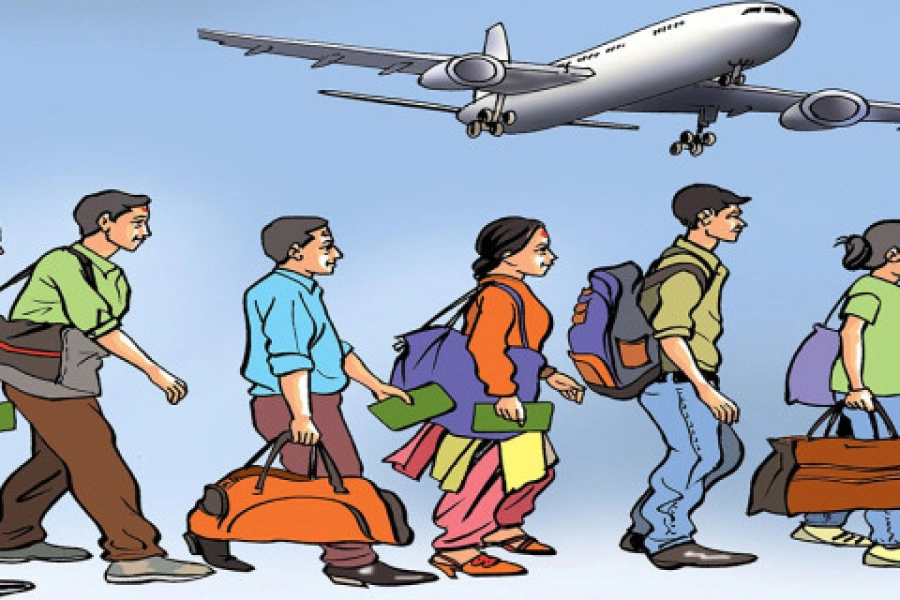
Such repeated power struggles have prevented Nepal from escaping the low-level-equilibrium-trap, because on one hand, wars consume resources, and on the other, destroy them. This forces able and competent citizens to leave the country for better opportunities. Such outflow of manpower signals a high-risk business environment, which automatically wards off potential foreign investments.
Communism holds a very idealistic view of economy and society. If a society followed these principles, it could either plunge to total failure, or rise with marvelous growth. History stands witness to numerous cases of the former variety. China’s economic boom started after Deng Xiaoping adopted capitalistic market principles and opened China’s economy to the world in late 1970s, defying conventional Maoism. His discarding of Chairman Mao’s motto of “Better Red than Expert”, and awakening the economy of China became instrumental in China’s rise.
For Nepal to escape this trap, apart from maintaining a clean and accountable political system, every other sector of the country must be free of political influence, mainly education, industry, bureaucracy and judiciary. Maoism found a breeding ground in Nepal because the other parties were losing their ground by not advocating competitive market system and democratic politics. But all the leaders should understand that no ideology has an algorithm proven to fit Nepal, because every country is an individual case. And certainly, it is high time we all realized that Maoism isn’t doing the country any good, because even after much ado, there have been no improvements.
The author is Program Manager at Janaki
Technology Pvt. Ltd.
barshaaa@gmail.com
Related story
Red Panda in school curriculum