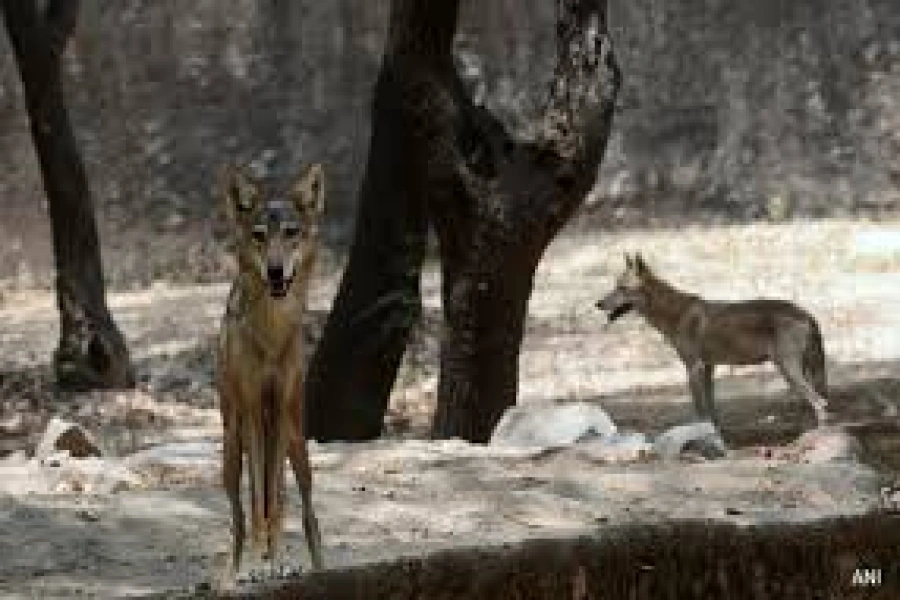
For example, although the IUCN Red List, a globally recognized inventory of conservation status of species, lists the Gray Wolf as “Least Concern” due to their relatively widespread range and stable population trend, they are listed as a “vulnerable” species, and hence protected by law in Nepal, Bhutan, India, and Pakistan. It is also listed in CITES (Convention on International Trade in Endangered Species of Wild Fauna and Flora) Appendix I for this region, making international trade of this species illegal.
Wolves have so far been thought to be divided into three distinct species: Gray Wolf, Red Wolf, and Ethiopian Wolf. The wolves found in the Himalaya were said to be part of the subspecies of the Gray Wolf (Canis lupus chanku), or Tibetan Wolf. However, recent genetic research done by Sharma et al (2003) and Aggarwal et al (2006) seem to suggest otherwise. Their studies, conducted on samples taken from India, Nepal, Kashmir, and Tibet, instead indicate that two distinct species of wolves exist in the Himalaya: the Tibetan Wolf, and a newly realized Himalayan Wolf species which the researchers claimed should be assigned a new species status –Canis himalayensis. This nomenclature was officially recognized by CITES in 2009 while IUCN’s official recognition is still pending.
Interestingly enough, this finding is in accord with the findings of 1847, by the then British Resident in Nepal B. H. Hodgson. He had identified the Himalayan wolf as a separate species, “Canis laniger,” based on its elongated muzzle, thick underfur and distinct coloration, before it was lumped together with the Tibetan Wolf.
The recent studies have identified the Himalayan wolf as the most ancient wolf lineage ever recorded, representing a pre-wolf, post-jackal lineage, which is at least 800,000 years old (compare that to the North American and Eurasian Wolves which are “only” 150,000 years old!) This divergence between the Himalayan Wolf and the other wolf lineages coincides with the period when the Tibetan Plateau underwent rapid upliftment, which was no doubt followed by related habitat modifications. In fact, Aggarwal et al’s study also identified the Indian Wolf, found in peninsular India and thought to be a sub-species of the Gray Wolf (Canis lusus pallipes), as a distinct species Canis indica. This species is thought to be 400,000 years old (The revised nomenclature has also been accepted by CITES). The rest of the wolves found globally all belong to a separate wolf-dog lineage. Tibetan wolves belong to this latter lineage.
Geographically, Himalayan Wolves seem to be spread across the Eastern Himalaya, including Nepal, the Tibetan Wolves northwards from Kashmir, and while the Indian Wolf is distributed below the tropical Terai belt by the outskirts of the Himalayan foothills. All these three species have a potential overlap of distribution in Kashmir, although they do not interbreed.

(c) Ambarish Singh Roy
Related story
PHOTOS: Dhanraj still draws Naag posters though printed impress...

According to the concept of “Centers of Origin,” an area with the greatest diversity of a species is taken to be the centre of origin for that species. Therefore, these recent findings of three distinct yet closely habitating wolf species, especially given the antiquity of two of these species, suggests that the subcontinent could actually be the origin for wolf evolution! But what a pity it is that the very area where these magnificent creatures probably evolved from is the very region where they are vulnerable to extinction and severely depleted in numbers.
Very little is known about the ecology, behavior, and distribution and conservation status of Himalayan wolves, which increases their vulnerability. In Nepal, there has been no study to date conducted on wolves apart from reported sighting in biodiversity surveys. They are thought to exist along the high elevation plains bordering Tibet, possibly occurring in Humla, Dolpa, Mustang, Manang, Langtang, Makalu-Barun, Manaslu, Sagarmatha, and the Kanchanjunga region, yet there is no estimate of their numbers. With the likelihood that the species found in Nepal are also of the Canis himalayensis species, this dearth of knowledge becomes all the more significant. Without adequate information, it is near impossible to create effective conservation decisions and action plans necessary to preserve this species.
Himalayan wolves probably number only in their hundreds in the Asian subcontinent. Their numbers are thought to be decreasing drastically with increasing conflict with humans. In the Himalaya, there has been an increase in human population with the corresponding loss of natural habitats and wild prey, and the increase in livestock density in the last few decades. With livestock numbers exponentially increasing in these areas, there has been a corresponding increase in wolves preying on these livestock, with an estimated 55% of their diet consisting of domestic animals. As livestock lack the anti-predator instincts and escape abilities of wild herbivores, they become easy prey for carnivores. Since wolves hunt in packs, even full grown yaks can be killed by such wolf packs.
This killing of livestock has led to greater human-wolf conflict, resulting in retaliatory killing of wolves by the pastoralists through illegal poisoning and destruction of dens. Studies have shown that though Snow Leopards and wolves both kill livestock, the villagers have a more negative perception of wolves and are therefore persecuted more. Perhaps as a consequence, villagers across the Himalaya report that wolf numbers have reduced in the last few decades.
Historically, persecution by humans in response to livestock predation has already eliminated several predators, including the tiger, lion and puma from vast areas of their former ranges. For the Himalayan wolf, a unique species which has survived for hundreds of thousand years in the region, their survivability for the next one hundred years is now in danger.