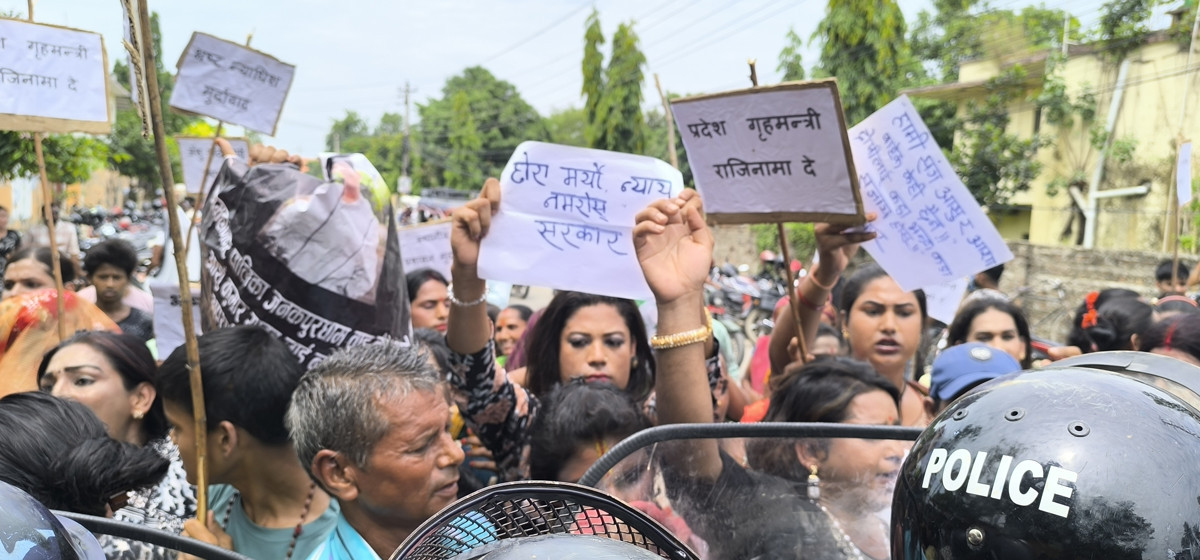
However, due to lack of proper sensitization of the bureaucracy and the debate (albeit a hushed one) over “natural-unnatural” aspect of sex, this momentous decision has been reduced to paper.
Those working in the field of sexual minorities’ rights often complain about the attitude of government officials (and others as well) toward LGBTIs. There is smirk on their faces; more questions, often humiliating and uncomfortable ones, are asked and various reasons cited for not adhering to the apex court’s orders on granting citizenship as per their status. The sad part is that even those who are aware of, and fight for, an individual’s fundamental human rights find it difficult to accept the LGBTIs as natural human beings.
This is surprising considering that Nepal has been on the forefront of recognizing sexual minorities as natural human beings, and crucially important, as citizens. Chanda Musalman, a 48-year old, was issued a citizenship certificate, not as ‘male’ or female’, but as both in Banke district in early Feb 2007. Later that year, on Dec 21, the Supreme Court ordered that lLGBTIs are natural people and hence should be entitled to all fundamental rights as Nepali citizens.
A year later the court again directed the government to form a committee to study the possibility of recognizing same-sex marriages. Since the SC order of 2007, sex between same-sex couples has been officially decriminalized. (The emphasis is deliberate as in practice discrimination and stigma abound.)
Pretty impressive stuff, if one just looks at this statistics. There is the other side as well and it is not pretty at all.
In January 2007, Dev Gurung, the then Minister for Local Development, had said, “Homosexuality is a product of capitalism. Under socialism this kind of problem does not exist!”
Khushi Gurung, 21, leads a miserable life in Pokhara after her parents abandoned her. A story by my colleague in Republica on Jan 18 tries to capture her pain. Born a boy, Khushi says she developed a girl’s behavior. “My parents forced me out of house by putting pressure on me to lead a life of a normal boy,” she shared her pain at a function on the rights of the third gender in the city recently.
Another colleague filed a story, published in Republica on Dec 20 last year. Arati Shrestha, 19, from Kanchanpur district was also thrown out of house for refusing to marry as per her parents’ wishes. She too was born a boy but started behaving like a girl. This was too much for her parents in a conservative society like ours. She is now taking shelter in Nepalgunj after brief stays in Dhangadhi and Mahendranagar.
Sunil Babu Pant, a Constituent Assembly member and founder and director of Blue Diamond Society which works for the rights of the sexual minority in Nepal, rues that despite the Supreme Court decisions, discrimination against sexual minorities has continued. He accuses Home Minister Bhim Rawal of not being very supportive of the LGBTIs rights. The district administration offices (DAOs) across the country - which work under the home minister – are still reluctant to issue citizenship cards under “tesro lingi" (third gender).
Rawal, on the other hand, denies being an obstacle to sexual minority groups and violating the apex court order. “No one can violate the SC order,” he told this writer. Rawal’s interpretation of the SC order is that the highest court of the land has not categorically ruled to issue citizenship under transgender category.
Among the people calling shots in Nepal, Rawal’s discomfort is shared by many other “natural” people.
In January 2007, Dev Gurung, the then Minister for Local Development, had said, “Homosexuality is a product of capitalism. Under socialism this kind of problem does not exist!” Two months later, his party and cabinet colleague Hisila Yami was not as harsh as Gurung. She said, “...don’t punish homosexuals, but we also don’t encourage homosexual behavior”.
While the fight for right is an ongoing battle, there’s another serious dimension to the sexual minorities. It is that of survival.
While homosexuals, so long as they are not out in the open do not have problem in getting education or employment (of course there are exceptional cases), the transgender face a totally different world. They say that since they are born as male (or female) and behave as the opposite sex, they are ridiculed and shunned. More serious is lack of access to health centers.
At a workshop on MSM, sexual minorities, sexual diversity, human rights and HIV in Colombo, Sri Lanka in late November, some startling data was shared by the organizers – UNDP, Naz Foundation International and the Asia Pacific Coalition on Male Sexual Health. Prevalence of HIV among the MSM (men who have sex with men) was rising on an alarming note, particularly in Thailand and Burma. According to the statistics, 30 percent each of the MSM in Bangkok (Thailand) and Yangon (Myanmar) have been detected with HIV. The figures are 15 percent in parts of India and more than 5 percent in Beijing.
While no specific data on HIV prevalence among MSMs in Nepal was available, the rise of the HIV infection in countries close to Nepal is something that cannot be ignored. There is more awareness about HIV and AIDS in Nepal and people do visit health centers and hospitals more freely than in the past. But cases like Mansara BK’s do happen. According to Dec 2, 2009 edition of Annapurna Post newspaper, this 30-year old woman was thrown out of her village in Santada in remote Achham district for being HIV positive.
Minority sexual rights activists say MSM have problems in having access to health centers due to the stigma attached with their status. With a data showing number of MSM on the rise in Kathmandu (and in Bangladesh), it is possible that HIV among them could be on the rise too. We can tackle the HIV among them. But for that we must accept the sexual minorities as one amongst us – human beings.
damakant@myrepublica.com
Related story
Nepal to host historic int’l tourism conference for sexual and...