

According to the Metropolitan Traffic Police Division, 465 people lost their lives, 1,697 were seriously injured, and 10,065 suffered from minor injuries in 14,114v road accidents that took place in the Kathmandu Valley since 2010.[break]
Traffic Police Inspector Sitaram Hatechhu points out that the main quandary lies in the fact that people are oblivious to and ignorant about even basic traffic signals.
“During my 22 years of work experience, I’ve seen that many accidents have been caused by sheer ignorance,” he adds, explaining that though the blame is entirely put on the drivers, pedestrians and passengers too are at fault for crossing the road and getting on vehicles in wrong ways.
To minimize accidents caused by drunken driving, the campaign against drink-drive, termed “MaPaSe” (madak padartha sewan), was implemented from December 3, 2011.
“The strict law and penalty against drunken driving caused fear among people, obliging them to maintain social discipline. After its implementation, we saw a remarkable decrease in road accidents and fatalities,” says DSP Rabindra KC of the Metropolitan Traffic Police Division.
KC adds that late-hour drunken driving, drivers of public vehicles consuming alcohol on long routes, and hit-and-run incidents saw a tremendous decrease after the campaign was enforced. The penalty, if found guilty, was Rs 1,000 in fine along with traffic education class. But to make the campaign even more severe, the rule to punch licenses with holes was imposed since December 7, 2012. Till date, 9,063 licenses have been punched, and if repeated five times, authorities will suspend the licenses.
“Those driving under the influence of alcohol will have their punched licenses under traffic violation records and in future they will have problems getting no-offense record. Which is why fear obliges them from violating the law,” says KC.
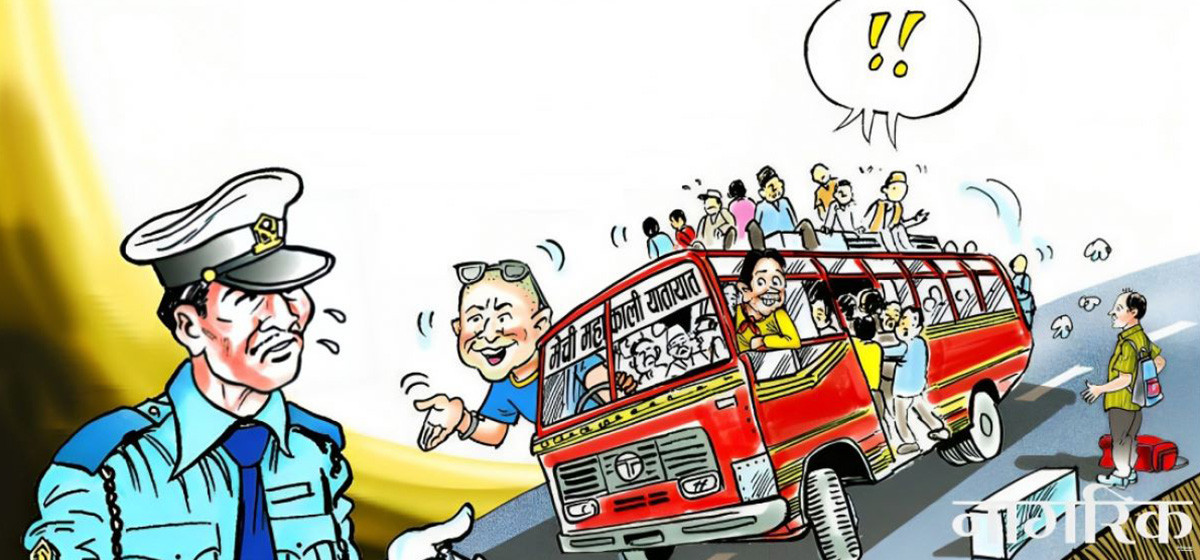
While the campaign has helped improve the condition of road safety to some extent, Inspector Hatechhu says that other issues of negligence should also be taken into consideration. Even passengers who get in overcrowded public vehicles should maintain discipline, as overlooking such factors are reasons that lead to chaos and fatal accidents.
He stresses on the need to reform the process of license trials as we still follow the trial based on 1992’s traffic laws. A person undergoing trial for motorcycle driving has to pass through a seven-second test and two minutes of written examination, and it’s three minutes for cars.
“The actual roads are way more dangerous and requires at least two to three months of coaching,” says Hatechhu.
“Back then, it was just 49,000 people and one million vehicles, and now the number has reached 700,000 people and four million vehicles. It’s been two decades and we still follow the same traffic regulations. This is something which concerns the safety of not only drivers but others and this requires radical reforms,” he says.
As per Police Inspector Tapan Dahal, while major accidents and those leading to deaths are often reported, many minor accidents go unreported.
“We’ve seen that usually youths 16 to 20 years old use vehicles under the influence of drugs which has been one of the causes leading to serious accidents,” he says.
He mentions that it’s also a responsibility of parents to control their children, as many underage youth are seen riding bikes recklessly.
Abrupt overtaking and over-speeding have been other major causes of road accidents, says Dahal. There are lots of challenges due to lack of traffic manpower, and he points on the need for the traffic police to be well-trained and also follow up on international laws to maintain and improve the rules.
While it’s easier to blame the traffic police for failing to properly manage vehicles on the roads, DIG Upendra Kant Aryal of Metropolitan Traffic Police Division asserts that it’s the responsibility of every individual to maintain and promote road discipline.
Aryal points out that there are mainly three reasons that cause accidents – human factor, condition of vehicles, and road infrastructure.
“The results of our analysis and research show that 90 percent of accidents are due to human factors alone, and mainly due to carelessness.”
He mentions that the Metropolitan Traffic Police has been continuously working on raising awareness of road safety through classes at schools and colleges on a regular basis, among other awareness campaigns. Disseminating information about road safety through Traffic FM 95.6 is also a positive effort of the Traffic Police.
Lack of proper road engineering and poor conditions of vehicles also are primary reasons behind accidents, says Aryal. He puts it that knowledge about road safety should be incorporated from childhood so that with age, school and college students will learn and upgrade their ideas about it as a part of the curriculum.
Another drawback is that the license trial is not scientific enough as it’s based on a model that doesn’t include road tests.
“The test is made on the same model and you can’t be a driver by just knowing how to drive as you need to master broader responsibilities,” he says.
From April of this year, a reformed concept of license trial is expected to be implemented and police authorities believe that this will help improve road safety to some extent.
Aryal further mentions that there are many agencies like the Traffic Police, the Roads Department, and the Department of Transport Management that work in road safety and traffic enforcement. But lack of effective coordination between these agencies is a major setback.
Keshab Thoker
“If there are issues of road safety, then the public will definitely blame the traffic police. But it’s also the responsibility of all multi-disciplinary agencies that come under various Ministries,” he says, further explaining that if traffic management authority is given to a single agency with enough manpower, then it can prove to be pragmatic.
“We can expect traffic management to be more effective then, as agencies will stop playing the blame game.”
Nepal still follows the traditional method where a traffic police stands on the road to give directives. “If technology can replace traffic, then we have enough manpower. But if not, then we need more manpower to control the chaos on the streets,” he says.
Aryal mentions that it’s imperative to have equal support and responsibility on the part of drivers, passengers and pedestrians to maintain safety measures once they step out on the road, as road safety can be maintained only through joint efforts.
Rashu, whose life changed because of one accident, says that even minor driving errors can lead to critical accidents.
“One of the main traffic problems is over-speeding and you can’t be reassured thinking that you’re driving safely as someone else’s fault can take your life. So each one of us needs to be more aware once we take on the road,” she concludes.
nistha.rayamajhi11@gmail.com
Related story
Road safety draft gathering dust at the Ministry of Transport f...














-1779250876.webp)





