

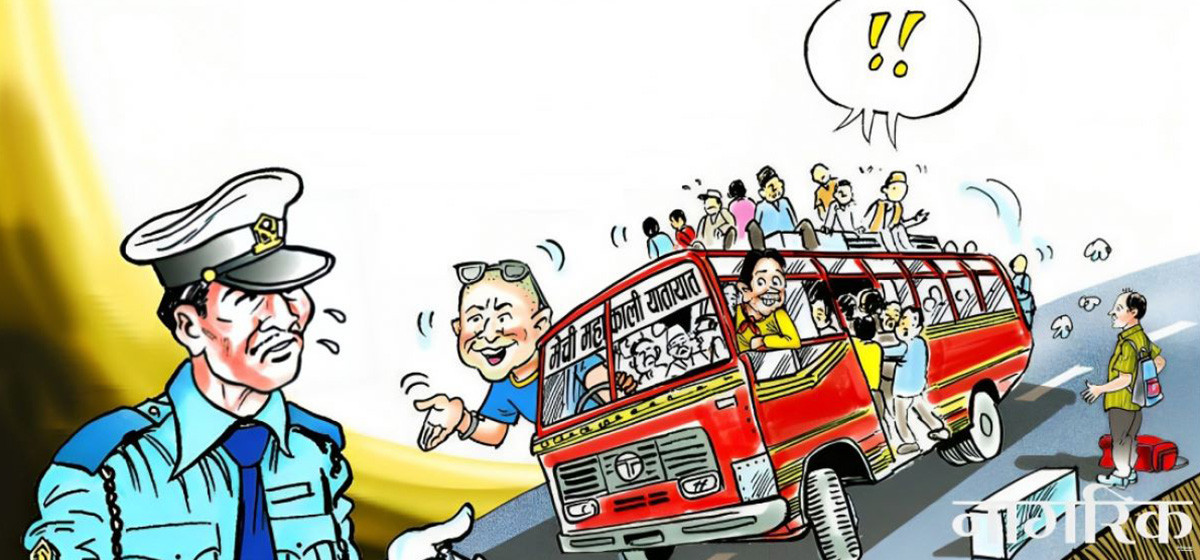
With the success of anti-drunk driving campaign in Kathmandu Valley, the need for extending the campaign to the highways beyond the valley had been widely felt and long overdue, especially with the recent spate of bus accidents in several parts of the country. Many of these accidents have left a high number of causalities (29 killed in Doti on Jan 12, three including a one-year-old child killed in Ilam on Jan 17, 25 injured and two killed in Kaski on Jan 16, three from the same family killed in Sindhupalchowk on Dec 6). In this light, we appreciate the Metropolitan Traffic Police Division (MTPD)’s recent decision of controlling drunk driving on the highways.
Of course, drunk driving is not the only cause of accidents. Most roads are poorly maintained, there are no streetlights or reflective lights to guide drivers even on dangerously curved roads (which are many in Nepal), and vehicles usually carry many more passengers than their capacity, with serious repercussions on the safety of the passengers within. While all of these factors need to be improved over time by the respective authorities, we appreciate MTPD for doing its bit to reduce traffic accidents by shouldering the responsibility of checking drunk driving on motorways beyond Kathmandu valley as well.
That drunk driving causes accidents is indisputable. It is corroborated by the fact that after the MTPD initiated anti-drunk driving initiative in Kathmandu, it apprehended more than 90,000 drivers in its first year alone. At first, the MTPD’s action was limited to making the drivers attend a lecture session, but later they intensified the action by perforating the driving licenses of violators after five recorded offences. They also started charging fines, which hugely boosted revenue collection, amounting to Rs 27 million in the first year. Apart from increasing revenue and preventing traffic accidents, this campaign had also scored in one major social area: Imparting a feeling of safety to residents of Kathmandu.
The number of people abstaining from drinking before driving has visibly increased, late night liquor consumption at restaurants and night clubs has reduced significantly, and as a result, the general public are feel much safer in driving and traveling in the nights. Besides, MTPD’s campaign has also ensured road safety during festivals and public holidays, when roads are typically full of inebriated drivers. According to MTPD records, 293 drunk drivers were apprehend on New Year’s Eve this year, and the number of accidents was brought to seven from last New Year Eve’s record of more than 40 injuries and one death. Surely, this is a notable success of MTPD’s initiative against drunk driving and road safety.
Now that the campaign has been extended to the highways, we expect that it will significantly help to ensure safety to highway travelers. At present, the MTPD plans to strictly implement blood alcohol level tests with breathalyzers at three checkpoints outside Katmandu: Kalanki, Thankot, and Nagdhunga, and plans to charge drunk drivers with the Public Offence Act 1992. Some municipalities like Dhading have emulated Kathmandu’s initiative and started apprehending drunk drivers. We expect that anti-drunk driving campaign will be extended to all the highways and cities across the country.
Related story
Road safety draft gathering dust at the Ministry of Transport f...







-1778925320.webp)





