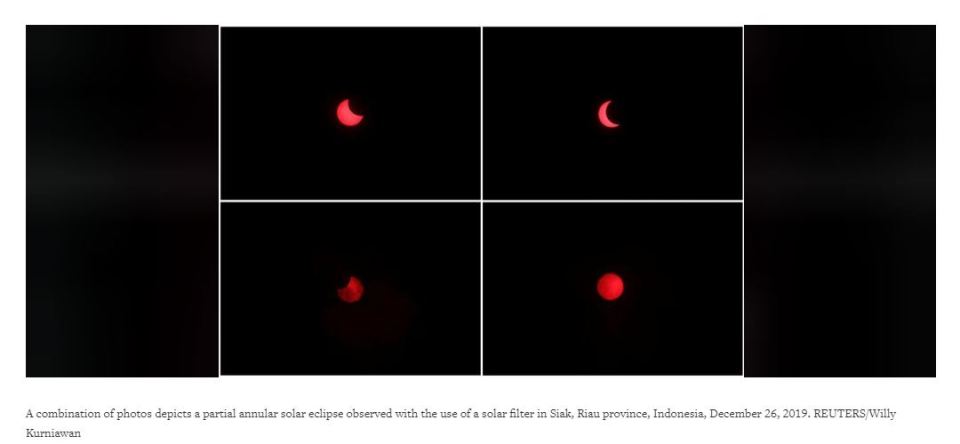
In solar eclipses, the Moon moves between the Sun and Earth, casting its shadow on the terrestrial surface.
- Related link: Annual solar eclipse of Jan 26 [break]
In an annular eclipse, a tiny shift in distance that results from celestial mechanics means the Moon does not completely cover the Sun´s face, as it does in a total eclipse.
Instead, for those directly under the alignment, the Moon covers most of the Sun´s surface, and a ring-like crown of solar light blazes from the edge of the disk.
For those watching from the fringe of the track, the Sun is partially obscured, as if a bite has been taken out of it.
According to veteran NASA eclipse-watcher Fred Espenak, the total eclipse track will run from west to east on Monday from 0606 GMT to 0952 GMT.
It will traverse the Indian Ocean and western Indonesia before petering out just short of Mindanao, the Philippines.
The partial eclipse will be seen in a much wider swathe, including the southern third of Africa, Madagascar, Australia, Southeast India, Southeast Asia and Indonesia.
It will be the only annular solar eclipse this year. The last was on 7 February, 2007, and after Monday, the next one will be on 15 January, 2010.
The big event for eclipse junkies this year is on July 22, when a total solar eclipse will be visible from India and China, the world´s two most populous countries.
Related story
Make a projector to safely see a Solar Eclipse