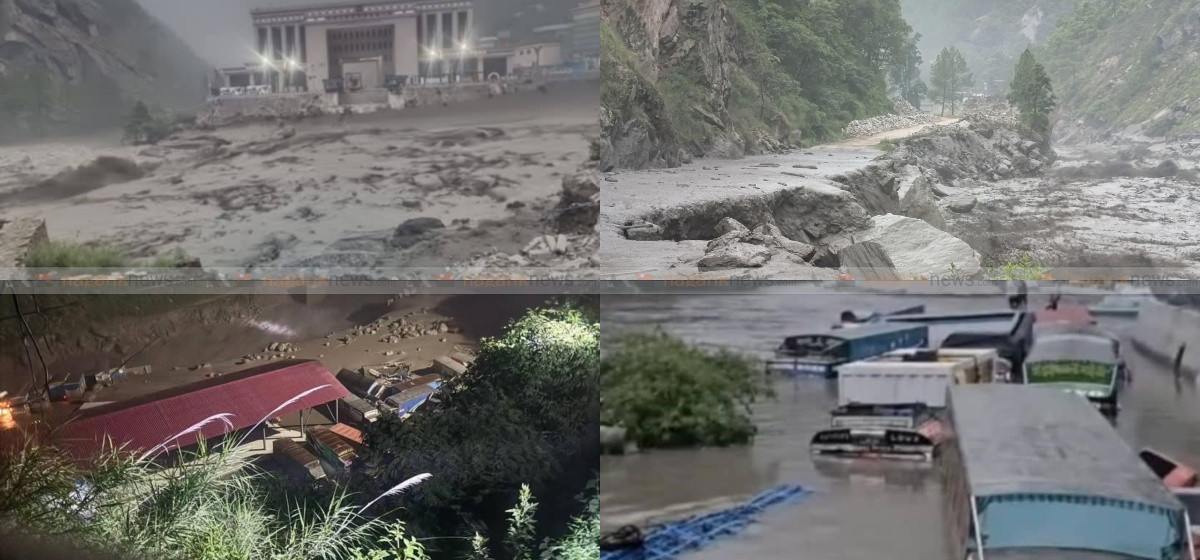
KATHMANDU, Aug 27: A preliminary assessment suggests that the massive flood in Trishuli river on Wednesday was caused by an ice avalanche upstream blocking the Lendhe River. The National Disaster Risk Reduction and Management Authority (NDRRMA) that a debris-laden flood occurred in the Lendhe River following an ice-rock landslide at the Nepal–China border, about 20 kilometres northeast of Rasuwagadhi.
“The same flood appears to have entered the Trishuli River after passing through Timure,” the authority said, amid various theories and assessments regarding the cause of the flood, which has now become a recurring issue.
Disaster expert Dr. Basanta Raj Adhikari also argues that an ice avalanche occurred in the Lendhe River, about 20 kilometres upstream of Rasuwagadhi, blocking the river and causing the flooding.
“Field information has not yet been received, but it appears that the river was blocked by an ice avalanche originating from the Nepal side,” he said. He said satellite imagery of the area was currently being reviewed and that a clearer assessment would be possible soon. He added that the risk remains because the water accumulated at the blockage site is several metres deep.
Avalanche-blocked river in Tibet likely triggered deadly Rasuwa...

Glacial lake and glacier expert Prof. Dr. Rijaan Bhakta Kayastha said that, based on the information available so far, the ice avalanche appears to have originated from the Nepal side.
“Satellite images will only become available after 24 hours, so it is taking time to confirm the incident. If there was heavy cloud cover in the area, it would be even more difficult to establish the main cause of the incident. A lake has formed in the Lendhe River, which flows along the China–Nepal border,” he said.
Binod Baniya, an assistant professor at the Central Department of Environmental Science at Tribhuvan University, said imagery from China’s Gaofen satellite did not show any clear indication that the lake had already burst.
"Looking at imagery from China’s Gaofen-1 (GF-1) satellite, specifically the Gaofen-1 WFV imagery with a 16-metre spatial resolution, there are no clear indications of a large-scale breach or opening associated with the bursting of the lake," he said in a social media post.
Climate change and glacier expert Arun Bhakta Shrestha said the incident had once again demonstrated that climate change was increasing risks in mountainous areas. He stressed the critical importance of early warning systems in dealing with such incidents.
Shrestha said Nepal lacks ground-based facilities and information systems capable of monitoring activities taking place in high Himalayan areas. China, however, has such systems, he said, making it necessary to establish arrangements for sharing early warnings and information immediately with Nepal.
“Information sharing between neighbouring countries such as Nepal and China can help prevent loss of life and property,” he said. According to experts, although information is exchanged between Nepal and China occasionally, there is a need to develop a dedicated mechanism for real-time information sharing.
Experts say the lack of an effective system for cross-border disaster early warnings and systematic information sharing has contributed to major losses in Nepal caused by floods and landslides originating in the Tibet region. They consider it a serious concern that Nepal does not receive timely early warnings about ice avalanches or river-blocking incidents occurring in Tibet, an autonomous region of China.
Since Nepal's upper catchment areas are connected to China, Shrestha said the two countries lacked an effective mechanism for assessing the actual causes of such incidents and forecasting the associated risks.
Experts have long stressed the need to establish a permanent mechanism for regular information exchange not only for emergency cooperation between the two countries but also among security agencies in border areas and the departments responsible for water and meteorological services.
“It has become essential to jointly establish and continuously operate satellite-based monitoring and early warning systems to monitor glacial lakes and river flows,” said climate change expert Shrestha.