– Tsoknyi Rinpoche in “Open Heart, Open Mind”
There are various facets of personality that a person has while living in a society. For instance, I’m an artist by profession but without considering the social inhibitions, I do have other identities, depending on the roles I have to carry. In that way, we all are on a quest to find our true identity which in itself is a challenge because the moment we’re born, we don’t know what lies ahead of us. Every moment and everyday can bring new obstacles in front of us and we attempt to maintain a balance by being cautious.
The above quote is very simple but its truth holds profound meaning. Even a stray dog on the streets has an instinct of survival but the ability to calculate things by being aware and conscious is what separates us from animals. We are always on the lookout to appear rational but we shouldn’t just live to survive but should be able to find our worth.[break]
There’s an incident mentioned in the book that made me reflect a lot about my own life. The author talks about a predicament he faced while he was abroad. He once had to cross a see-through bridge that connected two high buildings. But as soon as he started to cross it, he became numb and apprehensive as he thought that the bridge wasn’t strong enough. After calculating whether to make a move or not and witnessing people easily crossing it, his mind convinced him to move. But his heart stopped him again.
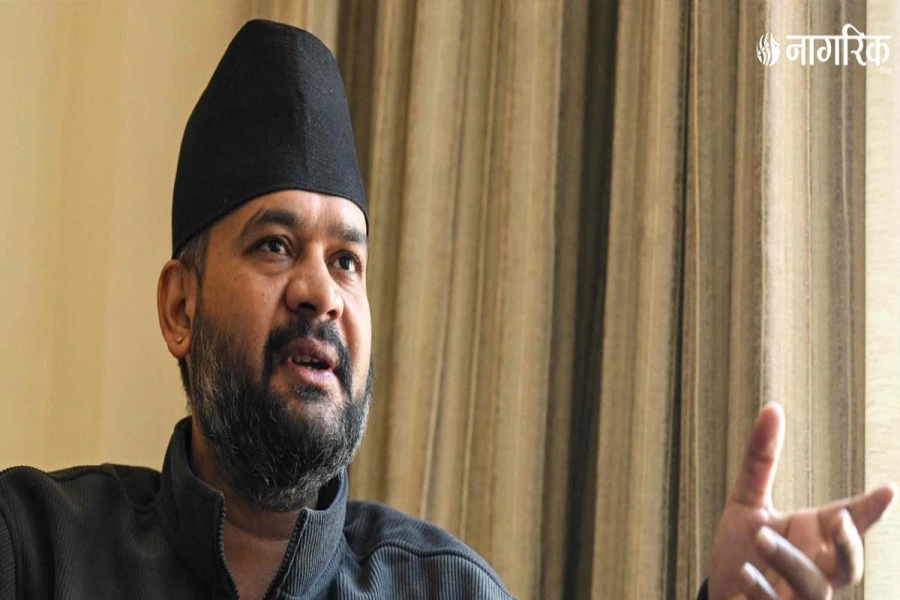
Photo:Chandra Shekhar Karki
So this incident tells us that an event that has happened in the past makes a habitual pattern in us which we believe to be the truth. But unless we try to find the reason behind how we act in a certain way and break the inhibition, we can’t move forward.
This book may look religious but it’s been written from psychological aspects. It has focused on various incidents that we face everyday and the way we perceive such events. We’re bound by responsibilities in life and are often stuck due to obstacles that come our way. So the book also talks about how we can untie such knots or problems that our heart and mind faces. It talks about Buddhist philosophy too, and has presented truth and reality in a simple way which makes it an essential reading.
About Ranjit
An interdisciplinary visual artist, Ranjit for a long time has focused her artistic works on woman’s sexuality, identity and gender perspectives. She’s also the director and coordinator of LASANAA, an alternative art space which is a non-profit art trust established in 2007.
LASANAA has published five books so far which include a book called, “Glocalization of Art, A Nepali Context” which is a compilation work of various writers on contemporary art situation in the country.
An avid reader, Ranjit says that one of her favorite Nepali writers is Krishna Dharabasi. “His book ‘Radha’ is worth mentioning because we normally see Radha from the perspective of Krishna. But in his book, he has presented Radha’s perspectives and her viewpoints as well.”
Ranjit believes that the growing number of violence against women demands that we need to focus and prioritize women’s issues. “I’m against any sort of discrimination as I believe that everyone has the right to live in his own way. In Nepal, patriarchal system is still followed strictly in many households. Thus women are obliged to live for others by sacrificing their own needs,” she says.
Talking about art, she explains that many people think that art is an object and the painter is a subject. “It’s hard for me to separate art from life as I think that art is a part of life.”
She believes that art is a form of expression and she derives her inspiration from what she sees in the society, her imagination, literature, her experience and things she has felt, and various other aspects of life.
“Life as a whole and nature inspire me. But not just nature per se but human nature and how a person behaves is also a subject of my interest and work,” she says. “They say that art is a mirror of society and that we as artists represent this current contemporary time. So we also have a certain responsibility which we give justice through art.”
Ranjit’s five picks
Seasons of Flight by Manjushree Thapa
Manjushree’s work as a writer is commendable and she’s one of my favorite authors. I really admire her way of writing. But if I have to choose, I pick this book of hers which is about the life of a Nepali woman who goes to the US. The book is basically about identity, finding one’s true self, and talks about the context of sexuality, identity and cross-cultural issues. What I like about her style of writing is that she really goes into the depth and focuses on details and characters.
Purity and Danger by Douglas
This is a very old book that got reprinted. Women’s sexuality has been analyzed and portrayed through a different angle in this book. It also talks about how people manipulate sexuality. In a patriarchal society, discrimination against women takes place, based on sexuality. So this book is helpful to understand that as well.
Knots by Gordon Perry
This is a craft book which I borrowed from a friend. It looks simple but is handy as it provides a guide on making various kinds of knots. For example, there’s a procedure of making a sailboat knot which doesn’t get loose by any outer means but by just touching its tip it gets untied. Making a reference to these knots, I’ve worked on artwork related to human relation which is my ongoing work. There are various relations that one shares, be it with a stranger, acquaintances, friends, parents. So I’ve focused my artwork on that basis.
The Whole Woman by Germaine Greer
I read this book when I was in Australia. This book pretty much reminds me of an incident there. In the book, the author talks about how the health industries persuade women to manage their bodies. The author has written various issues that women face in this century and presents it in such precise and witty manners.
Ghanchakkar by Sanjeev Upreti
This book has been written from the perspective of a lunatic and is about illusion in such a captivating way. This is an unconventional book which shows the mind pattern and perception of a person who is struggling with his own mindset. This book is commendable for its writing style and is one of my favorites.
As told to Nistha Rayamajhi.
Related story
Head held high