

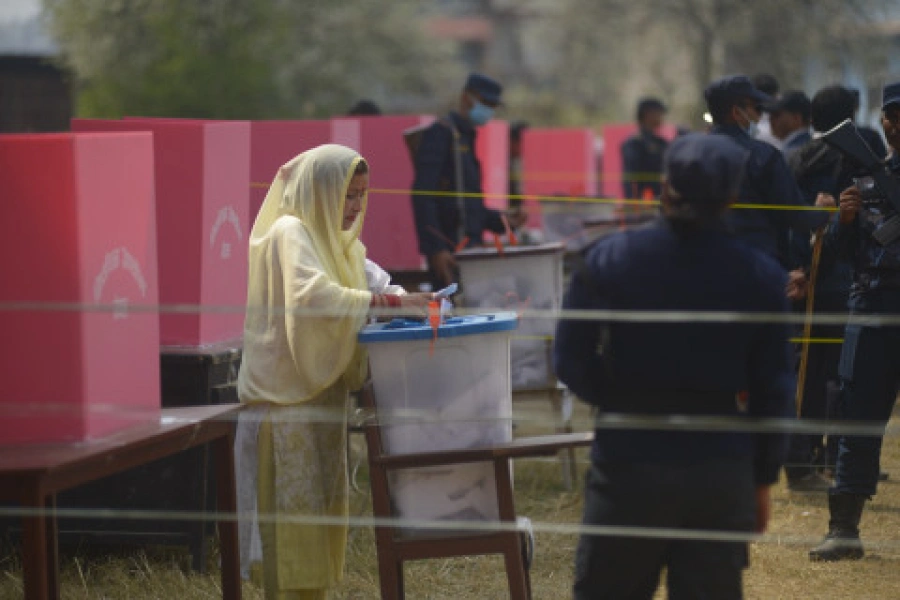
KATHMANDU, March 6: The House of Representatives (HoR) election concluded largely peacefully across the country on Thursday, marking a significant step toward restoring constitutional governance after months of political uncertainty and heightened public expectations. The interim government led by Prime Minister Sushila Karki, formed on September 12, 2025 following the Gen Z uprising on September 8 and the destruction on September 9, had opted for early elections. Except for minor incidents at a few polling stations, voting proceeded smoothly nationwide.
The Election Commission (EC) reported preliminary voter turnout at around 60 percent, lower than in previous elections. Counting is set to begin immediately after ballot collection, with final results for both the First-Past-the-Post (FPTP) and Proportional Representation (PR) systems expected within a week. If the schedule holds, Nepal could have a newly elected government by the third week of this month, restoring the country to constitutional governance after a period of political instability.
Altogether, 65 political parties contested under the First-Past-the-Post (FPTP or direct electoral) system using 61 election symbols. Under this system, 3,017 male candidates, 388 female candidates and one candidate from other gender groups were in the fray, bringing the total number of candidates to 3,406. Similarly, under the proportional representation (PR) electoral system, 3,135 candidates competed, including 1,363 male and 1,772 female candidates.
Voting under the direct electoral system was held across all 165 constituencies, while 110 seats have been allocated under the PR system.
The EC had set the voting hours from 7:00 AM to 5:00 PM. Election Commissioner Dr Janaki Kumari Tuladhar said that voters standing in line by 5:00 pm were allowed to cast their ballots.
Hawaii braces for long upheaval as erupting Kilauea boils

Although a few polling stations witnessed brief disruptions, there have been no reports of any official postponement of voting. Disputes that surfaced in Dolakha, Sarlahi and Rautahat districts were quickly resolved. Voting at the Malu polling station in Tamakoshi-4, Dolakha, was briefly disrupted but resumed shortly afterward.
The total number of voters listed by the EC stood at 10,893,689 for the election. Of them, 9,663,358 were male voters, 1,230,131 female voters and 200 belonged to other gender groups. The EC reported that there were 186,142 temporary voters in this election. Likewise, the EC had set up 23,112 polling centres in 10,967 polling stations, including 143 temporary polling stations for the election.
To ensure election security, a total of 79,727 personnel from the Nepali Army were mobilized, while 75,797 security personnel from the Nepal Police were deployed. Similarly, 34,567 personnel from the Armed Police Force were stationed across the country, while 1,921 officials from the National Investigation Department and 149,090 temporary election police were assigned for election duties.
Early assessments indicate that traditional political parties, particularly the Nepali Congress (NC) and the CPN-UML, may see reduced representation in the new parliament. Following the unrest in September, party leaders and activists appeared to vote defensively for their own candidates but largely failed to mobilize the broader electorate. Many undecided voters remained cautious until polling day, leaving these parties with diminished support.
Internal divisions, long present within both parties, were further aggravated by the events of September 8-9. While outward appearances suggested unity, internal dissatisfaction has intensified. However, unlike in previous elections, the number of rebel or independent candidates challenging official party nominees was relatively lower.
Even the traditional voter base of the NC and UML appears to have weakened. Many older voters expressed dissatisfaction with political parties, citing a lack of recognition, limited employment opportunities and frustration over their children seeking livelihoods abroad. This sentiment is particularly strong among voters over 60. Meanwhile, voters under 35 appear increasingly disconnected from traditional parties, with many showing little allegiance to long-established political structures.
The influence of younger voters was also visible within households. Children and grandchildren often guided the voting decisions of elders. Many young Nepalis living abroad reportedly advised parents and family members on which party or candidate to support. This generational shift marks a departure from previous elections, when household heads typically directed family voting decisions.
Traditional parties struggled to engage and mobilize voters despite efforts by their leaders. Young voters, both inside the country and abroad, encouraged families to reconsider their voting choices, reflecting a shift from earlier hope and trust toward growing frustration with what many perceive as self-serving politics. Analysts note that this may have contributed to a significant number of voters changing their political allegiance.
Caste-based and regional parties also influenced voting patterns, particularly in eastern hill districts. In Madhes, where the Nepali Congress has historically enjoyed strong support, regional parties have gradually weakened its foothold. Both the NC and UML are expected to face difficulties improving their position in these areas.
Smaller parties have also faced internal challenges. The Nagarik Unmukti Party in Sudurpashchim, for instance, has been weakened by internal disputes, potentially affecting its electoral prospects. Even the Nepali Congress faced difficulties in preserving its strongholds amid unresolved tensions stemming from its special general convention. Former Prime Minister Sher Bahadur Deuba’s decision to remain largely silent during the campaign appears to have influenced voter sentiment.
Unlike previous elections, the UML did not organize large centralized rallies. Party Chairman KP Sharma Oli limited his appearances mostly to his own constituency. Meanwhile, the departure of several former Maoist leaders to the Nepal Communist Party has further complicated the UML’s efforts to retain its vote base.
This election also witnessed extensive use of digital campaigning, moving beyond traditional methods of seeking votes. Voters appeared increasingly influenced by online outreach rather than candidates’ personalities, experience or party programmes. Rapid shifts in voter preferences are expected to benefit parties such as the Rastriya Swatantra Party (RSP), while relatively low turnout among loyal NC and UML voters in urban centres may further aid smaller parties.










-1782125987.webp)
-1200x560-1782120651.webp)


