But for those Nepalis who still want to dream, the third opportunity has come faster, though with more devastation. The loss of lives caused by the 7.8 whopper on April 25 and its several aftershocks has been almost at the level of the decade long insurgency, number of houses demolished stands above 500,000 and the wound of pain has been far deeper. In no memory of recent history of Nepal was this scale of suffering witnessed.There is a silver lining in this crisis, like on previous occasions of momentous change in Nepali history. For this, certain core issues wait to be addressed right away without further waste of time.
The most pressing issue today is rebuilding the country from the rubbles of the earthquake. Rebuilding Nepal right from the foundation was always necessary. Homes in villages were always in need of security, toilets, and proper drinking water supply. Late Dr Harka Gurung had proposed integrated settlements for Karnali region as long as forty years ago. He drew this conclusion as the government effort to reach facilities in sparse settlements had failed yielding results. The earthquake has necessitated now as the time to implement such 'crazy' ideas Nepal's best dreamers once had.
Reconstruction is without doubt a technical work of designing, engineering and building. But it gets political as soon as it enters the arena of raising funds in hundreds of billions of rupees and developing a credible authority to manage this.
The funds have to be raised with passion. They have to be spent responsibly, quickly and with accountability. Early estimates of loss, calculated immediately after the first earthquake, suggested around the need of Rs 500 billion to rebuild. Actual figures could be much bigger by the time the Post-Disaster Need Assessment, being carried out together by the government and the development partners, comes out. This is the reason why Nepal must keep standing in unison, giving message to the rest of the world that wants to help us, that the Nepalis can lead the colossal reconstruction work; and that they don't only fight and dispute but also demonstrate national unity.
To be able to rebuild and do so sustainably, Nepal's political class must realize that their politics can no longer afford to remain complacent. Newer generation of Nepalis, like their counterparts elsewhere, have short patience. Educated with good amount of exposure to the world, they work for quick results, faster solutions and are willing to go extra miles to achieve their goals. This generation, unrecognized by the government whatsoever, rose to occasion in helping the earthquake victims. This demonstrates our society's X-factor the current political class must fear from.
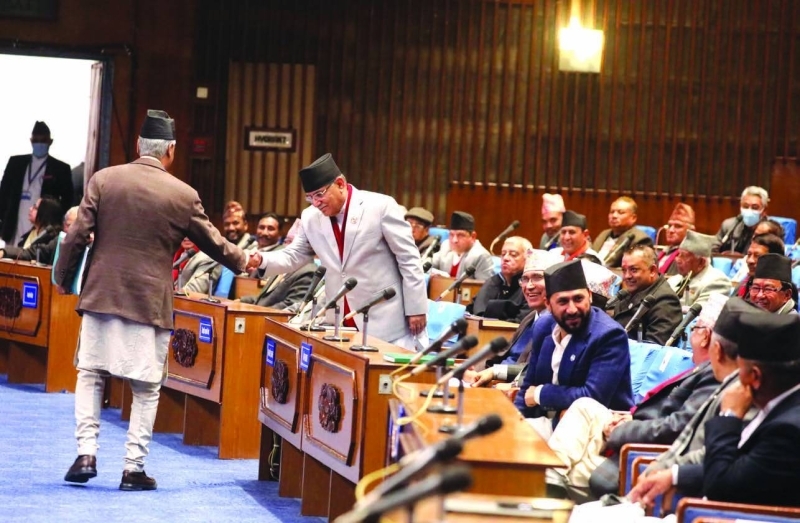
Well, there seems to be a realization. On the sixth day of the earthquake, UCPN (Maoist) Chairman Pushpa Kamal Dahal, who is also the leader of the main opposition in the parliament, had announced, "We have forgotten squabbling since the quake". He appears in a different avatar ever since: suave, selectively spoken and willing to compromise.
Prime Minister Sushil Koirala, with the coalition partner CPN-UML chair KP Oli strongly behind him, has tried to exude leadership by successfully mobilizing Nepal Army, Nepal Police, Armed Police Force and Civil Service for rescue and relief works. There were expected hiccups but what had been feared not to work has worked. The leaders and activists of Madhesh have climbed uphill, extending hands of support.
This presents a rare scenario of political unity in Nepal. In recent all-party meetings, the UCPN (Maoist) leadership proposed UML Chair Oli as the new prime minister, a political stride unthinkable before April 25. According to the two-step proposal, the opposition parties, both Maoists and Madheshis, would first join the current government, giving it a shape of an all-party government. This government would promulgate the new constitution within a month, paving way for PM Koirala to step down with the credit of success on constitution making.
Then, in the second step, Oli would be elected new prime minister with mandate to lead post-quake reconstruction and hold local elections. This is pragmatic; gives everyone an equal footing; no victors, no vanquished. Letting everyone a piece of the pie is the formula of political stability in struggling democracies. But what about federalism?
In 2007, we embarked on a journey to make a new constitution for federalism. The Interim Constitution that year declared Nepal a Federal Democratic Republic. See the irony today. We have to have federalism to make a new constitution. In the past, complicating the otherwise simple politico-economic calculation, which is an ability to align a costly political affair with financial practicability, UCPN (Maoist) led and still leads a coalition of paradox, comprising 30 plus political parties, whose demands range from strong single-ethnicity federalism to those opposing the idea equally strongly. This has to change.
Uncomfortable questions were ignored to press the political issue every time a debate on federalism broke out. This also has to change. People ask, as usual, where the money would come from, how everyone would be treated equally under ethnic governments, and how social justice would be guaranteed.
Despite all this, the new constitution, like the present interim one, will definitely have federalism, for without this there would be no constitution. But the question rises more vocally at the age of post-quake reconstruction: Where will the money come from? The answer is simple. You should cut your cloth only according to your size.
tikadhakal31@gmail.com
Related story
Oli planned the great political quake and Dahal executed it: Ga...