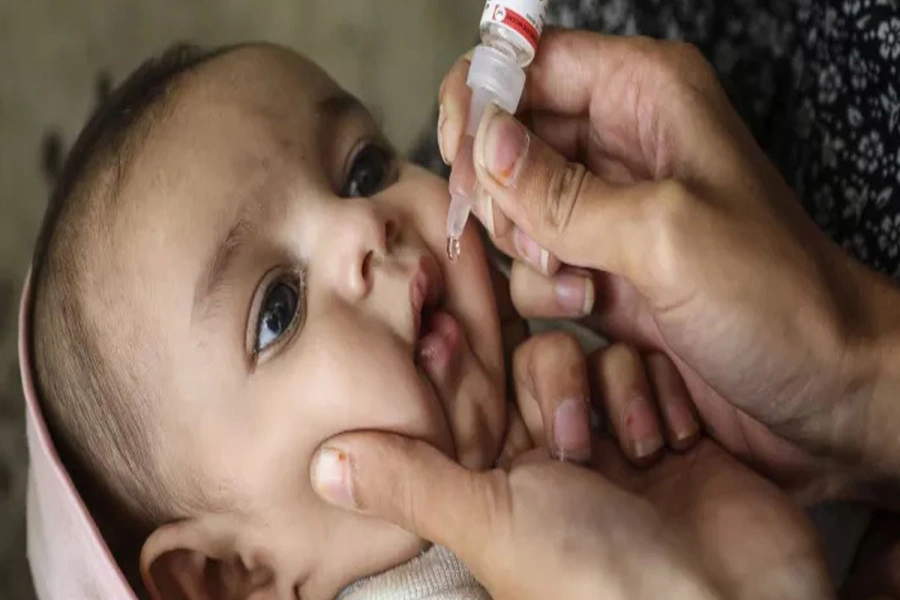
We were just beginning to think that the country was on track to bid good riddance to polio only to be rudely woken up by the news that the disease has reached a dangerous stage of local transmission. Nepal traced the last indigenous case of the incurable disease 10 years back but it has worryingly come back to haunt us again: Three of the five recent cases of polio detected in the two Tarai districts of Rautahat and Mahottari were shockingly transmitted locally, meaning that if pro-active measures (which essentially means preventive steps because the disease cannot be treated) are not taken immediately, there are real dangers of the disease turning into an epidemic.
The detection of indigenous occurrence of polio is a huge setback in our fight against the acute infectious viral disease. This means that our resources now cannot only focus on preventing import of the disease primarily from India’s Uttar Pradesh and Bihar states. According to reliable government officials, of the total 32 cases of polio detected in Nepal since 1999, 29 cases are in districts that are close to either of the two Indian states. Worldwide, polio still remains a scourge mainly in India, Pakistan, Afghanistan and Nigeria.
The new information makes for a compelling case to look into the reasons that is fostering local transmission. Doctors suspect that one major cause behind this could be faulty vaccines which, if true, calls for serious and thorough investigation to ascertain the causes leading to it. Medical practitioners also fear that children are not being administered polio drops as per the set routine or, on the contrary, being administered on malnourished children or children with worms. On all the instances, doctors say, the vaccine loses its efficacy.
It is clear that Nepal cannot win the fight against polio all on its own especially when it shares such a long and an open border with a country that is still one of the four countries in the world struggling to eradicate the disease. The two countries must join hands and make a concerted effort to fight the disease. The friendly neighbors must think along this line and chalk out a joint strategy without further delay. Nepal has already missed four deadlines to completely eradicate the disease and it looks unlikely that it will be able to meet the latest deadline set for 2012 but we must do all that is possible not to miss the next deadline if we have to eventually set one.
Related story
'Special Polio Vaccination Drive' to take place in 15 districts