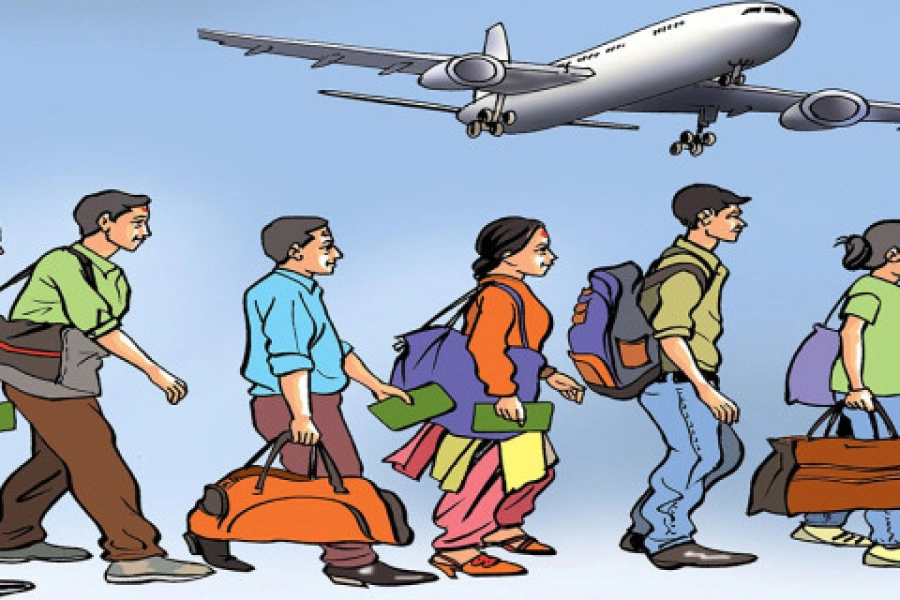
Amid slowing demand for workers -- especially blue-collar workers -- in the major destination countries, the number of departures for foreign employment dipped to 16,868 individuals between mid-Feb to mid-March from 18,715 individuals a month earlier, according to data from the Department of Foreign Employment (DoFE). [break]
The number of Nepalis flying to Malaysia -- the second largest labor market -- inched down from 1,553 individuals to 1,516 during the month.
The booming South East Asian country, which is a hub of multinational companies, has already shut the door to migrant workers in the service and manufacturing sectors due to falling overseas exports.
The United Arab Emirates (UAE) -- one of the labor-destination countries in the Gulf region most affected by the ongoing global recession -- saw a 5 percent decline in fresh arrivals of Nepali workers over the month.
The number of workers leaving for the UAE dropped to 2,398 individuals between mid-February to mid-March compared to 2,550 during the earlier month.
Similarly, departures of overseas workers to Saudi Arabia -- home to more than 500,000 Nepali migrant workers -- also plunged, by 12.58 percent, during mid-February to mid- March as compared to the previous month.
DoFE data shows that the number of workers leaving for Saudi Arabia during the review month slipped to 4,493 individuals from 5,140. However, the number of workers leaving for Qatar, the favorite labor destination among Nepali youths, rose marginally to 6,424 during the month from 6,413 a month earlier.
Though the number of Nepali overseas workers continued to fall for the last couple of months, DoFE data also shows that the number increased by 1,334 to 155,734 individuals during the first eight months of the current fiscal year 2008/9 from 154,400 individuals during the same period last fiscal year.
During the period, Qatar witnessed a 3 percent fall in arrivals of Nepalis to 52,626 individuals as compared to last year. Malaysia and the UAE also saw drops in incoming Nepali workers by 13.9 percent and 27 percent respectively from 35,136 and 30,483 individuals a year earlier.
Related story
NEPSE jumps 83 points, hydropower sector leads gains



-1200x560-1774606010.webp)