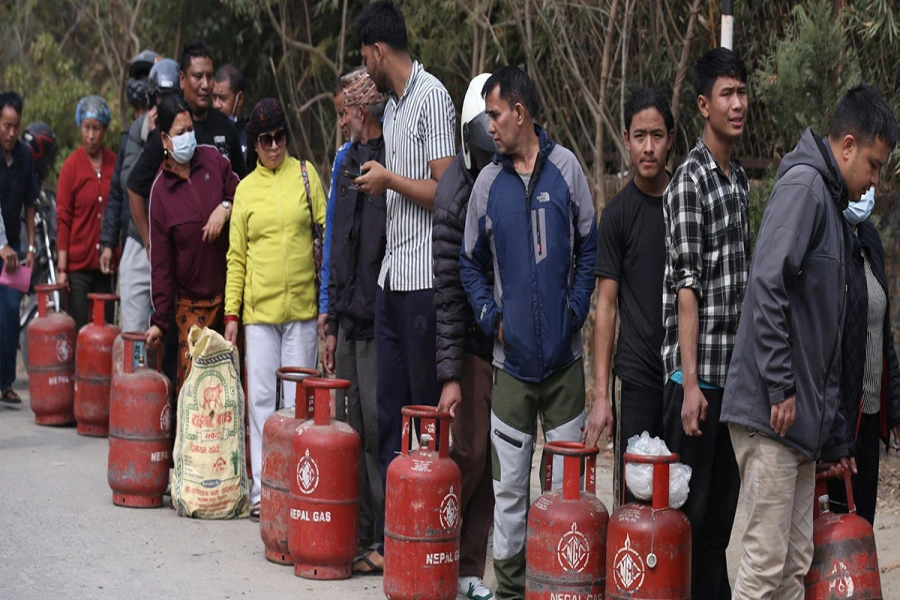
KATHMANDU, Aug 7: Whether it is India's border blockade or conflict in West Asia, any disruption to LPG tanker supplies from India quickly triggers cooking gas shortages in Nepal. With no LPG storage facility of its own, the Nepal Oil Corporation (NOC) has repeatedly failed to cushion the market against even minor supply disruptions, leaving consumers scrambling for cylinders.
While the NOC maintains storage facilities for aviation fuel, petrol, diesel and kerosene, it has no storage infrastructure for liquefied petroleum gas (LPG). After the corporation issues a Product Delivery Order (PDO), private bottling companies import liquid LPG from the Indian Oil Corporation (IOC), refill cylinders at their plants and sell them in the domestic market.
Officials acknowledge that the absence of strategic LPG reserves prevents the NOC from increasing supplies when demand surges. At present, bottling companies store only limited quantities at their own facilities before distributing the gas. As a result, even minor disruptions in the supply chain quickly create shortages. A dedicated NOC storage facility could help stabilize the market by supplying additional gas during periods of high demand.
Former NOC Executive Director Engineer Umesh Prasad Thani said Nepal needs its own LPG storage facility to ensure long term supply security.
"If the NOC maintains sufficient gas reserves, it can release additional supplies whenever demand rises and prevent shortages," Thani said. "That requires the construction of a modern storage facility."
Nepal currently has 59 LPG bottling plants. According to the Nepal LPG Gas Industries Association, these plants have a combined storage capacity of 11,000 metric tonnes, but companies do not keep large stocks because of the investment costs involved.
Fix the LPG Supply Chain
Association Chairman Diwan Chand said the private sector has repeatedly urged the NOC to build a storage facility.
"We are ready to invest alongside the NOC if needed," Chand said. "The lack of storage infrastructure is making supply management difficult."
The association estimates that around 15.5 million LPG cylinders are registered across the country.
Under normal conditions, 80 to 90 LPG bullet tankers meet daily demand. However, consumption has increased sharply, pushing daily requirements to around 120 tankers. Although bottling companies currently supply about 40,000 cylinders each day, that is still insufficient.
Monthly LPG consumption typically ranges between 45,000 and 48,000 metric tonnes. This month, the quota has been raised to around 55,000 metric tonnes. Chand said limited storage capacity means that even small disruptions affect the market, while delays in receiving PDOs prevent companies from fully utilizing their storage facilities.
"We have been demanding that the NOC build its own storage facility for years," he said. "If LPG could be imported through a pipeline from India, transport costs would fall, supplies would become more secure and recurring shortages could largely be eliminated."
He added that if the NOC cannot finance the project on its own, the private sector is willing to invest in storage infrastructure.
NOC officials also admit that Nepal urgently needs LPG storage facilities to address chronic shortages.
Vineet Mani Upadhyay, chief of the NOC's LPG Department, said discussions are underway on both an LPG storage project and a pipeline connection with India.
"We have started discussions with the Indian Oil Corporation on importing LPG through a pipeline and building the necessary storage infrastructure," Upadhyay said.
The NOC purchased land in Sarlahi nearly a decade ago for an LPG storage project, but construction has yet to begin. The corporation now says it plans to revive the project, citing rising consumption, supply management needs and energy security.
According to the NOC, a committee has already begun technical studies to determine storage capacity requirements and assess the feasibility of an LPG pipeline.
The corporation estimates that 115 to 120 LPG bullet tankers currently enter Nepal each day, bringing around 2,000 metric tonnes of gas.
When demand spikes unexpectedly, bottling companies often cannot dispatch enough cylinders immediately, resulting in shortages.
As one of Nepal's most critical imported energy sources, LPG requires strategic storage reserves. Building enough capacity to meet demand for at least several days, or ideally several weeks, would help protect the market from border disruptions, global supply shocks and other emergencies, reducing the recurring shortages that consumers continue to face.