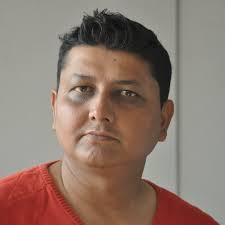
Shrestha, who captivated the nation with his evergreen modern songs such as Safal Timro Tyo Jindagilai, Paniko Rimjhim Barshako Bela, Phewatalko Aanganma Lai Lai and Kanchhi Hey Kanchi is glad that he stuck to his job at Nepal Airlines Corporation (NAC) even when his singing career was at its height.
“Singing cannot be a regular source of income,” says Shrestha who realized this early and pursued a parallel career at the NAC while chasing his dream of becoming a singer. “I advise the younger generation of singers not to get lost in temporary fame. An artiste´s fame doesn´t feed in Nepal.”
MELODIOUS JOURNEY
Born in Birgunj to a local business family on January 28, 1957, Shrestha was popular during his school days in Birgunj for his mellifluous voice, apart from his skills as table tennis and cricket player. Despite his stocky build fitting a sportsman more than an artiste, his heart lay in singing.
He decided to pursue a singing career in earnest at the age of 17 when he started doing concerts in Birgunj, Hetauda, Narayanghat, and Malangwa. But a dream to make it big brought him to Kathmandu in 1978.
Radio Nepal was a monopoly back then both for recording and airing songs, unlike today when there are over 50 recording studios in Kathmandu, apart from over a dozen music companies and over two dozen FM stations.

Shrestha recorded his first song Chhekera Chhekinnan Himalka Takuraharu, impressing the likes of Natikaji and Shiva Shankar who were present in the studio during the recording.
“Luckily, the song was a hit,” says Shrestha. His next song Gahiraima Dubdai Naduba, penned by Nir Shah, clicked.
Success after success of his subsequent songs eventually brought him to Kathmandu for good in 1980 as commuting back and forth between Birgunj and Kathmandu for recording his songs was tiresome.
“Due to the success of my initial songs, I never had to go around requesting lyricists to give me songs or musicians to compose them,” he says.
But it took ten years since the recording of his first song for Shrestha to bring out his first album.
“These days, singers start their careers by bringing out albums. In our days, an album was like a lifetime´s achievement,” says Shrestha, who works as an officer at NAC head office in New Road.

TURNING POINT
Shrestha became a household name in 1980 amid curious circumstances. Sunil Thapa, son of former Prime Minister Surya Bahadur Thapa, wanted Shrestha to lend voice to his words. Shambhujit Banskota had composed it.
“Back then, I was also a member of Narayani zone´s cricket team as opening batsman. I had to play a cricket match at 10 a.m. and record the song at noon the same day,” he reminisces nostalgically.
Shrestha´s team batted first in the match held in Tundikhel. He made some 30 runs before losing his wicket. But then, there was also the responsibility to field in the second innings.
“Sunilji was impatiently waiting for me to lose my wicket. After I did, he requested my team captain T B Shah to let me go as I had a recording,” he related. The two rushed to Radio Nepal and Shrestha recorded the song that would change his life.
“I remember that I was a little breathless as I had just come from a cricket match,” he says. “Back then, songs were recorded in one go from the beginning till the end unlike these days when technology has made it possible for recording songs in bits and pieces.”

The song clicked in a big way. And Radio Nepal aired it for decades. Music lovers across the country turned up the volume knob of their radios as soon as the RJ announced, “Upon the request of …, we present to you Prakash Shrestha´s Safal Timro Tyo Jindagilai.”
“I never had much hope on the song. I don´t know why and how it worked. After the success of several other songs that I hadn´t laid my hopes on and failure of songs that I had high hopes on, I still don´t know what ingredient makes a song a success,” he admits.
Shrestha has sung Safal Timro in his every stage program both in Nepal and abroad. When he was in Dallas during a tour of 16 US cities in 1999, he had to sing the song upon audience request even though he didn´t have its music track.
“I sang it without music as I hadn´t recorded its music track by then,” he says.
The song also caught notice of Gopal Yonjan and soon Shrestha was initiated into playback singing that he has reservations about today as he cannot bring out albums of the songs he sang for movies. “The songs are the producers´ property. Only a few producers are generous enough to let the singer bring out an album containing those songs,” he says.
Catapulted to national fame by Safal Timro that radios still air, Shrestha became a star attraction in the annual month-long Shikhar Saanjh concerts that toured the entire length of the country from 1988 to 1998. He also enjoyed what he calls his “golden days” between 1993 and 2003 when he toured dozens of countries around the world and received several national awards.
SINGING AS LIVELIHOOD
Despite his enviable stature in singing, Shrestha believes he wouldn´t have been able to pursue a singing career hadn´t his and wife Uma´s jobs at NAC taken care of his household finances.
“A concert hardly fetches Rs 10,000. FM stations do not pay singers for airing their songs and music companies offer peanuts in royalty,” he says.

But passion defies logic. Though heard from less these days, Shrestha isn´t finished with singing. He is bringing out a new solo album next month and planning his second solo concert in Kathmandu later this year.
“Singing didn´t give me money. But it gave me recognition. Strangers stop me on the streets to say that they love my songs. And nothing matches the satisfaction I get when my song clicks or when an audience applauds during a concert,” says Shrestha, who lives in Chhauni with his wife and two daughters.
“For that inner reward, I will continue to sing until my voice permits,” he says.
(All photos by Bikash Karki.)
bikash@myrepublica.com
Related story
Amitabh and Jaya Bachchan pay their last respects to Santoor le...