- Edward Shapiro
The country is waiting patiently as the government gears up for the announcement of monetary policy for the next fiscal year. In such times, it would be apposite to discuss the importance of an appropriate monetary policy which, hopefully, should be able to infuse the economy with fresh vivacity.
Of the two organs of economic policy – monetary policy and fiscal policy – the former originated much earlier. The classical economists have given a special place to monetary policy in their respective theories. Monetary policy in its present form is said to have originated in the 1920s and strengthened during the mid 1950s.
The purview of monetary policy primarily includes all methods adopted by the government to manage monetary and credit matters of the economy. Monetary policy is the guideline for controlling expansion/contraction of money and credit by the central bank for achieving definite objectives. The primary objectives of a monetary policy are:
Stability of prices: Rising and falling prices are both undesirable; efforts should therefore be toward the ideal state of stability. Such stability will also bring about steadiness in business cycles by mitigating its evils. Stable prices will also in turn reduce inequality of income and secure social justice. It may, however, be argued that such stability might not provide sufficient incentives to trade and industry. Here, I would like to advocate against this fallacious argument on the ground that normal profits earned by entrepreneurs can provide sufficient incentives.
It should, nevertheless, be kept in mind that price changes are sometimes due to certain unavoidable factors like change in consumer preferences, varying individual prices, improvement in industrial techniques bringing prices down or an increase in prices due to rise in cost of imported materials or capital goods. Therefore, while the general aim of monetary policy should be to keep prices stable, this must be subject to important exceptions and qualifications.
Balance of Payment (BoP): The monetary authority should formulate the policy necessary for maintaining BoP. Changes in the price-cost structure of a country’s export industries affect the volume of exports and thus the BoP position. Increase of prices due to high wages, higher prices of raw materials and/or inflation reduce exports and vice versa. Compulsions of essential imports without matching exports severely affect BoP. In Nepal, this can be visualized from the empirical data over the past few years. The BoP is also adversely affected by speculative transfers from one country to another. Such transfers occur if opportunities arise for earning higher interest in other countries or there is a fear of local currency depreciation.
At a time when the Nepali economy is plagued with myriad of problems ranging from stagflation, BoP imbalances, liquidity crunch in the financial market, capital flight and lack of infrastructure development, an effective and efficient monetary policy is the need of the hour.
Employment and output: Classical economists assumed the existence of full employment of all resources including labor as a condition of equilibrium. Keynes showed that equilibrium is possible at full employment or below full employment. It is the duty of the government to shift the economy from an under employment to full employment equilibrium.
In developing economies like Nepal, open unemployment and under-employment are the major problems which inhibit economic growth. Therefore, first of all the cause of unemployment should be determined. If it is low investment, rate of interest should be reduced to encourage investments. However, it is needless to mention that in most of the emerging markets, political situation plays a key role in determining the stability of the economy and thus investments.
The supply of money can be increased by the central bank through measures like open market operations, variation of reserve ratios etc. These measures may increase bank reserves, thus the banks lend more and credit expands. As more money is available, interest rates fall. Low interest rates lead to the expansion of investment or the marginal efficiency of capital goes up. However, monetary policy alone is not enough to attain the goals of employment, output and inclusive growth. It doesn’t work during depressing phases of the economy. In such times, money is available but no investment opportunities are present. Thus, it then becomes necessary to supplement the monetary policy with appropriate fiscal policy supported by stable political conditions.
Economic development & inclusive growth: Accelerating the pace of economic development is accorded top priority in developing economies where all sectors including agriculture, industry, commerce etc are mostly under developed. Capital formation and investment may be increased through monetary policy by encouraging savings and investment.
Interest rates on deposits should ideally be higher than the rate of inflation. Banks and financial institutions should widely expand in rural areas to collect the scattered savings. In this way, along with increase in the savings, it becomes easier to channelize the savings toward productive sectors.
To divert the investments to productive sectors, cheap interest rates should be fixed for priority sectors and higher rates for others. Government should be willing to incur expenditures in socio-economic overheads like entrepreneurship, technical know-how, transport and communication infrastructure etc.
Reduction in economic inequality: The central bank should consider launching different programs to benefit the destitute segment of the society. It should devise interest rate structure so as to encourage investments toward poverty alleviation programs. Lower interest rates should be fixed for farmers and small entrepreneurs. Micro- finance should continue to be a priority area.
Such collective measures could lead to an inclusive growth in the economy over a period of time.
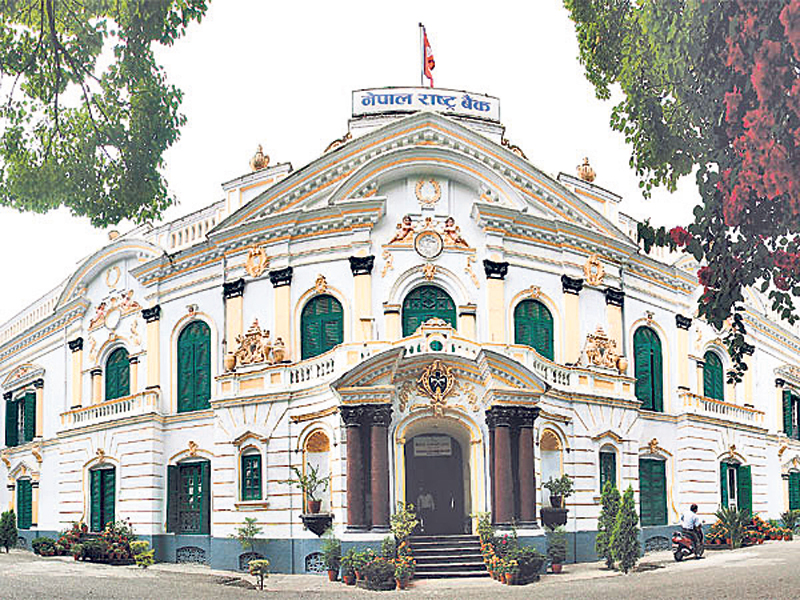
The monetary policy has been formally announced by the Nepal Rastra Bank (NRB) annually since FY 2002/03 as provided by the NRB Act 2002. Though a lot of hard work goes into preparing the policy every year, the crux of its success lies in the achievement of stated objectives. At a time when the Nepali economy is plagued with myriad of problems ranging from stagflation, BoP imbalances, liquidity crunch in the financial market, capital flight and lack of infrastructure development, an effective and efficient monetary policy is the need of the hour.
The expectation that the ensuing monetary policy would be an instant remedy for our country’s backlogged financial system is expecting a little too much. Perfect execution of the policy would indeed be a Herculean task given the backdrop of a transitional economy. However, the government/central bank should have a critical look at the monetary policy mainly to stabilize the economy and make environment conducive for growth, promotion of FDI, management of liquidity and prevention of capital flight. Along with emphasis on the productive sectors, credit should be tightened so as to curb diversion of funds into speculative sectors and avoid prodigal consumption.
(Writer is CEO, Standard Chartered Bank Nepal Ltd.)
Related story
Monetary policy to be unveiled next week: NRB Governor Adhikari