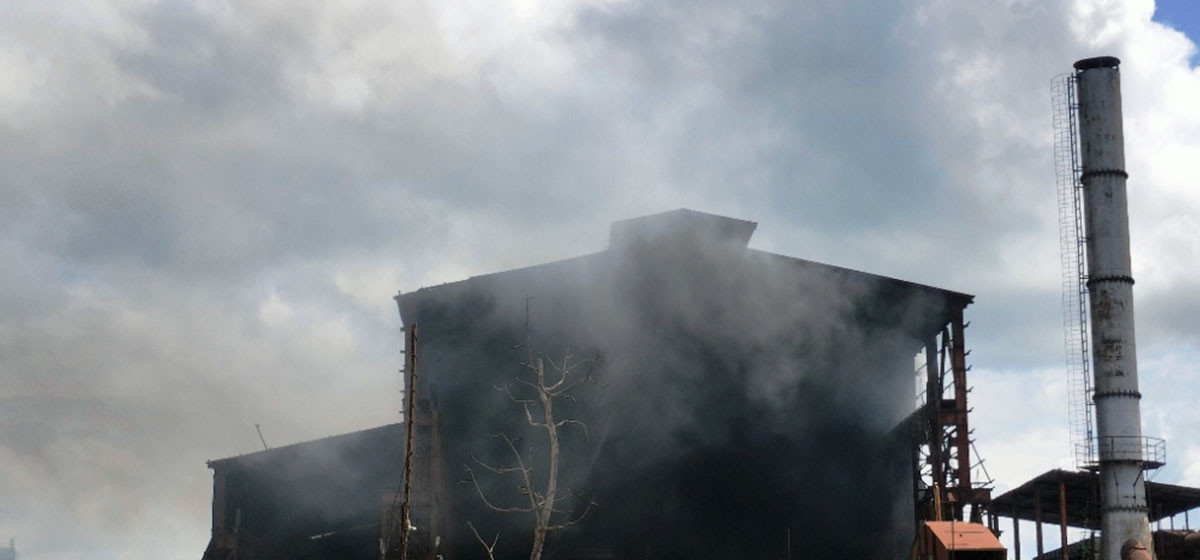
As this scribe tried to enter the place to collect information about the situation, some of the Maoist laborers came running and snapped: "Eh, eh dai, bhitra jaana mildaina (You can´t go inside)."
Balaju Industrial Area is a public place and there are no rules that restrict anyone from entering the place, provided one has a genuine reason. But logic always doesn´t work with whoever is holding protests. When they say don´t go inside -- that´s the rule. And this is what these agitated laborers have been doing since Monday, creating arbitrary rules and stopping everyone, including employees of various factories, from entering the industrial area to join work, while bringing factories inside to a grinding halt.
The reason: arrest by the police of two employees affiliated with the Maoist labor union, who were working as loaders in factories inside the industrial area.
Police say the two were among the people who thrashed Giriraj Bhandari, outgoing chief of Industrial Area Management Limited, on Sunday. Whereas the Maoist labor union says they are innocent and should be released immediately without any condition.
While all this is taking place, the industry minister, who is supposed to intervene in the matter and settle the issue by talking to senior Maoist leaders, is trying to avoid his responsibility by calling the entire episode a "political affair."
"This is a height of negligence," an owner of a plastic industry, who is losing some Rs 50,000 a day, told myrepublica.com on condition of anonymity.
Balaju Industrial Area is one of the biggest industrial areas in the country and is home to around 100 factories and other institutions. Big factories like Coca Cola´s bottling plant, Dairy Development Corporation´s fresh milk manufacturing unit, Nepal Gas´ cooking gas bottling plant, and oxygen bottling plants of Shankar Gas and Himal Gas are all located here. Together, all factories inside the industrial area produce millions of rupees of products every day, some of them essential commodities like oxygen required for hospitals, fresh milk and liquid petroleum gas that most of the households use to cook food.
However, since the closure, most of the factories have not been able to manufacture anything. Few that were allowed to operate -- like oxygen bottling plants and Dairy Development Corporation -- for the last two days were also forced to close down their units on Friday. On top of that, Maoists´ ban on entry of vehicles inside the industrial area on Friday prevented companies from ferrying their finished goods to the market.
But nobody cares.
On Friday, to mount up pressure on the government, Maoist-affiliated labor union also closed down all factories inside Patan Industrial Area. This industrial area in Lalitpur is home to around 92 industries, mostly related to handicraft. And most of the products manufactured here are exported, meaning delay in shipment of products could repel many of international clients buying Nepali products.
To exert more pressure, the Maoist-affiliated All Nepal Trade Unions Federation-Revolutionary (ANTUF-R), Balaju Industrial Area chapter, which is leading the protests, has further warned to close down all industrial areas across the country, if their demands are not met immediately.
At a time when manufacturing sector´s contribution to the GDP has declined from 10 percent in 2000 to around seven percent these days, how closure, like the one going on, will promote industrialization -- as touted by many leaders -- is a big question. It must also be kept in mind that manufacturing sector is one of the largest employment generating sectors.
rupak@myrepublica.com
Related story
Green leaves production down by half