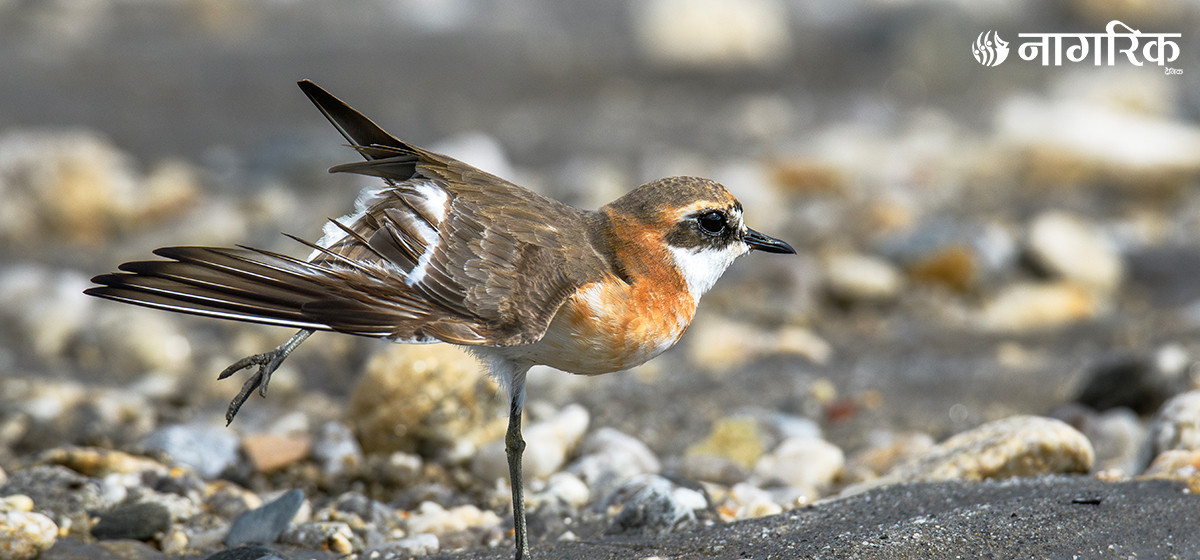
Nevertheless, their days seem numbered in the Kathmandu Valley, according to ornithologist Hem Sagar Baral. And more or less, similar is the fate of other bird species, be they migratory or resident.[break]
Kathmandu Valley boasts a total of 531 species of birds, according to the latest report by Himalayan Nature, a conservation research institute on Himalayan faunal and floral diversity. Among them, 17 are listed as globally threatened species.
Baral, who has been in this field for the past 25 years, informs that Kathmandu’s ornithological history is the longest one in Nepal. “All the early explorations in ornithology have had been made within the Valley. The pioneering Nepal expert, Brian Houghton Hodgson, while he was the British Resident in Kathmandu during the mid-19th century, has mentioned that Nepal had about 600 species of birds, which he claimed without exploring the high mountains and lowlands of Nepal.”
However, according to researches and ornithologists, birds’ habitats have shrunk in the Valley. While the surrounding areas and hills are still bird territories, their habitats inside the Valley have shrunk to a few patches of remaining forests. The pace in which development works and construction have been going on makes it inevitable. Several direct and indirect consequences of urbanization on different elements of environment, such as rivers, have also contributed to the shrinkage.
The Phulchoki Hills, Tau Daha, the Shivapuri Watershed Range, and Gokarna forests are some of the major bird sanctuaries in and around the Valley.
Baral points out that, along with its past abundant greenery and wetlands, the way traditional houses and buildings were constructed in Kathmandu were also wildlife friendly. “The small holes on the roofs and walls of Newar and Rana houses were separated as resting places or nests for birds.”
Currently, the scenario is totally different.

Vimal Thapa, birdwatcher and joint secretary of Bird Conservation Nepal (BCN), adds, “Sparrows are common resident birds of the Valley. But even for such birds, it’s getting difficult to adapt to the new architecture.”
But we take it as a minor issue, even though birds are considered to be one of the indicators of environmental changes.
“A few birds are adaptive to the changes but others move out of those particular areas. This is happening in the case of Kathmandu,” says Thapa.
“There are several other species of birds that we don’t find these days. For instance, partridges used to be quite common 40/50 years ago, but there’s no record of such birds at present. Forest birds like Wood Snipe, a globally threatened specie, used to winter in the forests of Kathmandu but they don’t anymore,” adds Baral.
Citing a few other examples, the ornithologist who heads Himalayan Nature, adds, “Pelicans, the water birds with massive beaks, were spotted in Kathmandu. But such birds require large expanse of water.” So, such wetland birds are the most vulnerable ones as the major wetlands of the Valley, such as Bagmati and Manohora, have degraded.
Bird expert Hari Sharan “Kazi” Nepali observes that migratory birds have limited areas to rest as the water bodies have been polluted. However, according to him, there are some species which have adapted to the present disintegrating environment.
Apart from it, Baral informs that migratory birds navigate, following the geographical features, such as river courses. But now, as there are changes in such features, birds like the Demoiselle Cranes, which are mentioned in our folklores, have stopped using the Valley as their migratory route.
A research by BCN has classified various sections of the Bagmati River system in three categories in terms of bird species richness, quality of the habitats, and pollution level. Sadly, most of the Bagmati River section in the urban areas has been marked under the low-biodiversity category.
One of the areas that is still considered as an ideal place to spot migratory birds is the Tau Daha (lake) at Chobhar. While this area still attracts a good number of birds, the Bagmati that flows nearby is polluted.
“It’s the resident birds that have suffered the most,” says Baral. He informs that due to the shrinkage of habitats, forest birds have been peripheralized to the hills or small remaining patches of forests. These peripheries, too, have only a certain carrying capacity; and it is obvious that if such places are crowded, these birds will start moving further away from the Valley.
For the conservation of such habitats and biodiversity, there are more than enough policies and acts, according to Baral.
“But the country lacks enforcement and implementation of these rules and regulations.”
Efforts like the Bagmati River Nature Park along the Bagmati River corridor, jointly managed by the UN Park and BCN, has been carried out to create suitable environment for both resident and migratory birds. For healthier life, the Kathmandu Metropolitan City (KMC) Office, along with other organizations, is now and then carrying out tree plantation programs.
The conservation efforts have yet to match the rapid adverse changes that are taking place, making the Kathmandu Valley inhospitable for its celebrated birdlife.
Related story
Take Avian Influenza Seriously