I’m not sure how many times I’ve told a woman that she is beautiful, resulting in a smile on her face. Stating that a woman or a girl is beautiful or a man or boy is handsome is intended as a compliment. However, I don’t often tell a man that he is handsome; after all, men don’t say this to other men.
I’ve been thinking about how commenting on physical beauty reinforces gender stereotypes, something seemingly of societal importance, leading to a very superficial understanding of, and connection with, others. I question though, what really is beauty, and why should it take on so much importance, especially when it comes to how we view women? [break]
In my eyes, my daughter is very beautiful: slim, tall, and with lovely facial features. But her depth goes well beyond her appearance as she is an actor, dancer, musician, writer, director and singer. Beyond her physical features, she is smart, sensitive and has a depth of personality which makes her very interesting. She doesn’t change her Facebook profile picture very often, which anyway is usually not her face. Although she cares about her appearance, she isn’t hung up on it, a quality that I’ve found to be highly unusual, especially among young women.

We may harm our children, especially our daughters and other female members of our families, by continually describing them as beautiful. If the comment is not followed up with an equal statement about their smartness or intelligence, on some level it means that females may not be taken seriously. (Would we say to boys that they are very handsome without also stating that they are also good athletes or smart?) Reminding a girl or a woman that she is beautiful maintains a need for attention, a striving to look like the celebrities.
On the other hand, when we see someone who looks “different” or is considered “ugly” we tend to shy away, make unkind comments, or see the person as invisible. A judgment is made, possibly even a dismissal, based on how we perceive someone’s outer beauty.
Breaking down gender stereotypes, i.e. how one is supposed to look, act, or dress, is a difficult task, and requires broadening our thinking, and in our male dominated societies, treating women as equals. Recently I saw a number of women wearing green and yellow bangles and mehendi painted on their hands. I decided to have a neighbor paint a pattern on my left hand, something which I had done twice in India.
The comments of this experiment ranged the gamut from “not suitable” to smiles. But seemingly it is ok because I am a Bideshi (foreigner). Did wearing mehendi mean in people’s minds, especially those of other men, that I should be treated differently?
I understand the differences in dress between men and women, how clothes might be designed to highlight a person’s body. But who is this for? In Kathmandu I haven’t seen many men in short shorts, or low cut shirts exposing their chests. It is a person’s right to choose how they dress and express their individuality.
I would never argue with this, but by dressing the way they want to, do people feel empowered, or does this only serve to reinforce society’s views of the differences between men and women? If a woman is to be truly powerful and taken seriously, must she wear a business suit and have the toughness of a man? In other words, must women conform to “men’s dress” in order to change men’s attitudes? Are women too fragile and not tough enough to take on difficult corporate and political assignments?
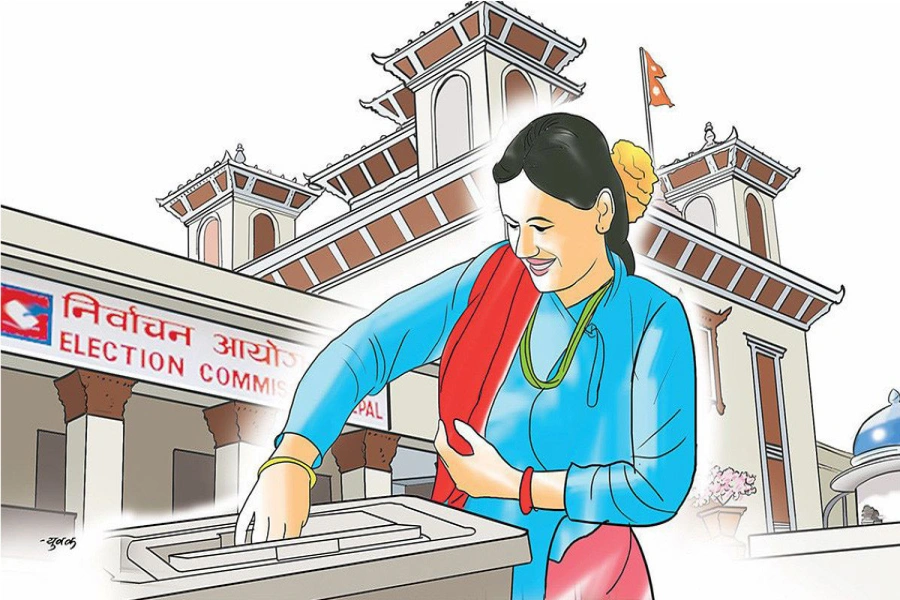
One method of creating further equality is through legislation. But then, one might question who the implementer is and if the legislation is being properly implemented. Can having reservations for women really help? Or is it more about having strong advocates running for political office and breaking down barriers? Does this issue really come down to those holding power, whether they be part of a caste, gender or political group, creating an enabling environment for power sharing?
The land rights for women represents a major shift in how Nepali men view their wives or daughters, enabling a more equitable power sharing and decision making. As more women and men share land certificates, at least a part of society may change their views on gender. But will this translate into further equity in the society?
Continuing to think about and making small changes in gender equality issues is vital for societal health.
I try to do this on the basketball court when I’m conducting trainings for young men and women. Whenever I see children self- segregate, I immediately ask them to integrate. At first this is somewhat of a “chore”, but over the course of the training, gender differences seem to disappear. I explain to the children that on the court there is no gender, only teammates.
We all look for beauty in the natural world, as if somehow finding this leads to more happiness. But if this is all that we aspire to, we miss out on the many shades of diversity and what this brings to our lives. It is up to us to recognize how beauty is more than skin deep. Once we change our perception, and lead by example, society will also change.
mikerlakers@yahoo.com
Related story
Japan hands over medical equipment for surgical eye camps to Hi...