




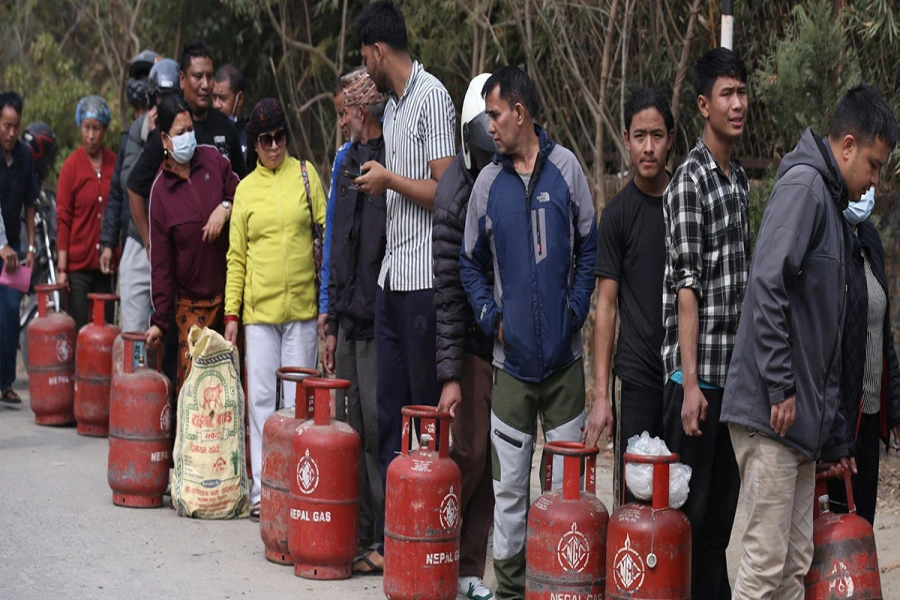
KATHMANDU, Sept 12: Where is the government when people cannot find cooking gas, patients struggle to receive basic healthcare and disaster victims continue waiting for rescue and rehabilitation?
That was the common question raised by lawmakers from both the ruling and opposition benches during Friday’s meeting of the House of Representatives (HoR), as they strongly criticized the government’s handling of issues affecting people’s daily lives.
While Thursday’s meeting saw little substantive debate, Friday’s session was dominated by concerns over the acute shortage of cooking gas, problems in the health sector and what lawmakers described as a slow government response to rescue and reconstruction following recent floods and landslides.
The lawmakers largely shared the view that the government was failing to take citizens’ hardships seriously and was increasingly seeking to evade responsibility.
With cooking gas in short supply and households struggling to keep their stoves burning, Rastriya Swatantra Party (RSP) lawmaker Ashika Tamang questioned the government’s failure to control alleged hoarding and black-market activities.
“Is the mafia bigger than the government in this country?” she asked.
RSP lawmaker Hari Mohan Bhandari, meanwhile, announced his resignation from the parliamentary committee dealing with consumer interests, accusing the government of failing to take the gas shortage seriously.
NOC says cooking gas supply remains normal
Lawmakers also raised concerns over problems in the health system, structural weaknesses in hospitals and the government’s failure to address the difficulties faced by patients.
RSP Whip Krantishikha Dhital raised the issue of suicide prevention, questioning Nepal’s response to the problem.
“September 10 was observed globally as World Suicide Prevention Day, but let us ask ourselves where Nepal stands in this campaign,” she said.
Referring to three cases of self-immolation reported within a week, Dhital said Department of Health Services data showed that around 20 people die by suicide every day across the country. She called for a serious review of the measures taken so far to prevent suicides.
The government’s response to the recent floods and landslides also came under scrutiny in parliamentary committee meetings.
At a meeting of the Finance Committee, RSP lawmakers Lima Adhikari and Toshima Karki accused the government of failing in rescue operations, relief distribution, management of holding centers and the search for people still missing after the Bhotekoshi flood.
A particularly distressing case raised in Parliament was that of Babita Kumari Paswan, a woman who reportedly gave birth on a roadside outside Gajendra Narayan Singh Hospital in Rajbiraj, Saptari, after she could not afford the required hospital payment.
RSP lawmaker Khagendra Karna was among the first to raise the incident in Parliament, drawing the government’s attention to what he described as extreme negligence in healthcare. He said the woman had only Rs 2,500 and was denied admission because she was short of Rs 700.
RSP lawmaker Ankita Thakur criticized hospitals for allegedly turning healthcare into a commercial transaction, saying it was shameful that a woman in labor could be denied care because of a lack of money.
Karki questioned the gap between constitutional guarantees and the reality faced by patients.
“We wrote the right to health into the Constitution. We wrote the right to safe motherhood and reproductive health. But why is there such a huge gap between the free services guaranteed on paper and the services citizens actually receive in practice?” she asked.
Responding to the lawmakers, Minister for Health and Food Security Nisha Mehta said the ministry had taken the incident seriously and sought an explanation from the hospital. She said an investigation committee had been formed and legal action would be taken against those found responsible. She also said the mother and newborn were receiving free treatment.
RSP lawmaker Deepak Kumar Sah accused the government of attempting to escape its responsibility by distributing limited financial assistance to flood victims. He called on the government to act not merely as a “giver” but as a fully responsible “guardian” of disaster victims.
Lawmakers also raised concerns about alleged mistreatment of lower-ranking police personnel and the lack of investigation and action against senior police officials accused of corruption.
UML lawmaker Sajida Khatun Siddiqui questioned the state’s response to people injured during the movement and the families of those who were killed. In an emotional remark, she asked, “Government, when will you make this country beautiful again after it has been reduced to ashes?”
RSP lawmaker Bipin Kumar Acharya criticized the government’s reconstruction efforts, saying private businesses had already rebuilt their properties faster while Singha Durbar and the Parliament building—symbols of the state—remained damaged or burned.
RSP lawmaker Amresh Kumar Singh accused the prime minister and his secretariat of bypassing established procedures and running the government in an authoritarian and adviser-driven manner, saying such practices were weakening the democratic system.
Friday’s parliamentary proceedings thus saw lawmakers question the government’s presence and accountability on a wide range of issues—from the daily struggle to find cooking gas and access healthcare to disaster response, damaged state infrastructure and the overall style of governance.
The criticism, cutting across party lines, pointed to a broader concern over whether the government is adequately responding to the problems citizens are facing on the ground.





