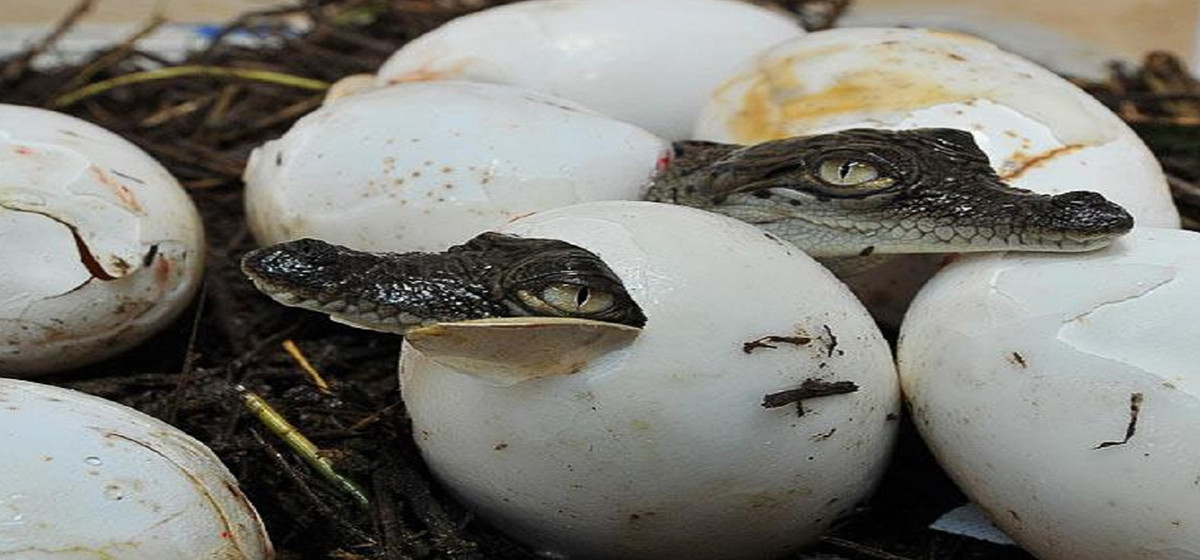
Under the supervision of experts, around 50 percent of the hatched babies normally survive, according to the park officials. [break]
“This time we expect to recover around 30 eggs each from 20 young female gharials. This will start from the second week of Chairtra (end of March), we have already started monitoring the crocodiles and the possible areas where they might lay eggs,” said Bed Bahadur Khadka, assistant conservation officer at the park who is renowned expert on gharials.
“Without technical intervention, the eggs are generally lost even before they are hatched. If they hatch at all, the babies are hardly spared by other species. So it is very important to collect as many eggs as possible,” he added.
As they could not thrive in natural habitat, the national park began to collect the eggs of the gharials and process its hatching at the breeding center in the park only since 2002. IUCN has enlisted gharials in its red list of ´critically endangered´ species.

According to Khadka, gharials lay eggs only at night and they choose suitable heap of sand on the riverbank to do so. They cannot be disturbed at that time. So the staffs have to carefully mark the mothers´ crawl signs in the morning to discover where they have exactly laid eggs.
“We are an eight-member team. Throughout the month of Chaitra, we will be busy monitoring the crocodiles for the eggs,” he said. “At one time a gharial can lay around 40 to 45 eggs. An egg weighs around 100 grams and is 35-40 centimeters long,” he added.
Interestingly, incubation of the egg and hatching is done by female gharials at the breeding center. Technical experts do the job if the gharials remain indifferent to the eggs. The baby gharials are raised at the breeding centre for up to five years and then released in various rivers.
Jhamak Karki, chief warden at the Chitwan National Park stated that though about 861 gharials have been released in various rivers in Nepal in the last three decades, only about 100 gharials remain in the rivers as most of them move to India but can´t return due to various dams and barrages on border.
He added that various reasons including habitat loss, shortage of food, pollution and the flooding of egg-laying sites during high water period are major threats to the species. “A healthy gharial lives as long as a human being. But their survival is challenged by human activities.”
Related story
202 endangered crocodiles hatched out at Gharial Breeding Cente...